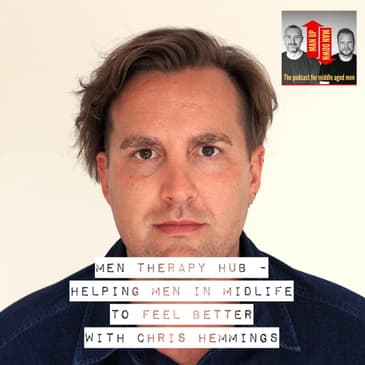
In this episode of Man Up / Man Down, Volker and David talk to therapist, coach and former BBC journalist Chris Hemmings. Chris shares how his father’s death led to cocaine misuse and a deep dive into men’s mental health, masculinity and why so many men are struggling in silence. He explains why empathy is a teachable skill, how boys are socialised away from their emotions, and why he created Men’s Therapy Hub – a male-therapist directory “by men, for men”. The conversation explores stigma, privilege, the gap between coaching and psychotherapy, and what it really takes for men to ask for help and change generational patterns.
Key topics
- Chris’s personal story: bereavement, addiction and rethinking masculinity
- Suicide, addiction, homelessness and violence statistics for men
- Why men are told to understand everyone else without understanding themselves
- Empathy as a skill and what happens when boys shut it down
- Going into schools to talk to boys about being a man
- Why so few male therapists exist – and why that matters
- The origins and mission of Men’s Therapy Hub
- Stigma: why men come to therapy only at crisis point
- Therapy vs coaching – and why combining both can be powerful
- Generational patterns, fathers, grandfathers and “rigid masculinity”
- Access and affordability of therapy, trainee therapists, low-cost options
Links
- Men’s Therapy Hub: menstherapyhub.co.uk
- Chris Hemmings: chrishemmings.co.uk
- Podcast: No Man’s An Island
- His book: https://amzn.eu/d/337CUyx
- Men’s Therapy Hub: http://menstherapyhub.co.uk
- 🎙️ Apple podcast: https://podcasts.apple.com/us/podcast/no-mans-an-island/id1849171262
- 🟢 Spotify podcast: https://open.spotify.com/show/5QgINHeUZKorBCE4LBoBXF?si=bee0565dbdbd421f
- YouTube: https://www.youtube.com/@MensTherapyHub
- Instagram https://www.instagram.com/menstherapyhub/
- Linkedin: https://www.linkedin.com/company/menstherapyhub/
Hosted on Acast. See acast.com/privacy for more information.
[00:00:00] Well I have to say that was an incredible episode that we've just recorded and you're about to hear. But yeah Chris Hemmings, well I don't think he's quite middle aged, he's a young whippersnapper compared to us but doing incredible things in the men's therapy space, particularly raising the profile of men's therapy through Men's Therapy Hub.
[00:00:27] But yeah I mean just the passion you know is so obvious and you know without wanting to stereotype it's just great hearing this sort of thing from a you know a northerner, did he say he was from Yorkshire? I've got into my head. No Manchester, thank you so dear. Right but yeah proper Lancasterian or Lancashirian, whatever anyway. But yeah you've obviously known relatively well Volker.
[00:00:54] Yeah I mean I've met him only a couple times before but obviously I'm part of the men's Therapy Hub. I support his work, I think he's doing great work and I didn't know if I found out in the podcast he also combines coaching with therapy. He comes very much from a therapy angle, I come very much from a coaching angle. But you know I love to have these conversations and I think it's one of the few podcasts where I, my talk ratio to you is a little bit higher. Yeah but I'll let you have one.
[00:01:22] No great episode, really enjoyed it and some really great nuggets in there. I think what I wrote, ah, and I don't have in front of me anymore but you know what he says to me just not made to be empathetic as men right? And yeah so yeah lots of stuff. Anyway enjoy. Welcome to the Man Up Man Down podcast presented by Volker Ballueder and David Pawsey.
[00:01:52] We discuss the pressures and challenges faced by men approaching middle age that we're often too embarrassed to speak about with our friends. You can find us online at www.manupdown.com. Enjoy the show and don't forget to subscribe and leave us a review. Welcome to another episode of Man Up Man Down. So we are delighted to have Chris Hemmings on the pod today.
[00:02:22] So Chris is a therapist and coach who specializes in working with men. He's the founder of Men Therapy Hub, a directory for male therapists for male clients. Before training to be a therapist he was a BBC journalist, writing and making documentaries about men, masculinity and mental health. He's also the founder of Empaths who go into schools across the UK speaking to students about what it means to be a man. So very much on topic for Man Up Man Down.
[00:02:51] Chris, welcome to the podcast. Thanks for having me. So do you want to give us an overview of the same... Obviously I read out this snippet, but there's a lot more behind it. So, you know, working with the BBC as a journalist is quite the thing. I mean, David is an ex-journalist. So I don't know anything about journalism. But yeah, if you want to introduce yourself a little bit more, then we can take it from there.
[00:03:16] Yeah, I mean, the journey for me started in 2013 with the death of my dad and my descent into rampant cocaine use as a means of coping and trying to bury all of the challenging, difficult feelings that I was... Well, that I was experiencing, but I was desperately trying not to experience. And as you mentioned there, at that time I was a BBC journalist.
[00:03:45] And after three, four months, I snapped out of it basically. And I started to have these thoughts of how could somebody who grew up with all of the privileges that I grew up with, and I did grow up with plenty of privileges, still end up in that place. And I started to look around at the plight of men and what was going on with the men around me. And as a journalist, I started to research some statistics and figure stuff out.
[00:04:14] And I found out 12 years ago now that the biggest killer of men under the age of 45 was suicide. But to me, that was one way of looking at the statistic. And that is the way that we most often hear the statistic. But I thought to myself, well, shit, that means that the most likely way that I will die today is by choosing not to live. And that blew my mind. Mm-hmm.
[00:04:38] And then I found the addiction statistics, the homelessness statistics, the violence statistics, because men are more likely to experience violence and be the perpetrator of violence. And I started to look at all these things. And so what I started to do was to look at issues that affect men and that men affect. And that was the focus of my journalism for many years, writing, making documentaries. I wrote a book that came out in 2017.
[00:05:07] And yeah, once my book came out, people would say, well, hey, do you do talks? And because I'm a man, I said, yes, of course I do talks. And then when I was doing a talk in a school one time, the teacher came to me afterwards. It was like, oh, we had someone pull out in a month for some workshops. Do you do workshops? And I was like, yeah, of course. I'm male. I can figure that out, right? Like they don't need to know the truth.
[00:05:33] So I designed this empathy workshop because they said, what is your workshop about? And I was like, empathy. And they were like, oh, wow, what a great idea.
[00:05:41] And the reason it was about empathy was I had realized from a very early point of this discovery, it was just around the time that we as men were being actively encouraged to understand what it's like to be female, to be black, to be queer, to be disabled, to be all of these things that aren't white and straight and male.
[00:06:06] Which I think is all good, by the way, like increased levels of empathy is good. But my burgeoning understanding was we as men, we are raised specifically not to engage with our own emotions. So we are basically saying to men, you need to understand what it feels like to be everybody else, despite the fact you haven't got a fucking clue what it feels like to be you.
[00:06:33] And I was just like, well, that's not fair. But most of all, that's not possible. And the thing about empathy is you can teach it. Empathy is a skill. And my belief is that it's not that men have less empathy. The research doesn't show that men have less empathy. It's that men have less ability to show it and are connected to it less.
[00:06:57] Because what I realized in myself was, from about the age of 15 to 25, I had actively cut myself off from my empathetic self. I had chased the macho ideal. And within that is not empathy and compassion. So what I did was I reconnected to it and I retrained myself in it and I learned it and I taught myself it. And I think I'm quite good at it now. I mean, I'm a therapist, so I guess I have to be. But it's taken time.
[00:07:27] And so the thing for me was to go into schools and to tell the boys, you know what? I understand why you're having these experiences and I understand why you're struggling with certain things. And me too, by the way. And I would share about my own experiences. But here's actually where it's harming us. And it's not, we're doing ourselves a disservice. And the culture around us is doing ourselves a disservice. And in that, that's not just men doing that. That's women, that's everybody.
[00:07:56] You know, research shows that parents of both genders will police the emotional responses of their baby boys more than their baby girls. So, you know, it's incumbent on all of us to do this, but also to say to the boys, like, from my experience, once I started to re-engage with the world empathetically, a whole different world opened up to me of kindness and compassion and, you know, being seen. Fuck, being seen, right? Being understood.
[00:08:23] Being seen in the world and realizing how much of the loneliness epidemic is not about physical isolation. It's about emotional isolation. And so many, anyway, so many doors opened and, you know, you two will know once those doors open, you can't go back through them. And it's just been this beautiful exploration ever since to now launching Men's Therapy Hub.
[00:08:45] And this is a long answer, but launching Men's Therapy Hub, because on my therapy course, I was one of three guys who graduated out of a cohort of 24. More women of color graduated on my course than men. And it's great for women of color, by the way, but it's shocking for men. And nothing on the course was tailored for men and how men engage with the world and how men see things and how we operate as men and how we might encourage men to open up.
[00:09:13] And it was just, you know, having studied men and written about men for 10 years, there was just glaring omissions. And then once I qualified, I realized out in the therapeutic world, I'm a massive minority. So in the way that Empath also works in businesses. So in the way that I'd been into construction companies and had spoken to the women of X and the women of these big sports companies, because they're a minority. Well, we're a minority in the therapy profession.
[00:09:43] And so let's create a space that's by men for men and try to encourage more men into therapy on both sides of the sofa, because that's what we need. Wow. That's, yeah, quite a few interesting statements there. I mean, that was sort of one of the questions, you know, that, well, I guess that we talk about a lot on here.
[00:10:11] But, and you sort of talked about both sides of the therapy sofa. I mean, if we focus on the patient side of the therapy sofa, and I'm not a therapist, but I have been on the patient side. Why, why is it that, yeah, men, well, haven't, haven't really engaged with that kind of therapy?
[00:10:40] Traditionally, I mean, yeah, it's a huge question. And the simplest answer I can give is you can't be what you can't see. And traditionally therapy actually was a load of old white blokes, right? So Freud, Jung, Rogers, these great thinkers, but therapeutic interventions were mainly targeted at women because women were the quote problem sex,
[00:11:07] because women were struggling domestically, understandably, I might add, given that they had zero autonomy or agency. That's a whole podcast in itself. But, but these, but these men would be pathologizing women, because these women would be causing men problems in the home, right? And if men had problems, it would be because we're tired or we're overworked, you know, very male take on things. And so a lot of the interventions were actually focused on women.
[00:11:37] And I don't think they were particularly designed with men in mind. This is my personal take on it. So then in the 50s and 60s, what happens is women, the explosion of women in the workforce. And so what sort of work did women do already? Well, nursing, midwifery, caring for people. What would now be labeled the heel, the kind of the heel subjects. So health, education, administration, literature.
[00:12:08] And therapy was very much in the health bracket. And what do you need to be a therapist? You need compassion, you need empathy. Or do women have an abundance of that because they're heavily socialized into it. So it makes sense. I'm not suggesting there was some great feminist conspiracy to take over the therapy professions. What I'm suggesting is that it is an obvious fit for women to go into the therapeutic professions. It's not an obvious fit for men. On our podcast, on the Men's Therapy Hub, we've just launched a podcast called No Man's an Island.
[00:12:36] And I interviewed the first therapist who joined up Men's Therapy Hub called Stephen Hall. And he's great. And you should have him on, by the way. He's a brilliant guy. And I said to him, I made this joke of like, who the fuck are we, Stephen, to think that we can create a space for someone to come and do emotional healing? Like, we're both a couple of blokes from Northern England. Who the hell do we think we are? Is that joking, right? Because that's kind of the point.
[00:13:02] Like, so many men, first of all, opening up about your own emotional pain is so far away from your own reality. But then to think, well, to then become the person on the other side? Like that's bonkers as a man. Because also modern therapy is not the kind of super psychoanalytical Freudian approach where you are a blank screen. You bring yourself in, it's a lot more humanistic.
[00:13:33] So, but men don't talk about their feelings. So why would I, it's all, it's all so complex, but actually really simple is that why would men go into a profession that is about extolling the virtues of empathy and compassion when we have been told from being a boy not to be like that.
[00:13:50] So then you go on a therapy, you go on a therapy website, not men's therapy of course, because that's all male therapists, but you go on most therapy directories, you type in men's issues and the vast majority of therapy profiles that comes up a female. And it's just like, can you imagine if you typed in menopause and the vast majority of profiles were male, there would be uproar rightly. Also that was how it was, you know, 70 years ago. It's, it's ridiculous.
[00:14:18] So I don't blame anybody for this. It just, and I hate this phrase. It just is how it is, right? It's just, that's just how it is. But that doesn't mean that we have to just play it like that. That means we can change the game. And we change the game because I'm not saying with men's therapy hub that all men should have a male therapist. I'm not saying that men make better therapists for men. I'm not saying that you shouldn't have a female therapist if you're male.
[00:14:42] What we're saying is for men, if you build it, they might come. And, and I am so inspired by the likes of Andy's Man Club and Talk Club and all these amazing places where they've created spaces for men and men come. So if men aren't coming to therapy yet, maybe that's because they, we haven't created a space that feels like it's for them. And the spaces that feel like most are for men are male only spaces.
[00:15:12] So I've created one. And let's see, right? The proof will be in the pudding. We'll see whether it works. Currently we're coming towards the end of the first month. And Volker, you are one of them. One of the 130 paid up therapists on the site, right? 130 paid up men, ready to go, subscribed, going to be on the site. Five quid a month. I'm not charging a lot. It's not about making money. This is about advocacy. This is about trying to change the world. So let's do it.
[00:15:41] And hopefully, well, I already know a small handful of men have had some success with therapists from men's therapy. So it's already been a success, but I want to get more men into therapy. And I hope that by men seeing men doing it, they'll come because the thing is, and this is what I really want to get across to anybody listening. All of those men who are male therapists, they've all been through the challenge of going to therapy.
[00:16:09] And know how fucking hard it is and terrifying and not knowing what to say and thinking they're going to say some dumb ass crap that's going to make them embarrassed and shamed and think they're going to be judged. And they haven't. And it's been beneficial, so beneficial that they're now therapists themselves. Hmm. There's so much in there, Chris. I just love to listen to you because I just love listening to it. But there's so many challenges, right? As you say, right?
[00:16:37] As a man, you grow up, you know, don't cry. Don't show your emotions. Right? And I think it's getting better now, right? With the new generation, but our generation. Undoubtedly. Yeah. I mean, our generation, surely, I don't, you know, of all my clients, most of our middle aged men, and they all grew up like that. Right? And the common issues are, you know, relationship with my dad, with my mom. Right? There's no emotional connection. You know, and it's just how we grew up, if you like.
[00:17:08] And I think the other common thing is because there's a stigma still around therapy, particularly for men. Right? Because therapy is for the loonies, right? For the guys that can't keep up, right? With the pace of, you know, strong men moving forward. And, you know, it's just, I forgot my train of thought. But basically, you have the stigma, and you don't want to show your emotions.
[00:17:38] And, oh yeah, most of my therapy clients, exactly, that's the point I want to make. Most of them go like, oh yeah, my wife or my partner saw an ad of yours. Yes. You know? And I thought I'd give you a call to see if you can help me. Right? Yeah. It's usually, it's a partner that goes like, hey, there's a therapist. There's nothing wrong with you talking to that person. Well, I mean, can I just... When is that going to change? So, yeah.
[00:18:03] Yeah, I mean, I was just going to say, sort of just to continue on from that, the sort of, you know, taboo, perceived taboo of it. Or as you say, you know, kind of, it's almost seen as what you do when you reach crisis point. Yeah. Rather than, you know, something that helps you work out, you know, some of the problems. Yeah. I mean, you know, do you think that is, again, sort of part of the issue that it, you know,
[00:18:31] is almost seen as kind of the thing of last resort as opposed to preventative measure? Well, it is. The research shows that the vast majority of men come to therapy at a point of crisis. And women don't. Women come to therapy, and this is obviously, of course, it's a generalization, but women come to therapy to continue to talk about the issue they've already been talking about with the people around them that actually you need a professional's opinion on. Or a professional perspective, I should say.
[00:19:00] But men, and I'm sure this plays out with you, Volker, like men come to therapy and, okay, my relationship is about to break down, or it has. I am suicidal. I am at the depths. I'm about to lose my job because of anger issues. You know, I've done so, and it's, I think maybe it's starting to change a little bit. But I have noticed, and I've not been a therapist for so long, only a few years.
[00:19:27] I've noticed already that so many men come and they are at crisis point, which means that there is nowhere else for them to turn. And they don't have a network. And they don't have a strong friendship. I mean, they have good friends, but they don't have like depth of friendships. And with their, and in their relationships, they, they have, they have loving relationships, but so many of them will say, I shouldn't laugh.
[00:19:57] But so many of them say, Oh, but my partner just says I'm closed off. And I'm like, well, are you like, well, well, yeah, I guess like, right. Okay. But let's start by accepting that it's not your fault that you are right. You are, you have been made this way. And actually I think the biggest barrier that any man has to come to therapy and to, and to make breakthroughs in therapy is to overcome the shame. Because so much shame is poured upon men.
[00:20:26] We are meant to be provider and protector. We are constantly told that we are privileged. We are, we are meant to be able to look after everybody else. And so many guys will say, well, you know, yeah, I'm, I've got, I've got a wife and kids or, or my friends or my partner and my needs come last. And right.
[00:20:52] And we have to say, I have to say to remind them, like if your needs are always coming last, then your needs are never being taken care of. It's the, it's the oxygen mask principle. Sometimes you've got to take that whiff of oxygen yourself, right? Just so you can get some shit done. And you will actually be a better husband, a better father, a better brother, a better son. If you are brave enough, because it does take courage. If you are brave enough to, to, to do the work on yourself.
[00:21:19] But it goes against generations worth of programming. I was asked on a podcast recently, what would, in fact, it was on our own podcast when, when my cohost interviewed me and he said, what would your granddad would have, what would, what would my granddad have made of me being a therapist? And my, my answer to that was my granddad would have said, that's nice son. Did you watch the cricket? Yeah. That's what he would have said. He would have just changed the subject and spoken about the one thing that he knew he had in common with me, which is that we both loved cricket.
[00:21:49] A hundred percent. Yeah. Yeah. I mean, to, to, to be honest, and I don't think my parents listen to this. I don't think my parents understand what I'm doing at the moment. Right. Um, you know, it's no, you know, I, I, I, I don't even try anymore. Right. Because I don't have this traditional career. Right. I mean, I do lots of other things alongside therapy, but they don't get it. And, and it's okay. You know, it's, it's, it's, it's, it's, it's, it's, it's, it's, it's, it's, it's, it's, it's, it's, it's, it's, it's, it's, it's, it's, it's, it's generational, um, thing. Right.
[00:22:19] I mean, so, so, so, so when years ago, I, I, I, oh, over the years, I had lots of coaches. Right. And, uh, and looking back, I'm thinking I should have had therapy that probably would have helped me more. But before I started my therapy training, I never even considered therapy. That's how I was programmed. And that's how many people, you know, you just said it, right. That's, that's, that's most of us. Right. Why would I, I don't need a therapist, but a coach coach can help me propel me forward. Right.
[00:22:48] But what, what about all the shit we collected over the years we need to sort out? Yeah. That's where therapy comes in. Well, I explained, cause I, I, I was trained on the only, uh, course in the UK that is currently, um, accredited to synthesize, uh, counseling and coaching. Ah, you've been on Nash Popovich course. Yes. On, in University of East London. Yeah. Yeah. Yeah.
[00:23:12] Um, and what I say to my clients is, yeah. I love, I love, I love the, the, the psychotherapeutic work. Right. I love, I love the fact that we need to go back and we need to figure out what happened to you that can explain what is presenting in you now. And I think that's wonderful, but I think where that falls down is it can just be quite churny and we just keep going round and round and backwards and backwards.
[00:23:42] And where I think straight coaching falls down is okay. With coaching, we're going to start putting some new pathways in place. But what if those pathways are repeats of the old patterns that you don't know about because you haven't done the work. So it's like with the, with the, with the two combined, we can do the figuring out where you've come from and then we can say, right.
[00:24:09] So what new patterns and choices can we make that are breaking those patterns? Because if you're somebody that like, okay, I need, I need, I need job coaching, which I've done, like, you know, I need job coaching. Okay. You think that you're going to get, you think that getting this promotion is going to give you everything that you need. Right. Actually, what we figure out is you need to go down to four days a week. Right.
[00:24:35] Or you need to, you need to, if you're a, you're a, you're a middle-aged guy who's earning a shit ton of money that he doesn't need. What about if you go for a job that is one rung down from where you are and you can do it standing on your fucking head and you're going to have load, you're still going to have plenty of money, but you know what you're going to have more of time with your kids. Right. Like, holy shit.
[00:25:02] I hadn't thought of that, but that is about the therapeutic training as well, because that is what, why, why, why have you grown up in a household where you were told you were never good enough? So you always have to strive for more. And you think that by striving for more, you're going to finally reach the promised land, but you never will. Right. So it's much more complicated than just the straight coaching for me, but it's also more complicated, I think, than just the straight therapy. And I love both of them together. I love it.
[00:25:33] Same. So, um, it's part of my, um, so, so I haven't done Nash Popovich course, but I spoke to him a few weeks ago because, um, my, I do my dissertation at the moment for the NCHP for, for, for, for the masters, um, on how the therapeutic knowledge enhances leadership coaching. So, because I'm, I'm looking at a perspective of, say, not, not coming from a therapy point of view, but coming more from a coaching and business perspective. So working with executives that, that are so stressed out and, and have roadblocks of not being able to move forward.
[00:26:03] So, so you want to move them forward. So if I say coaching first and then you go deeper. So if you look at the iceberg model, right? Where, where, where you say, you know, everything you see and then the values, beliefs you don't see, right? And coaching, it's like this therapy sits a layer below, right? You know, your, your childhood issues, your, your, your traumas, et cetera. Being able to, to go to full depths of that iceberg, you know, that's, that, that's a skill and, and being able to, to, to, to change either within a session or from session to session.
[00:26:33] Um, you know, I, I say I do it all the time, right? And I think, I think it's the right approach besides, and I've done all the research recently and you, you would know that most modalities in coaching, right? You know, they're taking CBT, they call it CBC, you know, solution focused based therapy becomes solution focused based coaching, right? Yeah. The same basis. Hello folks. It's Volker here. I hope you enjoy this week's episode.
[00:27:02] As you know, I coach executives, whether that is for leadership skills or sales leadership skills or working as a therapist too. There are few ways I can help you to get unstuck, improve your work life balance or become a better version of yourself. So you will be more productive and have more time for your family. Whatever it is, you can join my client list of people from General Electric, Pepsi, DHL, Boots and many others.
[00:27:32] Book a free exploratory call via my website www.opnat.us. That's O-B-N-A-T dot U-S. Now back to the show. People have said to me, like what are the therapists on Men's Therapy Hub? And I'll be like, all of them and everything in between, right? Yeah.
[00:27:58] So like I'm a, I'm a, I was my, my foundation training was in psychodynamics. Then I did the counseling and coaching course. Right? I don't call my, I call myself therapist. Cause I don't even know if I'm a, I'm a therapist and a coach. Am I a psychotherapist? Am I a counselor? Like whatever. But like Jet Stone, who is the, the U S director for when's men's therapy, launches that. Yeah. He's a clinical psychologist. Right? And he is, you know, he, he irons his shirts.
[00:28:28] Let's point it that way. Right? Like he's a professional looking guy. I'm not, I'm some hipster looking dude from Manchester. Like, and all of our approaches are different. And the thing about therapy is Volker, you could be the best therapist for someone. Yeah. And then another guy comes through the door and you could be a terrible therapist for him. It doesn't mean that you're a bad therapist. And I've had clients who've, who've after like four sessions have been like, Chris, I don't like your style. And I'm like, good.
[00:28:58] Well done. Like go and go and find somebody else. That's, that's fine. Therapy is not homogenous. It is. And also the, the, the, the genius thing about therapy is the biggest indicator of success in therapy is the quality of the relationship you create together. So if you think your therapist is a dickhead, don't keep seeing him. Like if you think that hearing me talk like this every week for an hour is going to piss
[00:29:28] you off, don't have me as your therapist. That would be silly. Go and find somebody who, go and find somebody who you, who you can relate to. And that's the point. And that's why men's therapy is important because it's about finding people we can relate to. And also then finding the person who whose approach is the approach that you're looking for. And it comes back to the point you made earlier, right? Well, it's, you know, most, most men will have a better relationship with another man to open up. Right.
[00:29:55] They don't have to, but they, they, you know, I, I find, you know, I had both female and male therapists and, and I find male therapists, you know, understand me better because they're male, they get it right. They've been there, done it. And it's a thing called the affinity bias. Yeah. And the affinity bias is what we use to explain why it's important to have female CEOs, black
[00:30:20] and brown and queer, uh, members of the, on, on boards, because you're more likely to then connect with people who look like you. And so in a therapy space, why would it be any different? And again, yeah, I'm not saying that the female therapists aren't good for men. What I'm saying is there's a vast swathes of men right now who don't feel like therapy is for them. So let's tell them that there's a shitload of really good men out there who've done this work, who want to work with them because they are a man.
[00:30:50] And you are more likely in my opinion to have an affinity with a male therapist if you are a man, not definitely and not with every man, but that's the true. That's true. If I go to a pub, I'm not going to like every bloke in a pub. I'll find that one guy who likes cricket as much as me. And I'll sit and chat with him. Like, you know, that's how it is in life. And it's so different in the therapy room. Yeah. Davies, you can get the word in as well. Sorry.
[00:31:17] I mean, you mentioned about how on your podcast, you know, your co-host sort of said, what would your granddad think of this? And you also sort of mentioned that obviously the death of your father was a big catalyst for you to, you know, start exploring this world or that was your entry into it. Yeah. Um, and also we've sort of talked about how, you know, our upbringings and, you know, social
[00:31:45] conditioning affects, you know, how we are as men. I mean, so what, what was the relationship like with your father? Um, if you don't mind me asking and, you know, and, and obviously, you know, it was obviously close because, you know, he sent you on a spiral when he died. Um, but yeah, I mean, were you sort of brought up in a, a caring sort of nurturing environment or was it a bit more, you know, more competitive? Both.
[00:32:15] Both. Um, my dad was a wonderful man. He, he loved us. He played with us. He was very present. He skived off work so he could come and watch us play sport. Like he was very present in my life. Um, how I described my dad and I, I first described him as this in my book. So 2016, I wrote this. I described him as a transition man. Cause he had grown up with a man who had been in the army post-war. He hadn't fought in the war, but you know, he was, he was, my, my granddad was brought
[00:32:44] up by a generation of men who'd fought in the wars. Right. And my granddad was made of stone and my dad had been brought up in a very not loving household. And somehow my dad broke free from that. And he was determined and you could tell, and you know what? I don't have kids and both my brothers do.
[00:33:10] And I look at my brothers and I see how fantastic they are being fathers. And I think that's my dad. My dad was the one who broke the mold. He, my dad broke the generational trauma basically. Um, but what my dad couldn't do. I also want my, I had, and my mum, uh, heard me speak recently and she specifically called me and pointed out because I talked about the struggle that a lot of men have being silly. She was like, your dad was really silly.
[00:33:40] And I was like, yeah, mum, that's why I am. That's why I am able to do that. I don't take myself overly seriously. But what my dad couldn't do was show emotional pain. Even in the run up to his death, he was in denial. He wouldn't talk about the fact he was going to die. He wouldn't talk about his funeral plans. He just, no, no, no, I'm fine. I'm fine. Don't talk about it. Smile on his face the whole time. No wonder I was also in denial too.
[00:34:09] I was raised to not cry. I was raised to not show fear. Um, in fact, my mum and it kind of annoyed me given what I've been doing for the past 12 years. My mum told me about 18 months ago. She was like, oh yeah. Do you know, Chris, one day I actually had to say to your dad, like, Chris is not like the other, the other two boys. He's much softer. You have to be much kinder to him. And I was obviously, I was like, what the fuck, mum? Like, that would have been good to know.
[00:34:39] Like with all of this narrative I have about myself. But I kind of knew that anyway. But I think that made my dad work harder on me. Because he still had that part of him that was to be a man is to be tough and strong. And so actually, in the, in the, uh, in my book, what I wrote was this book is dedicated to my dad who taught me to be strong. And to my mum who taught me that I didn't always have to be. Because that's what I needed. Because there's nothing wrong with the courage.
[00:35:09] There's nothing wrong with the bravery. There's nothing wrong with that amazing virtues that my dad installed in me. It's just, unfortunately for him, it was absolute. It had to be that all the time. So I've broken free of that, which is good. And that's why I came up with this term, rigid masculinity. I don't talk about toxic masculinity because that's bullshit. And that's a whole other podcast we could do. Right? But it's the rigidity of it. It's the problem. It's that this is the only way you can be in order to qualify as being male. And that's horseshit.
[00:35:39] And so my dad gave me the space to, to, to, to kind of figure this stuff out for myself. Because he had shown me love. He'd shown me compassion. He'd shown me care. But he hadn't shown me vulnerability. So me and my brothers, our generation, we did the next step. Whether I could have done it if he died, if he hadn't have died, I don't know. That's a, that's a question I'll never be able to answer.
[00:36:08] I wouldn't, I might not be here now if my dad hadn't have died. I might not be doing all of this. It's such a weird reality that I live in, in terms of that. So were you already sort of doing the journalism or were you already a journalist sort of before your dad died? I was a, I was a BBC sports journalist when my dad died. And I was on air with Radio Manchester and I was working for BBC sports news. And I blagged my way into the BBC about a year before, cause you know,
[00:36:38] privately educated middle-class white guy, it wasn't so difficult. Um, and you mean you're privileged. Is that what you're saying, Chris? Well, I am, I am privileged. I am privileged, but you know what? This is an aside. I've recognized that this, this, this, this language of privilege is one of the biggest barriers that men also have to overcome. Because David, if you punch me in the face, my privilege doesn't make it hurt any less. Right?
[00:37:05] Privilege is not a shield against pain, against trauma, against difficulty. It is, it is helpful maybe in the aftermath. Because I can afford therapy or I could afford plastic surgery depending on how hard you punch me. Right? I can't hit that hard. No, I mean either. But, in fact, I've thrown one punch in my life, missed, punched a car bonnet and shattered my knuckle. Um, so I'm 0 for 1 and I'm out. Um, but yeah, I did grow up privileged. Absolutely I did.
[00:37:33] And that didn't protect me from the challenges that I had. So, what I did was I ignored it. I obfuscated it. And actually, the head of BBC North, and I'll never forget this, he came and found me in the building one day. And he was like, Chris, go home and don't come back for like some weeks. Because I forgot the name of the England cricket captain on air when I was doing the sports news for Radio Manchester.
[00:38:04] And the TV was on in front of me. They were playing live in front of me. He was batting. And I was so fucked up. Because I was just like, I wasn't on cocaine ever at work. But I was like, coming down off it every day. I was just a mess. Because I didn't want to accept. And that was the legacy of my dad and my granddad and his dad and his dad and his dad and his dad. And so many men are saying no fucking way.
[00:38:34] We're not doing that anymore. Because look where it left us. It left us in such fucking shit. So I'm not doing it. I'm going to try something new. And it's going to be hard. And it's going to be terrifying at times. But you know what? It's got to be better than what we've been doing. There's something else that you touched on there. I'd just like to ask. and then I'll let Volker get some questions in again. I mean, you know, and I sort of, you know,
[00:39:03] derogatory sort of said, oh, you know, privilege. But that is like one thing that I'm sort of very conscious of is that I've been able to afford to have therapy for, you know, quite a number of years. And I remember hearing like a story, like a good two years after the Manchester Arena bombing, saying the people involved in that were still on waiting lists to get therapy. And I mean, that is sort of something that,
[00:39:34] you know, has kept me awake at night, you know. Well, it's something that plays on my mind is that, yeah, I, you know, I've been able to afford to get the help, but there are so many people that, and again, you know, we've sort of talked about, you know, access and stigma, but there is also sort of quite a financial barrier for, you know, many people, often, you know, people that need it the most. And I'm not saying, right,
[00:40:03] can you start offering services for free? But I mean, how, you know, and there's so much talk about the government, you know, whoever, whichever political party that isn't at power at time, tackling, you know, well, and obviously we talk about the mental health pandemic following the COVID pandemic. I mean, I don't know what my question is, but yeah, I guess it's a frustration for me.
[00:40:33] And what are your thoughts on it? Yeah, do you know what the therapy profession is terrible at? Is marketing the therapy profession? Because what there are right now is there are hundreds and hundreds and hundreds of hundreds of trainee therapists who are available for 20 quid a session, some even cheaper, some for free. My first therapist, because I was paying for my student loans and stuff and everything, and I didn't have a lot of money.
[00:41:02] My first therapist was a trainee therapist and he was 20 quid an hour and he was wonderful. And he was my therapist for about two years because I couldn't afford a high paying, a high cost therapist. And you know what? There's some absolutely fucking terrible therapists out there and there's some terrible therapists that are charging a hundred quid an hour. And there's some absolutely fantastically wonderful humans training to be therapists who will do a damn good job of helping you
[00:41:30] and need actually to help you in order to help other people in the future for 20 quid an hour. My first ever client paid me 20 quid. I mean, I didn't get a penny of it because it went to the training institute, right? He paid 20 quid an hour. He still comes back every now and then for sessions at the full rate, I might add. But we started with 20 quid an hour. And some people can't afford that. There are free therapy places. There are places that will do free therapy.
[00:42:02] The NHS is fucked, right? In terms of mental health. There's parity of esteem that never happened in terms of mental and physical health. Mental health wasn't mentioned once in the budget because of course it wasn't because bullshit, right? But there are so many options out there. But also a men's therapy hub. There are guys, you know, I charge quite a bit. I mean, I don't live in the UK anymore. I live in Copenhagen. I don't need to tell you how high Danish tax is. So I need to charge a fair amount.
[00:42:31] But, I mean, I'm full pretty much. But there are guys on men's therapy who will be charged 20, 30 quid an hour because they live in certain places in the country or they're new starting or whatever it might be. There's options. There's options. There's cheap therapy options. I wish the therapy profession was better at marketing itself because you don't come in and lie down on a sofa. You're not accused of wanting to have sex with your mom, right?
[00:42:59] We will talk to you about who we are as people. We will be humans, most of us. And you don't have to pay out through the nose for it. And actually for a lot of people, their workplace can pay for it if they have a job like that. Like through insurance and Booper and stuff. Like, I know that's, again, people already have the money. But there are so many different options out there other than just paying top rate. So go and have a look. Type into Google low-rate therapy, my area,
[00:43:27] because you will find cheap-ass therapy. I was a trainee once. Fulky, you were a trainee once. We all need to start somewhere. And that doesn't mean that they're bad therapists. Actually, they're going to be just as good therapists as they will be when they grow and develop. But, I mean, it's a completely different topic. I don't know if you want to open that up. But I actually think therapists should charge a lot more for what they do, right? So in terms of marketing, what's the question? So if you think about coaching, right?
[00:43:56] So coaching, I charge B2B, I charge 500 plus an hour, right? Why wouldn't I charge the same in therapy? Because I'm almost doing more change work. Or what qualifies coaches to charge as much? But, you know, a complete different discussion probably going off on a tangent. But I totally see David's point. There should be more... I think that's a challenge with therapy. A lot of people go into therapy because they're coming from the helper perspective, right? So they charge very little.
[00:44:24] So I think there's lots of therapy available at a low-cost entry price, which is good. And it doesn't mean you pay more, you get a better service, right? Which is such a challenge. So there needs to be something to be done. But on the other hand, and I appreciate it's not available for everyone. If you look in the US, in the US it's very common, you know, Mondays you have your therapist, Wednesdays you have your coach, you know, Fridays, I don't know, you might have someone else. Yeah, your PT.
[00:44:53] Yeah, let's say, exactly. So you have your three different, you know, maybe you have more, I don't know what happens in the US. But it's like, it's a common thing, right? Like you have your mortgage, you know, you see a therapist. And I think in Europe, we will get there eventually as well. You know, we'll have these, you know, and let's call it personal consultant, right? What Nash calls them, right? A personal consultant that helps you with your mental health, and you might have a personal consultant
[00:45:21] that helps you with your physical health. But of course it comes at a cost, and not everyone will be able to do it. In the NHS, yeah, we all know that's not going to happen. But I think there are options out there. I agree with you. And actually, I don't know if you do this, Volko, and I need to talk to you about that 500 quid an hour. But a lot of the therapists I know, and I do this, I have two slots for students, for unemployed people, or for apprentices,
[00:45:51] that is like half price. And, you know, those slots are always full, because of course they are. Yeah. And ask. That's the thing. Ask a therapist and say, do you have any, because I can't afford 70, 80, 90 quid an hour. I can only afford 40. Will you take it? A lot of guys will. Yeah. To be honest, I'm literally in that situation, it's a moment, right, where I have a client who says, I can no longer afford you, I need to stop.
[00:46:21] No, you're not stopping. Yeah. Let's have a conversation. I just fucking got you here, man. Like, you're not stopping. What can you afford, right? But you're right. And I think all therapists I know have different rates, right? Because you do want to help, right? That's in our nature. So, yeah. Do ask, right? Absolutely. And most people don't ask, and so is why we should forgive, right? No. And I also understand that coaching, you know, charge more because you don't have
[00:46:50] 70, 80 coaching sessions, right? Therapy lasts a long time. Coaching is a shorter... Short hobby, yeah. But does that justify the higher costs? I mean, I was shooting myself in the foot here, right? I was starting that discussion, but it's, you know, to be a coach, you just do an online course for 20 quid and you're a coach. Yeah. Or you don't do any course and you're a coach. No. I mean, you could do that as therapists as well,
[00:47:19] but it's a bit dodgy, you know. I mean... But now we're getting into talks of ethics, Volker. Now we're getting into talks of ethics and one of the things that is important to me is the reason why any therapist on the men's therapy office has to be a part of a professional organization that has a code of ethics and also in supervision. Exactly. But coaches don't need to have that. Coaches don't need to be a provision. No. And I've considered setting up as a coach, but you know what? I don't just want to work as a coach. I want to work as a therapist
[00:47:49] and if people are going to come and they're going to tell me that they want to make this change, I'm automatically going to be like, well, let's have a look as to why, what's going on to help explain this. Yeah. That's not what they're there for. Because actually to me, the coaching part of the course that I did wasn't the bit that enthralled me most. It was the counseling. It was the counseling skills. Yeah. It was the understanding, understanding things like self-compassion and self-esteem, self-worth, like all of these like beautiful human,
[00:48:19] the things that make us human. Yeah. Right? And to me, the privilege of sitting with a client over the course of 20, 40, 60, 80, sessions, right? I think 80 is my record. To, and seeing the growth and being and sitting and witnessing it. And then, you know, so many times I've heard clients say, oh, but you know, this must be really tough for you. Like, oh, this thing, you're hearing me,
[00:48:49] hearing me like all of my problems all the time and all of your other clients' problems all the time. And I'm like, tough. Yeah. But it's a fucking privilege. It's an absolute privilege. Because I genuinely think in terms of lasting change, therapy is a far better solution than coaching. Yeah. I agree. And that's, again, you know, we go in circles, but that's where the combination, I think, comes in. Anyway, before we end, just one or two words about your book.
[00:49:19] What is your book about? Honestly, I would say, well, I know what my book is about. My book is called Be A Man. It's sold out and it's no longer for sale. So, it doesn't matter. I just ordered it on Amazon. Okay. Two copies were available. I think they were used ones, but, you know. Yeah, used ones. Okay, used ones. Honestly, Volker, I stand by everything that I said when I said it. Right? Yeah. I wouldn't write the same book now because it's 10 years on. Yeah. Right? The book was about macho culture.
[00:49:49] It was partly autobiographical. It's about all the different areas of the world in our world where this drive to be seen as macho is causing issues, not just for us, but for others. My biggest regret with that whole book is if I wrote it again now, it would be far more compassionate towards men. But I was new at this. I was young at this when it came out. I remember somebody saying, like, you're very young to be getting into this space.
[00:50:18] So, the book's called Be a Man. What's really interesting is I interviewed a guy for No Man's an Island called George Bell, and he's just released a book, and it's called Be a Man About It. And I interviewed him, and I'm like, wow, you've just written the decade update of my book. Like, great. So, actually, don't buy my book. Go buy his, because mine's out of date now. Fair enough. Unfortunately, we have run out of time,
[00:50:49] but it's been great chatting with you, Chris. Have you got plans for another book or anything else like that? Oh, man. In the UK, I play for a team called the Authors Cricket Club, and do you know how many times I've got asked that question? Like, yeah, I will write another book at some point in the future, but right now, no, I'm focusing on Men's Therapy Hub. Okay. All right. Well, so if our listeners want to find out more about you and Men's Therapy Hub, where are the best places to look?
[00:51:19] Best places to go. So, right now in the UK, menstherapyhub.co.uk. That's where you'll find the directory. You'll also find resources. We have our own podcast called No Man's an Island, hosted by me. So if you're not sick of my voice already, you can go and check that out. To find me personally, I'm chrishemmings.co.uk. Available for all talks and workshops and whatever it is, whatever your needs might be, I guess. But yeah,
[00:51:48] more than anything, don't find me. Go and find the men on Men's Therapy Hub because there's a load of men out there who are waiting to work with you and to spend time with you and to meet you in your challenge. And I really hope that you can find somebody to help if you need that help. Brilliant. Thank you, Chris. Thank you. All the work you're doing. Thank you.
[00:52:16] Thanks for listening to this week's episode. Feel free to reach out to Folker or David via our website www.manupdown.com or podcast at manupdown.com with any feedback or to let us know what topics you'd like us to cover in the future. Hear you again soon.