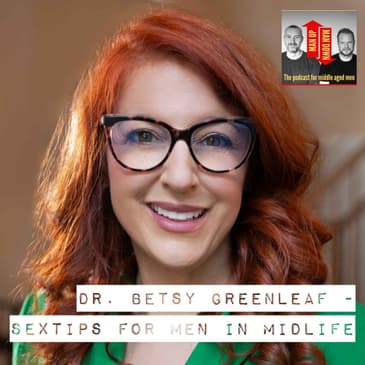
In this conversation, Betsy Greenleaf discusses the critical link between erectile dysfunction and cardiovascular health. She emphasises that a decline in erections can be an early warning sign of significant heart issues, often occurring about ten years before a major cardiovascular event. Betsy highlights the importance of consulting a cardiologist when experiencing erectile dysfunction, as it can indicate underlying vascular problems that need to be addressed.
Giveaways:
You will get a link to 10% off at the Pelvic Floor Store this will be sent to your email
Women’s Pelvic Meditation: https://femversity.com/pelvicmediation-sign-up
Hormone Quiz: https://link.apisystem.tech/widget/quiz/Xxe3hNPG5Iora9LqUILT
Websites:
The International Pause Institute: https://pauseinstitute.com
The Pelvic Floor Store: https://pelvicfloorstore.com
Affiliate Sign Up for the Pelvic Floor Store: https://af.uppromote.com/the-pelvic-floor-
store/register
Social Media Links
https://www.instagram.com/drbetsygreenleaf
https://www.instagram.com/drbetsygreenleafmenshealth
https://www.instagram.com/drbetsygreenleafspeaks
https://www.tiktok.com/@drbetsygreenleaf
https://www.tiktok.com/@drbetsygreenleafmen
https://www.facebook.com/dr.betsy.greenleaf/
https://www.instagram.com/internationalpauseinstitute
https://twitter.com/DrBGreenleaf
https://www.pinterest.com/drbetsygreenleaf
https://www.youtube.com/channel/UCdu6ZIxyAYGKsmJPtEvTS4w
https://www.linkedin.com/in/drbetsygreenleaf/
Music
Menopause Rock Album by Doc BET-Z
Menopause Memo https://distrokid.com/hyperfollow/drbetsygreenleafbeats/menopause-memo
Life Fire
Rising From Ash https://distrokid.com/hyperfollow/lifefire/rise-from-ash
Fire Under Glass https://distrokid.com/hyperfollow/lifefire/fire-under-glass
Fire Leaves Its Mark https://distrokid.com/hyperfollow/lifefire/fire-leaves-its-mark
Podcasts
Some of Your Parts https://someofyourparts.libsyn.com/
Body Mind Spirit https://www.wytv7.org/body-mind-spirit
Hosted on Acast. See acast.com/privacy for more information.
[00:00:00] Well, that was another cracking episode, one I think you're definitely going to enjoy. I mean, we're recording when the temperatures are freezing, but that one got a bit hot and steamy, wouldn't you say, Volker? It did, because we went down a slippery slope, you know, talking about all things hot and cold, literally.
[00:00:20] But yeah, we had Dr. Betsy Greenleaf on, who has got quite an extensive CV, which you'll hear a bit more about in the episode. But yeah, she was talking a lot about men's and women's health, sexual health. She gave us all the green light to do more of what men enjoy doing. So, you know, dot, dot, dot. You have to listen to the episode, obviously. So yeah, enjoy.
[00:00:56] Welcome to the Man Up, Man Down podcast, presented by Volker Ballueder and David Pawsey. We discuss the pressures and challenges faced by men approaching middle age that we're often too embarrassed to speak about with our friends. You can find us online at www.manupdown.com. Enjoy the show and don't forget to subscribe and leave us a review.
[00:01:24] Welcome to another episode of Man Up, Man Down. And we're pleased to have Dr. Betsy Greenleaf as a guest. So Dr. Betsy Greenleaf is a triple board certified physician, a trailblazer in pelvic and hormonal health with more than 20 years of experience. She founded the International Paws Institute to help men and women over 40 reclaim energy, confidence and intimacy through hormone harmony, pelvic wellness and functional care.
[00:01:52] Her no fluff taboo breaking approach has lent her features in major media and made her trusted voice on midlife vitality. There we go. Short intro. Let's see, but I'm all curious. So take it away. Give us an introduction of who you are, what you do. Yeah, perfect. I love the taboo breaking stuff. So always a big fan. Welcome to the podcast. Yeah. Thank you, Volker and David. I really appreciate being here.
[00:02:22] So, yeah, I actually started my career in gynecology. So in women's health. But as I kind of moved forward and entered kind of the menopause space, so women over the age of 40, I started finding that I was helping them. And the same process that's going on in women we have with men, too. Men go through their own like menopause, which is called andropause. And a lot of people haven't even heard of that. And I'm always telling men, I'm like, guess what? You guys don't get out.
[00:02:52] You get your own version, too. So a lot of my patients were like, hey, I'm feeling so much better. Can you help my husbands, my partners, you know, the important men in my life? So I ended up adding men's health into what I was doing. And it kind of, I mean, it all goes through the same. And then in addition to being a triple board certified, I'm now working on my fourth board certification in integrative medicine with Dr. Andrew Weil.
[00:03:18] So that's kind of also coming more from this holistic standpoint, because, you know, I think when we get trained in traditional medicine, a lot of times it's like medicines and surgeries and medicines and surgeries. And I realized that there's got to be more to this, especially when I wasn't seeing the results that I really wanted to in people. And I wanted to understand the body and how it worked even better. So, yeah, so that brings me to where I am today. So are you still a GP?
[00:03:47] Are you still practicing as a gynecologist or as a day-to-day? Yeah, no longer as a gynecologist. So now I'm just basically seeing men and women over the age of 40 and working on their hormones. So, because unfortunately in both of us, men and women, we start seeing a decline, especially in testosterone once we hit 40.
[00:04:07] So, you know, men that shows up as that dad bod, you know, where they start like exercising for years and they're like, I'm not seeing the changes that I used to see. Or like I'm starting to kind of get a little like soft around the middle. And what am I doing? And that's unfortunately because of that decline in testosterone that starts happening in the 40s. And then women are starting to experience that too. So I'm helping them to look at their hormones. But here, you know, I'm located in the United States.
[00:04:36] Here we're starting to see this really big boom when it comes to women's health with menopause. And men are kind of getting forgotten a little bit. And unfortunately, we're having all these hormone companies that are popping up that are just throwing hormones at people. And people are complaining that they're not seeing the differences that they want. And because I always tell patients that hormones are just a tool in our toolbox.
[00:05:01] It's if we don't look at the whole system and the whole body, we're not going to get those tools to work as well as they should. And the biggest thing is stress. Because let's just, I'll go into the science behind it. But cholesterol is our parent hormone. And unfortunately, cholesterol often gets vilified. It's made into this bad guy. But cholesterol is not bad unless it becomes sticky. And it becomes sticky from inflammation.
[00:05:29] And so inflammation and stress in the body is kind of handled the same way. So if you're in a nice relaxed state and everything's working properly, cholesterol should come down and be made into the sex hormones such as testosterone. And in women, testosterone and estrogen. And men actually get a little estrogen too. So that's supposed to be happening in a nice relaxed state. When we're stressed because of things like inflammatory foods that we're eating,
[00:05:57] not sleeping enough, not getting enough fluids in our diet, not staying well hydrated, just general stress of work and life because life gets lifey and things happen and we get stressed. If those stressors stay up too long, our body will take from our sex hormones and convert them into stress hormones. So this is really important to know this, that even if, so if you're stressed in any way,
[00:06:28] that could be causing your hormones to be low. And then on top of it, now when we start getting to the age of 40 and above, our hormones are naturally dropping. And even if we give somebody hormones, if we don't deal with the stress on the other side of it, anything we're giving to them, they're just going to convert back into stress hormones. So it's more holistic view of things. Right. So is that why we have a lower sex drive as we get older? Yeah. Yes.
[00:06:57] So testosterone being the biggest one. And then the other thing is from the brain standpoint, I always tell everyone your brain is your most important sex organ. So you can do everything you want below to try to stimulate things, but if the brain is not there, it's not going to work. So this is what we also see with Viagra. Like unfortunately, you know, with women, they think like, oh, it's not fair. Men have Viagra. Men have all these pills. And I'm like, you know, they still have not invented a horny pill.
[00:07:26] They haven't, like that has not existed yet because everybody's brain is different and what puts them in the mood is going to be different. So really focusing on the brain and how do we get that stimulated? And then also what's happening in like 40s, 50s and beyond is if you're someone who's been in a long-term relationship, there's this process, unfortunately, that is called habituation. And habituation is basically where you just get really used to the other person.
[00:07:56] And so sometimes it takes a little bit more to kind of spark the brain. You know, if you think about like when you first are with somebody and you know, like it's kind of like fireworks and you're like all excited every time you see them, every time you're in their presence, every time you think about them, it's like your brain is going crazy because that's that boost of dopamine that makes you feel really good. But the longer you're with somebody, unfortunately, it gets harder and harder to get that boost of dopamine. So, um, so this is,
[00:08:26] so not only are we dealing with the declining hormones, but in some people, if they've been in a long-term relationship, you could also be dealing with that lowering of that dopamine because they're just used to each other. And that's when you have to try to bring novelty into, into the situation. And once again, for people's brains, you know, different things stimulate different people's brains. So it's like, that could be anywhere from bringing in devices or toys.
[00:08:52] That could be, you know, bringing in fantasy. Um, you know, if you talk, most people, if you talk to them about vacation, sex tends to be the best sex that they have because they're in a new location, you know, they're maybe away from the stressors that they're normally experiencing. So, um, it tends to be, you know, they get away from the stress, which helps with the hormones and now you're in a new place. And so that's new and interesting. And that can bring about that, that kind of like little new spark. So.
[00:09:22] I love it. We're five minutes in. We're already on the sex point. I'm like, there we go. That's it. You got all the secrets to hormones and, uh, and sex. Liberty slob. Love it. For Friday afternoon recordings, this is brilliant. Yeah. So, um, I mean, how often sort of do you, I mean, you sort of mentioned about, uh, sorry, no, not how often that. I mean,
[00:09:54] you sort of mentioned about how you'll be sort of treating a female, uh, patient. And then she's like, actually, I think, you know, my husband could sort of benefit from this. Um, I mean, if, if we sort of talk about sex, I mean, how often is it? Well, I guess, you know, the underlying causes as well, but how often is it where, you know, it is both sort of both members of the couple, as opposed to, you know,
[00:10:25] someone's frustrated. Um, yeah. I mean, how it's really, is it sort of typical that you get to an age and yeah, you lose interest or, you know, does it with some people, does it, you know, keep on going? Yeah. I mean, really, I mean, there's no reason for us not to keep going for the rest of our lives,
[00:10:49] but I think there's this general thought that when things start becoming difficult and becomes more work because you're not 18 anymore, you know, when you're 18, things are a little bit easier, probably because there's a lot less stress when you're 18, um, than when you're like in your forties, fifties, sixties and beyond. But, um, we get to the point where people kind of just start accepting it and they go, all right, well, I'm older. And then this is the way it's supposed to be. And, you know, that's not the way it necessarily has to be.
[00:11:19] So that you can have a very thriving sex life for the rest of your life. And in fact, actually, we have to start looking at it different as a way of pelvic physical therapy, because if you don't use it, you do lose it. Because both for men and women, anytime the genitalia becomes stimulated, it's actually forcing blood into those organs. That's why men get erections, because that's a blood flow issue.
[00:11:47] And so by constantly, you know, regularly stimulating that area, you're actually helping to support the blood flow and the blood vessels to that area. So it's actually, we need that for like this pelvic physical therapy to get things to keep working. Um, you know, they also, the scary thing actually, specifically for men, from the moment a man starts to have issues with erections,
[00:12:16] whether that's when they're with a partner, or even waking up, and they're not no longer getting morning erections. That is one of the first signs of heart disease. Because, um, I don't know about you two, but I know my husband is really bad about going to the doctor. So, you know, how does, how is nature going to get a man's attention? Like, well, let's go for the penis, because that's the best way to get their attention. So, um, so that's something really to pay attention,
[00:12:45] because once erections start to decline, it's about 10 years before, till a man will have a significant cardiovascular event. So a significant heart event. So if that's happening, one of the first, like, well, a lot of times patients are coming to see me because I do treatments, um, for erectile dysfunction. And I'll talk, I can talk about that in a minute, but, um, but the, they come to me because that's what they're seeing or experiencing. And I'm like, okay, before I do anything,
[00:13:14] I got to get you to a cardiologist because we got to make sure that your heart health is good, because that's the first sign that there's a problem going on with the, with the, the vascular system, the veins, the, the arteries and the heart. So it's a major, major, major sign. So I can't emphasize that anymore. Is that like, you know, that's happening, get to the heart doctor. So, but at the same time, just like exercise is good for the heart.
[00:13:44] Good. Anything we do for the heart is going to be good for your sex life. And then also using the genitalia and using it regularly, whether it's self stimulation or with a partner is going to keep that blood, the blood flow and keep things healthy. So, so is it, is it an old wife's tale that, um, men who have regular, um, you know, sex or orgasm, I think, I guess, I don't know what, what's officially a finish is have less prostate cancer. Yeah. No,
[00:14:14] that's actually true. Yeah. That's actually true. So, yeah. So, yeah. Not an old wife's tale. Yes. It's definitely like, let's put this on your exercise schedule. So not only is it going to help with erections, but decreased prostate. Yeah. But also decreased prostate cancer too. Yeah. I suppose for some it's inherited, right? But, uh, yeah. I mean, there's also all so many other factors. I mean, we also have environmental toxins that can affect this. And, oh,
[00:14:44] unfortunately the environmental toxins, you can drive yourself crazy because we can't really get rid of them in modern life, especially, you know, the biggest thing is decreasing the number of plastics that we're exposed to because let's say drinking out of plastic bottles. I mean, we know that even if the plastic is BPA free, there's still other chemicals in the plastics. And especially for men, these hormones act, they act, these chemicals act like hormones and they can actually,
[00:15:12] actually trigger the estrogen receptors, which can actually increase risk of prostate cancer, even breast cancer in men. So, yeah. Interesting. So about the pelvic exercise you were talking about, so I, or pelvic wellness, what, what do you mean by that? Because I, I only know, I mean, I know that, that women do pelvic floor exercise and stuff after giving birth to, you know, restore the muscles down there because they've obviously been, been stretched, right? Yeah. Yeah. Yeah.
[00:15:42] Um, it's, it's, it's, so, so when you, when you talk about pelvic wellness, is that what you mean? Or is there something men should be doing as well? Yeah. So it's a combination of, well, like I said, using the organs regularly and, um, whether it's, like I said, partnered or herself, but also men should be doing Kegel exercises also. So we have muscles, both men and women that basically go from the front where pubic bones are all the way and sling back around the rectum.
[00:16:12] And those muscles help keep our pelvic floor. And those muscles help keep our pelvic floor, um, more firm and help us with control. Women tend to have more issues because of childbirth and damage to those muscles, but men can also lose control of those muscles as they age also. And we start losing about 8% of our muscle mass every decade that we live after the age of 30. And so most people think about exercising their arms, their legs,
[00:16:39] but they don't think about exercising their pelvic floor. And so doing a Kegel exercise, and I'll explain that in a minute, um, why it's important, especially for men, because not only will it help things like holding in stool or gas, because if we, those muscles become too weak as we get older, you know, we can have problems where we can have accidents with that. Um, but then it also can help with sexual control. So that's why, you know, you having strong muscles in the pelvic floor are really good.
[00:17:09] So really you want to think about is kind of like tightening and lifting the muscles that you would use to, like us, I'm going to just be blunt about it, basically holding in a fart. So, you know, what the muscles you'd be using to prevent passing gas, those are the ones you would want to be tightening. And the Kegel exercises can be done in a number of ways. They can basically, where you tighten the muscle and hold it for a count of 10 and then relax and then do that 10 times. Um, or you can do what's called quick flicks.
[00:17:38] That's where you like tighten, relax, tighten, relax, and do it very quickly. And to a count of 10 and then kind of relax and then do it again. Um, but like with any exercise activity, you don't want to kind of do too many too soon. Cause not that you're necessarily going to pull a muscle, but you could fatigue the muscles and you can have some side effects from that. That may be, you know, maybe harder to holding gas, uh, for a little bit. So I always tell people start with just like one set of those and then basically move up,
[00:18:08] maybe just do it one or once or twice a week and then kind of move it up to like, all right, like two sets of 10, three sets of 10, and then move it up to like, and maybe like two to three times a week or even, you know, we're getting up to five times, times a week. Yeah. So, and it's, and it's one of those things where it's one of those exercises you really can do anywhere. No one will even know that you're doing it. So you don't have to go to a gym to do it. Um, but if, you know, if you are going to a gym, there's, there's other ways to strengthen those muscles,
[00:18:38] the machines where you have to pull your legs together. Those are also activating those muscles or even sitting down, and putting like a ball or a towel in between the legs and squeezing legs together will also strengthen those muscles. So, yeah, they're also great exercises for men to do. I bet all the listeners just tried it all out anyway, wherever they listen to podcasts. Now they've, you know, if they're walking, they just probably just stop and be like, Hmm, you know,
[00:19:06] sitting on the train or the commute or whatever they do. I'm sure all three of us have been doing our exercises since we started the podcast. Exactly. You know, you used to tell people like every time you're watching TV and there's a commercial, but you know, now with streaming networks, nobody even is either fast forwarding through commercials or there's no commercial. So, you know, just, uh, maybe setting a calendar reminder to do them daily. And, you know, you can do them while you're on the train or in the car, you know,
[00:19:34] when you're at your desk or whatever you're doing that day. So. That's a good idea, actually. Yeah. Um, I mean, I'm, I'm learning a lot, uh, in this episode. Um, but I mean, is there, I mean, you've obviously talked about how, you know, we're, we don't have the same vigor for want of a better word, you know, as, as we did when we were 18. Um, for both sort of men and women, you know,
[00:20:02] that have sort of reached this sophisticated age of, you know, sort of forties, fifties, what, you know, what is something that we might not appreciate about our partner's body that has changed, you know, over the last decade or, you know, longer? Yeah. Well, I, you know, two things come to mind. Number one, I find, and, um, in this, I don't want to sound sexist.
[00:20:27] I do find that the female partners tend to be a little bit more concerned with the way they look. Um, and they get really kind of stuck on their weight and how they look and they don't look 18 anymore. And I'm like, listen, you're, you know, if you're with a male partner, they don't really care. Usually it's just, you know, appreciating each other for who you are. The other thing is, you know, when we look back at the science behind the sexual kind of function, um,
[00:20:57] we think actually all the way back to Masters and Johnsons who they did their research in the 50s and 60s. And their model of sexuality, their graph is actually very good to describe men's sexuality, but not so much for women's. So actually having an understanding of both of those graphs is pretty, pretty good. So typically it starts off where there's a desire and arousal, and that brings the graph up. And then there's, you know, sexual activity. And hopefully, you know, there is an orgasm, but it doesn't have to be. Um,
[00:21:26] but usually like, let's say an orgasm and then resolution. And it's a very linear graph from start to end. And, um, that's very representative of typically what happens with men. Um, women kind of get stuck in that. That's the way things should happen with them too. But there was another researcher in the nineties, her name's Rosemary Basson, and she remodeled the female sexual function. And unfortunately, when you look at it, it's kind of a lot more confusing. It's all these interconnected circles.
[00:21:57] And so she says there still can be spontaneous desire and arousal, but it tends to happen less and less at, for women as they get older. And also as they're in a longer relationship. So in her model, she says, if you wait around till you're in the mood, you might be waiting for a while because life stressors, you know, get in the way. And so they, that might just prevent things. So you just don't wait till you're in the mood.
[00:22:27] The first step should be willingness. And that's actually having a conversation with the partner about like, okay, let's try this. But at the same time, not forcing yourself to go through anything, because if you force it and becomes uncomfortable or on, you know, it's just a, not a fun situation. It's going to basically cause this negative feedback. That's going to make you not want to do things. So you basically have some kind of like conversation ahead of time. Like, all right, if things aren't working,
[00:22:57] let's have this agreement that we say a certain word, or we just have to stop and say like, Hey, it's not working tonight or today. Let's try this another time. And then in the Rosemary Basson model, she says, if women start with willingness and just kind of go through the actions, there can physiologically then be this increase in blood flow to the genitalia, which then can actually increase sensation. And then, so you don't have to start with the desire. It's just the willingness.
[00:23:26] And then now when things kind of get revved up, all of a sudden the person goes, Oh, wait a minute. I think I want to do this. And then hopefully then it's a satisfying sexual event. And then they want to do it again. So a lot of times when I get women in the office and they're like, Oh, my sex drive is low. I think I need testosterone or I need hormones. When I show them this graph and I explain it and I'm like, why don't you, while we're checking, you know, your blood work and your, your hormone levels,
[00:23:54] why don't you go home and try this with your partner and let me know how it works. And I will tell you, I have not yet have anyone come back and say it hasn't worked. Usually they're like, Oh my gosh, that was amazing. It made me think like, why am I not doing this more often? And I'm going, yeah, exactly. Exactly. So, yeah. So, but I think, you know, the biggest thing is with any partner, um, with, you know, with partners, it's, it's all about communication.
[00:24:23] And so, you know, communicating like how things are going, what do you like, what do you don't like? And, you know, even trying new things. So, so, you know, and I don't, I think there's this general thought that it's just supposed to get easier over time, but it isn't, it's just a changes, it gets different. And, you know, there's different conversations, that need to be had constantly and just keeping that conversation open. Hello folks,
[00:24:53] it's Volker here. I hope you enjoy this week's episode. As you know, I coach executives, whether that is for leadership skills, or sales leadership skills, or working as a therapist too. There are few ways I can help you to get unstuck, improve your work-life balance, or become a better version of yourself. So, you will be more productive, and have more time for your family. Whatever it is, you can join my client list of people, from General Electric, Pepsi,
[00:25:24] DHL, Boots, and many others. Book a free exploratory call, via my website, www.opnat.us. That's O-B-N-A-T dot U-S. Now, back to the show. I know Volker's got lots of questions, so I'll just ask one more, and then let him get another one in. Pardon, pardon the pun. But,
[00:25:53] what, you're terrible. I mean, you know, you're sort of saying that, you know, communication between partners is highly important. And, you know, obviously we sort of talked about how, when you're younger, nature takes its course a lot easier. I mean, if sort of, I mean, either both of you, or one of you, have had quite a sort of conservative upbringing.
[00:26:24] You know, how, how do you kind of, yeah, you know, almost get past this conditioning, that you've had for, you know, your upbringing. Wow. And, you know, there obviously are sort of, certain communities where, you know, some things are a lot more taboo than others. Yeah. I mean, well, how, how do you sort of address that conversation? And also, how do you reach those sort of communities to, you know, spread a message about health?
[00:26:55] You know, that's, that is very challenging. I mean, I was, I grew up in a very conservative upbringing. And in fact, actually my mom had me come lecture her church not too long ago. And she was like, please don't talk about vaginas or sex when you, and so, you know, I find out, I find with everything that actually, the more you talk about it, it's not easy, but the more you talk about it, the easier it gets.
[00:27:23] And it's really just kind of getting over that first conversation. In fact, there was a study that was done in Europe, um, that said that 65% of women are uncomfortable saying the word vagina. Yet 83% of women will have a pelvic health condition at some point in their lives. And it's like, if we can't talk about it, how are we going to, you know, get help and change? So, you know, they haven't done that same study with men and I don't know why, but, um, but I think it's, you know, just having the, practicing the conversations, having the conversations.
[00:27:53] And unfortunately, sex is such a complex, uh, topic because cultural beliefs, religious beliefs, historical beliefs carry forward and have an effect on it. Um, so really I just try to do it more from a purely medical standpoint because it's easier because, and I do, I have, you know, I have communities where I try to talk to them about, uh, self pleasure and, um,
[00:28:23] and that is a, you know, can be very taboo and even against certain religions. Um, and, and that can be very difficult, um, to have that conversation. And I don't want to, you know, change people's minds about these things. However, from a purely medical standpoint, um, self pleasure is very good for your health. And, um, not only from the time that you're young to figure out how do your parts work, you know, if you can figure out how, you know, what you like and what,
[00:28:53] you know, when you're doing things, it's easier to have that conversation with a partner going like, okay, you know, do it more like this, do it more like that. Um, and then fast forward as we get older to keep things in working order and try to, you know, to keep, you know, like it healthy because like I said, we're, we're thinking about exercising other parts of our body. We don't think about exercising down there. So, um, from, I usually just have to come from it from a very purely medical standpoint as,
[00:29:21] as this is good for your health. Um, and even there's been studies, let's even say, um, self-stimulation with or without a partner and within or without orgasm. There've been studies showing that there's a 98% improvement in sleep quality. So given the choice between that or sleeping pill that has side effects, I think I'd rather go for the self pleasure, um, or the partnered pleasure. Um, you know, there's also, uh,
[00:29:50] I think there was like a 93% improvement in confidence. Trying to remember some of the other statistics. They were all like really, really good statistics. Um, so, you know, coming from it, from that standpoint. Um, and then even when we start getting into kind of things that are a little, potentially more crazy is this idea of sex toys. And a lot of the, the sex toy companies are now kind of remarketing as well, intimacy, wellness devices,
[00:30:19] because they're really trying to come across. I mean, first of all, that's easier to sell when you say it's that it's not as taboo, but big from a standpoint, and they're getting more into the wellness research to be like, okay, look at these are things that can help things continue to work. These are things that we can, you can help with, um, with intimacy. Um, you know, sometimes I do post on social media because I am a spokesperson for a company. Um, and I had, they have me doing posts on this and sometimes I get a lot of backlash, especially, you know,
[00:30:49] sometimes people will be like, Oh, I don't need one of those devices. I have a partner. And I'm like, well, you know, these are things you could be using with a partner. Um, sometimes I get a little pushback from the men. The men are like, are intimidated. They're like, what happens if my female partner likes this toy better than they like me? And I'm like, it should never be like a this or that. It should always, the answer should always be an and it's not an, you need to improve your conversation in that case. Once again, it's language.
[00:31:18] It's not like it's this or that it's this and that, and this and that, and that, you know, like there's so many potential options. So, um, it's just, I think being curious and, you know, kind of like having a zest for life and, and having those open conversations and seeing, where, you know, you are and seeing where your partner is and, um, you know, and continuing that conversation. I'm, I'm just wondering. So,
[00:31:47] so anyone who's listening now, what, what's going through their heads, right? Especially if I see our, our male listeners, I mean, you, you just basically said, you know, rank as much as you want to, right? Because it's, it's good for you. Finally, you know, I got the old green. Yes. I can do this often as I want. Yeah. Got a doctor's note. Yes, exactly. Exactly. Um, and then, but by lots of intimacy, wellness devices, right?
[00:32:18] You know, next time a parcel comes from, uh, you know, love honey or something like that, right? It's going to be like, yeah, it's a wellness device. You know, it's good for you. It's like, Oh, you know what I also, I think is, it's also like a misconception. A misconception. A lot of people have, both men and women. Um, when it comes to women is that this misconception that the amount of moisture that a woman has is equal to her level of,
[00:33:12] of excitement. It's kind of like, there's no good way to explain it. Like a condensation, like this fluid that comes through. And so if a woman is dehydrated, if she doesn't have great blood flow, certain medications can prevent that. Um, so there is no shame in using lubricants. That's why these, these companies exist. Um, however, I will say that there are some lubricants that are healthier for women's health than there are, um,
[00:33:42] then there, there's so many out there. Um, but there's only three that come to my mind. There may be more that actually are tested for the pH. So balanced for acid, um, the, the proper acid level, and also for something called osmolarity. So osmolarity has to do with the salt, um, concentration of a solution. And if it's not perfectly balanced, it can actually dry a woman out more, which actually ends up for the company. They end up selling more lube, but it actually in the long run can affect a woman's health.
[00:34:12] So, um, I usually tell people, I don't know if I can mention brands here. I'm not. Yeah. I'm not associated with any of them, but, um, the top, the top three that I know that are balanced for women are one called, um, good, clean health, um, or good, good, clean love. Sorry. Good, clean love, Uber lube. And, um, ah, yes, those are the three that I, that I do know have are balanced for both peach and that salt balance. But yeah,
[00:34:41] it should not, you know, and sometimes, you know, listen, I know partners don't always talk even like in the moment they don't talk. And then you're trying to guess, you're like, I don't know, am I doing like, maybe she's not that wet. Like, am I doing the right thing? You know? So it really always comes down to communication. And once again, that is, doesn't mean that she's not excited. It just means that there might be other things going on that's affecting her hydration levels. So, yeah. I mean,
[00:35:10] if we speak about the general sex drive, right? I mean, obviously men and women have different sex drives, right? Yeah. Um, so what, what, what can we do to, to lighten it up? You know, as a man, as a woman, I mean, there's no general rule, right? There's not like, you know, men over 40 are more horny than, than women over 40. Right. I think, as you say, right, it's an individual thing. Yeah. Yeah. But, you know, should be, or should be, you know, I mean, they're, you know, just, you know,
[00:35:39] independent studies suggest, right? Um, you know, some people don't have sex at all anymore. Right. Once, once they had children, you know, they never got back into it or whatever. Right. Yeah. But it's, it happens, David. Yeah. What can we do? Should we? What happens if we don't? Is it literally,
[00:36:08] does it actually affect our overall health? You know, as you've mentioned, um, you know, hormonal health, potentially pelvic health, et cetera, et cetera. It's not having sex actually bad for us. It, it, that's a loaded question. Um, um, the benefits, right? How, how good it is to have sex, right? Obviously, yeah, it can. You're burning calories. That's, that's my argument. Yeah. Yeah. You're definitely, you're, yeah, you're burning calories,
[00:36:38] you know, you're keeping things in working order, but then also, you know, sometimes it just gets to a point where, you know, maybe there's just not a drive. Maybe there's health conditions, you know, orthopedic conditions that are just preventing it. It really comes down to the level of emotional stress that it's creating. Cause if a couple is perfectly fine with the way it is, and let's say they're not having sex, then like, then that's fine. But if it's like one person is not interested in the other one is now,
[00:37:07] that can create a lot of stressors in their relationship. And then that can create. So like I said, once again, it comes back to communication. Um, the other thing is, yeah, I just hate, I don't like people forcing themselves through things just to came and meet the other partner happy because then that creates this negative loop and people are like, Oh, you know, and then I will tell you, honestly, like I've been married for 22 years and there was a phase of my life where, you know,
[00:37:35] my husband would kind of like come up and like even touch me on the shoulder and I would jump. Cause I'm like, Oh God, does that mean he wants to have sex with me? And I'm not in the mood. So this is, you know, you know, this is something I've also had to figure out for myself and be like, okay, you know, and, and have that conversation and kind of learn along the way. And now, you know, now we're good. Um, now I'm the one who's touching on his shoulder and he's like, really again? He's like, come on. And I'm like, but, um, no, I joke, but, um, but, you know, it is from,
[00:38:04] from a purely physical standpoint, it definitely has a lot of health benefits, but I also don't want people to feel bad. If they're in a situation where they're like, you know what? I just don't like, I don't want to anymore. Um, because you don't want to, you don't want to force yourself through it. Um, there was something else I was going to say with that. I kind of, my mind blanked out, but, um, and endopause and, you know, menopause, that changes sex drive as well. Right. Yeah. Yeah,
[00:38:34] definitely. And so, and then this brings up the conversation about hormones and whether people should take hormones or not. So, and that also becomes a very personal decision because, you know, look at, we did not evolve to have hormone replacement, you know, we also probably didn't evolve to live as long as we are, you know, now, but, um, but at the same time, there is some actually cultural benefits to having people that don't have a sex drive
[00:39:02] because the elders or anybody older or outside of that reproductive, um, phase would be the ones that would be kind of caring more for the community, um, where, you know, the younger ones are doing the reproducing. So, if we look at it just from a cultural kind of, um, standpoint, there are some benefits of that. Uh, but at the same time, you know, I think that we're all like, I'm in my fifties. I'm not ready to throw in the towel and be like, okay, things are all done.
[00:39:32] Um, so there are tools if you want them, such as hormone replacement therapy, um, that can help. But once again, it's not the answer. It's just a tool. Um, sometimes it's, uh, you know, some of the other tools are things that, you know, decreasing our stress, you know, that may sometimes that may look like meditation for some people that may be finding a hobby. Um, some people, oh, I remember what I was going to say, you know,
[00:39:57] the other thing in between couples is any kind of skin to skin touching, or it doesn't have to always be sexual, but any kind of skin to skin touching can boost oxytocin. And oxytocin is the hormone that makes us feel bonded to each other. It makes us feel closer. So, um, that, you know, any kind of touching will do that, but the other, and it doesn't have to be sexual. The other thing that can make you feel closer to a partner is just doing things together. You know,
[00:40:26] whether that's going for a walk, you know, going to a movie and then having a conversation about that movie afterwards, doing more activities, um, with each other. Because, um, like I said, if you're, if you're like single and you're getting into a new relationship, you might not have all these issues because you tend to have more of those dopamine hits, even, even when you're older. But like people for people in long-term relationships, they kind of get into this pattern where they're not necessarily going out on dates like they used to when they were first, you know, first together.
[00:40:55] So that's important to keep finding time. Um, I tell patients really to use their calendar as a tool and block out time, whether that's actually to get out of the house and go do things together or even just to spend time with each other. And it doesn't have to always be sexual as long as they're spending some sort of quality time. And, and don't ignore that calendar block. You don't want to be like, all right, well, I really have all these 10 other things to do and we'll just hang out later because you'll just keep putting it off.
[00:41:25] You got to like make that block on your schedule, like a sacred block. And like, unless the like house is burning down around you, like you need to make sure you're spending time together. Yeah. Sorry, darling. I've got a meeting with Brian from accounts. It's long enough to cancel. What about actually scheduling sex in your diary? Is that something you recommend as well? Yeah. Yeah. But you know, sometimes, you know, maybe it's scheduled and then, you know, that time comes around and, you know,
[00:41:54] maybe you had a Mexican for lunch and you're just not feeling quite up to it. A little bit too many beans or something, but you can still be like, okay, well, it was scheduled, but you know, I'm just not feeling like that great today. Um, but maybe you can still, you know, sit on the couch and hold hands or just kind of be close together. Or, well, you know, maybe if not, if you had too many bean burritos, you might not want to do that. By the way. Especially if you haven't done your pelvic exercises and you can't hold it in.
[00:42:23] That's when they're really going to come in handy. Exactly. Oh, it's great that we've come full circle. Yeah. Double whammy or something like that. That's for the part. Anyway. Oh my goodness. It's so funny. That's not good on that slippery slope at all. Yeah. Yeah. That is too funny. Wow. So, so, so would you advise maybe because you just touched on hormone therapy, would you advise for or against hormone replacement therapy?
[00:42:53] I mean, I'm a big fan of it, but just from a personal standpoint, like if someone's like, all right, you know what? I've tried some relaxation techniques. I've tried vitamins. Um, and even the vitamins are kind of hitter there. I still love supplements, but, um, yeah. All right. Nothing else is working or I really want to try. I think it's good. I think it's also, I prefer testing and kind of looking at the hormones and then going, all right,
[00:43:21] like let's say the testosterone is low. My first question is why is the testosterone low? I don't want to just treat that. Like let's deal with the stressors. Let's figure out what the, because if I'm going to give testosterone, I want it to work because I don't want people to, take it and then them convert more into their cortisol. So I also, I check cortisol levels too, to see where the hormones are going. Um, I think there's a big fear behind hormones sometimes is that like, especially in the United States,
[00:43:50] we had back in the nineties, more so for women, um, actually it was early two thousands, more so from women than men was this idea that hormones cause cancer because there was a study that, uh, called the women's, um, health initiative that came out and it was a poorly done study. Um, and so now they're realizing it's the type of hormones that are used. Um, and there are some synthetic hormones that are on the market. Um, but I have people,
[00:44:19] we use more what are called bioidentical. So bioidentical hormones are more of what naturally occurring in the body, even though they can be made synthetically, um, um, here in the United States. And I, I assume you guys get, you get, you don't have to deal with the FDA. So you guys get stuff a little quicker and sometimes easier than we do. But, um, um, in the United States, why the synthetic hormones even exist is because you can't patent what occurs naturally in the body.
[00:44:49] So what happens is how do you protect your business is you create something that's very similar to a natural hormone, but you put some extra molecules on it and now it's a novel item and now you can patent it. So that's why these hormones even existed. Um, so I think there's more and more information coming out about how these things are just not processed in the body in the same way. And they're very, can be very inflammatory and that can potentially aggravate or potentially cause issues with cancer.
[00:45:18] But even with, with men's health, with testosterone, not taking testosterone, it's very important that you're getting your normal screening because when we talk about just the, the question about cancer is the idea is our body is make probably making cancer cells all the time. Like while we're sitting here and the idea is your immune system should be taking care of that. Unfortunately, there are situations for whatever reason, your immune system doesn't do its job.
[00:45:45] And now that cancer cell kind of takes hold and now can grow. So that's why anytime someone's on hormones, it's really important that they're doing their normal cancer screening and keeping on top of that because it's not that the hormones are necessarily causing it. Um, if they're not going to cause it, if they're in balance, um, hormones out of balance can potentially aggravate that situation or potentially feed it. So it's going to be something that's really important that it's being monitored. So,
[00:46:16] yeah. Right. Well, unfortunately, I mean, this episode has flown by and I mean, we've, we've covered lots of incredible topics. Um, there is still a lot more that I wish we could cover. So maybe you might have to, uh, to like organize around too. Anytime. But I mean, so if, if people want to find out a lot more about you, Betsy, um, how can they find you? Yeah. Yeah. I'm all over social media in one form or another.
[00:46:46] Um, so for my women's health stuff, it was usually, especially Instagram, it's just Dr. Betsy Greenleaf, B E T S Y and then Greenleaf. Um, and then I also have from the men's health, I just started a separate one so we could separate out some of that information. Um, it's Dr. Betsy Greenleaf, men's health, and that's on Instagram, Tik TOK. But if you just look up Dr. Betsy Greenleaf, I'm someplace in, in social media, pretty much all over the place. Yeah. Brilliant.
[00:47:16] Well, um, yeah. Thanks so much for your time. It's yeah. It's been a brilliant episode. Yeah. And as I say, it'd be great to perhaps get you back on another time. So, uh, thanks very much. I would love to have a great time with you guys. Okay. Thank you very much. Thanks for listening to this week's episode. Feel free to reach out to Volker or David via our website,
[00:47:39] www.manupdown.com or podcast at manupdown.com with any feedback or to let us know what topics you'd like us to cover in the future. Hear you again soon.