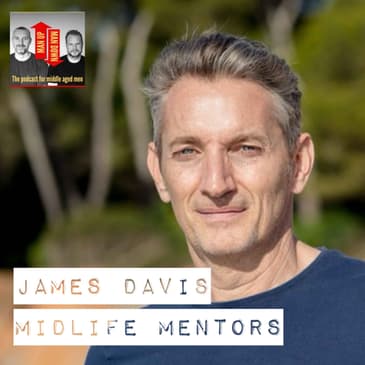
In this episode, Volker and David welcome James Davis, a coaching psychologist and co-founder of The Midlife Mentors. They discuss the challenges and opportunities of midlife, focusing on testosterone levels, andropause, and lifestyle changes that can enhance health and happiness. James shares his journey from psychology to coaching, emphasising the importance of understanding hormonal changes in men and how they can impact overall well-being.
The conversation also touches on the dynamics of working with a partner and the reflections brought on by the COVID pandemic. In this conversation, James Davis discusses the complexities of balancing business and personal relationships, the evolution of values in partnerships, and the importance of community and social connections as we navigate life transitions.
The dialogue also touches on the changing dynamics of work and how these shifts impact our sense of belonging and emotional health, particularly for men. The speakers emphasise the need for vulnerability and maintaining social networks to enhance well-being as we age.
Key takeaways:
•James Davis is a coaching psychologist and co-founder of The Midlife Mentors.
•Testosterone levels in men are declining, impacting health and well-being.
•Lifestyle changes can naturally boost testosterone levels.
•Andropause is the male equivalent of menopause, marked by declining testosterone.
•Midlife can be a time of transformation rather than crisis.
•COVID has accelerated reflections on personal values and life choices.
•It's important to understand the hormonal changes that occur in midlife.
•The dynamics of working with a partner can be challenging but rewarding.
•Men and women often seek coaching from different mentors based on gender.
•Values change over time, and it's crucial to reassess them in midlife. It's crucial to separate work and personal life to maintain a healthy relationship.
•Evolving values can significantly impact how couples work together.
•Recognising the dynamics in relationships helps in fostering collaboration.
•Isolation is a major risk factor for mortality, especially in men.
•Men often struggle to maintain deep social connections compared to women.
•Vulnerability should be seen as a strength, not a weakness.
•Community and shared experiences contribute to longevity and happiness.
•The shift from traditional work environments affects community dynamics.
•Maintaining social networks is vital for emotional health as we age.
•Future generations will face different challenges and opportunities than we did.
Find out more on https://themidlifementors.com/
Hosted on Acast. See acast.com/privacy for more information.
[00:00:05] Welcome to the Man Up, Man Down podcast, presented by Volker Ballueder and David Pawsey. We discuss the pressures and challenges faced by men approaching middle age that we're often too embarrassed to speak about with our friends. You can find us online at www.manupdown.com. Enjoy the show and don't forget to subscribe and leave us a review.
[00:00:34] So welcome to another episode of Man Up, Man Down. As you can hear, my voice is a bit hoarse, but we will get through that hour, so bear with me. So we welcome James Davis today. James is a coaching psychologist and one half of the husband and wife team behind the multi-award winning coaching company and podcast The Midlife Mentors. The couple are highly regarded as leading experts in midlife health and happiness. So bang on topic, James, right?
[00:01:05] Claire and James, also known as The Midlife Mentors, are also co-authors of bestselling book, public speakers and feature regularly in the national press. So if you haven't seen them. Over a career spanning a decade, James has trained thousands of clients and is incredibly passionate about offering an anti-fat approach to the health and wellness narrative. So no fancy diets or pseudo science. The words I can't pronounce here.
[00:01:33] So I'm sure you know what I mean. Just authentic, balanced information based on a wealth of professional and personal experience. James also works with corporates including KPMG, Citibank, Google, Cisco and more, providing coaching and wellness programs for individuals and teams. Championing the andropause and empowering midlife men with the knowledge and tools to make meaningful changes to their lives is a particular passion of James.
[00:02:02] So James, first of all, welcome to the podcast. Thank you, Volker. It's great to be here. Thank you for having me on. Yeah. So my intro is a bit, you know, all over the place. I'm blaming my cold I had all week. So I'm not sure when we go live, but at the moment it's cold and flu season in the UK. Yeah. There's a lot in there. So from andropause to midlife, you know, crisis, midlife mentoring. Where do we start?
[00:02:30] Do you want to start maybe with giving us a bit of an intro in terms of who you are and how you started looking at all these topics? And we can take it from there. Yeah. So I guess I'll give you the short version. So I was always kind of fascinated by human behavior. You know, why we do the things we do, how much our beliefs can get in the way of stuff. So I didn't really know what I wanted to do when I was a kid. So I left school. I did a degree in psychology. Loved it.
[00:02:55] So then I did a master's in applied psychology and didn't love it quite so much because you have to like start specializing. But it was interesting. I started working as a psychologist for a very short time before I left to pursue my passion, which at that time was youth culture journalism. So I was lucky enough to work for Ministry of Sound, launching their magazine, got to travel the world, clubbing all the time. But of course, that was a young man's game.
[00:03:22] So from there, I stayed in media, digital media, but kind of moved more towards a business development, commercial strategy side. But all through this time, I was still keeping up my own fitness, my own training, my own health. And then in 2011, I was kind of like, you know, I enjoy what I do, but maybe things could be different. So I took the decision to move to Ibiza to set up retreats. And basically at that time, the retreat model was very much focused on weight loss. So it was like, we'll take you away.
[00:03:51] We'll just beast you for eight hours a day and feed you like a few hundred calories of rice and beans. And yeah, great. You'll lose weight. But when you go home, it'll all go back on. And I was like, no, let's turn this on its head. Let's partner with five-star hotels. Let's have a healthy menu. But if people also want to go for a steak and chips, they can. Let's give them the proper tool. So yeah, lots of working out, but let's talk to them about nutrition. Let's talk to them about the role that their psychology plays. You know, why do you keep self-sabotaging yourself?
[00:04:19] So that was a company, 38 Degrees North. We still run retreats today, but this thing called COVID came along, which severely curtailed it, as you can imagine. I was running the business with Claire, my wife, and a lot of our clients were kind of hitting that midlife bracket. And we were seeing so many similar things present in terms of either physical ailments or I guess like emotional, psychological ailments. And then we were at that age ourselves.
[00:04:49] And so many of my friends were just like, oh, you know, it's the beginning of the end. It's the inevitable downhill from here. I've always got to put up with the expanding waistline, the low libido, low energy. I was like, no, it doesn't have to be this way, right? There's so much we can be doing from a lifestyle perspective. We've got longer lifespans. Let's make sure we've got good qualities. We launched our podcast, The Midlife Mentors, just kind of talking about anything midlife related, wanting to share our expertise. And then from there, we've gone on.
[00:05:17] We've launched like a group coaching program we run called Midlife Reset. We work one-to-one with clients. We do a lot of corporate work, as you mentioned, going in, talking about things like the impact of menopause, how men can be good menopause allies, the impact of lower testosterone as we age, what men need to know about that. Impact of stress, how we can manage it better, the role of communication in relationships, how we can deepen our relationships, all kind of things like that. So that's kind of a very brief history, I guess. There's still a lot in there to explore.
[00:05:46] So thank you for that. Should we start with lower testosterone or should we start with the andropause? So is that connected anyway? They're kind of the same thing. So I think as men, there's two things we need to know. And the first is that in the Western world, testosterone levels are falling. So, you know, the average 20-old year old today will have lower testosterone levels than a 50-year-old in the 1980s. So it's falling quite rapidly. And why does that matter?
[00:06:16] Well, you know, as we age as men, we lose testosterone anyway. So for women, their primary sex hormones are estrogen and progesterone. They'll tend to be at their peak in their 30s. And then they'll go through perimenopause and menopause when levels of those fluctuate and then decline away. So we're all very familiar now, thankfully, with like, you know, what's going on with perimenopause and menopause. There's a lot of information about that. For men, it's slightly different. It's happening over a longer span of time. Our primary sex hormone is testosterone.
[00:06:46] That's peaking in our late adolescence, early 20s, then it declines at a rate of 1% to 2% a year, which doesn't sound a lot. But when you're compounding that, by the time you're in your 50s, it could be 30% to 50% lower than it was in your 20s. And then we can start to note some of the effects. So there'll be stuff like we lose muscle mass. Our metabolism slows. So we get weight gain around our middle. We might have lower energy. Our libido might fluctuate or disappear. Have trouble with focusing, low-level anxiety, confidence. All these things come into play.
[00:07:15] And that's just being driven from, if you like, the testosterone direct effect. Loads of other hormones and neurotransmitters are changing at midlife as well. Plus we have the kind of psychological pressures of this stage of life. You know, we think we'll be on top of our game by the time we get here. But, you know, when we're young and we're looking ahead to when we're like in our 50s, we're like, oh, life will be amazing. I'll have made it. But actually, you know, we're juggling probably maybe aging parents who need care, children.
[00:07:43] We're still juggling our careers, our finances, our relationships. So all these things kind of come into the mix to put us under a lot of pressure, really. And I think testosterone isn't talked about enough. It's kind of had a bad reputation from the fields of sport and bodybuilding about this image of like, yeah, take loads of it and become really big and aggressive. But actually, it plays a really important function in the body, both physically and psychologically.
[00:08:11] And if we've got falling levels of it generally and it's falling as we age, we need to know what to do about that. What should we do about it? Great question. Well, there's the things you can do from a lifestyle perspective. So I'm personal proof of this. So a few months ago, I got my levels tested. So guys, if you're kind of like, you know, 40 or over, I'd say you can go and see your GP and say you want your testosterone levels tested, simple blood test.
[00:08:38] And unfortunately, they'll only tell you your total testosterone. So this is an important note. We have our total testosterone. But around 98% of our testosterone is what we call bound. It's being used in the body in processes. So it's actually the free testosterone number is arguably more important. But anyway, on the NHS, you'll get overall. So if it's low, that'd be a thing. So mine was slightly below threshold. And that's because I knew I had a long period where I've been injured. I couldn't train in certain ways.
[00:09:07] I'd let my diet slip through the summer, a bit more summer drinking. So I kind of thought, right, let's put into practice what I preach here. So changed my training up, cleaned up my diet, went drinking, had another test, and I've managed to push it like back over the threshold again. So first thing to say is you can naturally raise your test levels. How you do that and why are they so low anyway? Well, there's a number of reasons they're low. There's environmental pollutants, which is like, let's face it, there's not a lot we can do about things like that.
[00:09:37] But we can eliminate things like ultra processed foods from our diet. We can eliminate sugar from our diet. Sugar is inflammatory for the brain, the gut, the hormone pathways, the body, and it's in absolutely everything. We can eliminate sugars, minimize alcohol. That will disrupt our hormone pathways as well. But the key thing really is to make sure you're getting enough sleep and recovery and to make sure you start moving your body.
[00:10:01] So I see David laughing because I know he shared just before we came on air that he's had a whole week of sleepless nights with his dog. Yeah, I mean, sorry. And just to clarify, though, that is like I'm always moaning about my lack of sleep. So, you know, it's part of the brand. But sorry, James, carry on. Part of the brand. Well, it's interesting, actually. So we look at things like people who do shift work patterns and then work through nights. They will often have lower testosterone levels than baseline because, again, they're not getting enough recovery.
[00:10:31] But the biggest thing we can do is train in certain ways. So if we train and when we're older, when we're midlife or above, you know, we want to train at intensity, but not in long stretches. So this is where I see a lot of clients go wrong. Right. They're like, oh, you know, when I was in my 20s or 30s, I could just get on the treadmill for 25 minutes twice a week. But it doesn't seem to work anymore. So I've been getting on the treadmill for 50 minutes, four times a week. And while you're just increasing and we'll talk about the role of stress and cortisol.
[00:10:59] What we want to do is just really short bursts of intense training, like high intensity interval training, because that will actually help elevate levels of testosterone. But for guys, really lifting weights as well. So just just, you know, we can do it with body weight. We can do it with bands. But if we can get into the gym and lifting weights will also give us that testosterone boost. So, I mean, you sort of began by saying that testosterone levels are a lot lower than they were, well, you know, 40 years ago.
[00:11:28] Do we know why that is? I mean, you've sort of hinted, you know, lifestyle, that lifestyle has an impact. So is it our lifestyles have changed so drastically? Is that the reason? Yeah, there's a number of hypotheses to it, but nothing that can really be proven one way or the other. I mean, certainly one thing is, you know, since the introduction of the contraceptive pill, there's a lot more estrogen in our water. And of course, if we're consuming more estrogen, that's going to suppress our testosterone.
[00:11:53] So it's thought that could potentially have a big effect because even though our water is treated, that estrogen does stay in it to some extent. There's more chemicals for sure in our environment generally and in our food chains. They have a disruptive effect on our hormones. I think people and men in particular are more sedentary than they were even 50 years ago, certainly than they were 100 years ago. And we know that, you know, testosterone responds to movement.
[00:12:19] So, you know, if we're not out being active, that's going to be low. So and then the final one, this is still not really known, but, you know, there's an argument, you know, have we have we have women selected partners based more as we've had women's rights go through that? They're going more for less masculine traits and those more empathetic traits, which in turn could lead. But that's I think we're too early in evolutionary timescale to say that's been an effect. But it's something to look out for down the line. Right.
[00:12:48] So another question I was going to ask and, you know, be good to move on because you've meant, you know, in your intro, you mentioned so many amazing like areas to talk about. I mean, how often should you sort of get tested for your testosterone? Well, listen, the tricky thing about any kind of... Yeah, the tricky thing about... Well, here's the first thing. Most men will go to their doctor and say that they're feeling like fatigued or tired or low.
[00:13:18] And the most commonly requested test for GPs in the UK is the tired all the time test, TATT, which screens for a load of different things. So good. Doesn't look at testosterone. Doesn't look at testosterone at all. So that's a major failing of it. I'd say if you're kind of 40, 45 plus, then go to your GP and ask. I'd say you want to leave it at least three months between tests.
[00:13:45] But also the tricky thing with hormone testing is, remember, we're testing at a moment in time. So you could go in one day and have the blood taken. And for whatever reason, your test levels were just a bit low on that day. But actually, generally, they're fine. If we could, it'd be ideal to like have regular testing at different times of the day. But obviously, that's not practical for most people. But I'd say, you know, just try and make sure under the same conditions, maybe every three to six months.
[00:14:15] If listen, if it's fine. So the other thing is like if you're asymptomatic, you don't have the symptoms of low testosterone. Like you're not feeling fatigue. There's not erectile dysfunction. Your libido is fine. You can focus then, you know, maybe get a test out of interest. But you obviously don't need to go and get tested. If you have got those symptoms, then yeah, regularly check and see what you can do. The other thing we talked about solutions. I've talked about lifestyle.
[00:14:42] The other solution, of course, is testosterone replacement therapy, which is where you would actually get a prescription to take testosterone. But, you know, that's one to really discuss in more depth with your health practitioner because it's not as clear cut as HRT for women. There's a there's pros to it, but there's also some cons to it. What are the cons? Cons are it's not suitable for everyone. If you've got risk of certain types of cancers, it cannot be good.
[00:15:10] It will if you're still planning on having children, it will affect your fertility. Basically, if we introduce external testosterone, we're going to shut down our production. So if we take it for an extended period of time, then you're basically looking at a lifetime commitment to it. So that's just something to be aware of. I'm like, oh, I'll take it for a few months and then I'll come off when I feel good again because your body's own testosterone production will have shut down. So I think that's the main consideration. You're going into a lifetime commitment.
[00:15:39] We talked about low testosterone. So it's the andropause essentially then men having low testosterone. So is it similar then to the menopause? Is that how we define andropause? Yeah. So the andropause is a term used for it's called age related testosterone decline. And as I said, typically, yeah, between 45 to 50 years, you know, men may start noticing some of the symptoms of it.
[00:16:06] I think what's really interesting, you know, if we if we look at the menopause, they're obviously very, very different experiences. But what's interesting is men and women are likely to be going through these at the same time of life. So if they're in a relationship together, that can obviously cause huge problems as there can be a big relationship impact in it. You know, if both partners are having all these changes going on that are hormonally driven, not understanding what's happening.
[00:16:33] They don't even understand what's going on for themselves, let alone what their partner is acting like that. If they don't understand it and talk about it, it can drive a big wedge in between. Yeah. I mean, that's that's something we started discussing with. Was it Bruce? No, it wasn't Bruce. Yeah. You talked about menopause, what men should know about the menopause, right? Yes. There's a lot of men. You know, we don't know, right? We don't want to say we're ignoring it, right?
[00:17:01] But I think it's just just a hormonal thing. So let's let's not worry about it. Doesn't affect us. But it does affect us. It does affect us. We should be aware of that. Absolutely. Hello, folks. It's Volker here. I hope you enjoy this week's episode. As you know, I coach executives. Whether that is for leadership skills or sales leadership skills or working as a therapist, too.
[00:17:28] There are few ways I can help you to get unstuck, improve your work-life balance or become a better version of yourself. So you will be more productive and have more time for your family. Whatever it is, you can join my client list of people from General Electric, Pepsi, DHL, Boots and many others. Book a free exploratory call via my website. www.opnat.us.
[00:17:56] That's O-B-N-A-T dot U-S. Now back to the show. So you said something earlier, which I like to pick up on. And I don't know, maybe that's the way I think. But you said the way we imagine ourselves, right? When we're younger, what we're like when we're older. And it's actually not how we imagine ourselves or how life really is.
[00:18:23] I absolutely love when you said that because I sometimes still feel I'm 16 years old, right? Or I'm 18. You know, A for my thoughts and B sometimes what I behave like as well. So we never think we're getting old, right? I mean, I'm 47 now and I think, you know, I could be 36 or 20. You know, it's just a body. But also from a mental point of view, I think it's so interesting to think, yes, when I was
[00:18:52] I don't know how old I was, you know, let's say I was 10, 15, 18 and thinking, oh, what is life going to be like when I'm 40, 50, right? Always thought like, you know, it's a big house, a big car, you know, it's a steady job, you know, great income, you know, nice holidays, whatever. And life isn't like that. You know, it's like, where is that coming from? And what can we do? And is it a bad thing? I don't know. So you mentioned that. It's a great question, you know. So we talk about the midlife crisis, right?
[00:19:22] And what's interesting was that that term was first coined by a psychotherapist, I think in the late 50s and early 60s. And he gave a talk first and he wrote a paper on it. And he talked, I think his words, I'm paraphrasing, like the inevitable decline downhill towards his own mortality and how depressed, depressing that was. But what was interesting is, I don't know if you've seen the book, The Happiness Curve, which says for men, peak unhappiness is about age 44. And then we start to come up the other side.
[00:19:50] But this psychoanalyst, psychotherapist later said, at the time I gave those talks and wrote that paper, I was really depressed myself, but I feel much better now. And I think, you know, midlife is a challenging time. But I think I like to look at it as a second adolescence and a time of opportunities rather than a crisis, time of transformation, because we've got the wisdom of age, right? We've got experience. And probably for a long time, we've been not prioritizing ourselves, right?
[00:20:19] We've been focusing on family, career, stuff like that, to the extent where we might not have looked again at our values. And we don't realize our values change over time. And that's fine. You know, if we start a certain career when we were like 25, it's like, yeah, I'm passionate about this. These are my values. By the time we're 50, 55, you'd be there and like, I'm still in this career and it doesn't light me up at all. Like, what am I even, I don't care about this stuff.
[00:20:46] So I think it's really important we recognize that our values change over time and we should actually take time to look at them and think what they are now and whether what we're doing aligns with them. But to your point about, yeah, this, this, this, this, I think our culture paints this very linear picture of progression, right? Oh, you go to school, you get the grades, you go to university, you get the job, you get blah, blah, blah. And some people's lives are like that, right?
[00:21:14] But I'd say a lot of people I speak to have taken a more conventional path. Sometimes they're there and they're like, well, I've got, I've got the job, I've got the house, I've got the car, but I feel like there's something missing here and I feel a bit lost. I feel a bit disconnected. And then on the other side, there's people that have like maybe not been as conventional. I mean, they're like, wow, where's all the stuff I was, I was promised. But I think it's fine. I say, you know, don't look back. You're not going that way.
[00:21:43] We can learn lessons from the past, but actually be now like, okay, I've got an opportunity now to reinvent myself. Where do I want to be 10 years from now? What are my goals for that? What identity do I need to actually be that person that achieves that? So this is where we're tapping into psychology. What are the beliefs I need? What are the values I need to get to where I want to go? And that's the work we can actively do rather than just kind of shrugging our shoulders and going, well, this is where I am and I don't know what to do next.
[00:22:09] It's being proactive about taking charge, taking life by the scruff of the neck and going, right, where do I want to go next? And how am I going to make that happen? No, I couldn't agree more. I think it's a midlife transition, right? I mean, you hit midlife and I believe COVID accelerated that as well. If I say not only for men in midlife, but you get to this stage in your life where you go like, shit, what am I actually doing? What's important to me? And to your point, right? Values change, right?
[00:22:36] What was important to me at 18 was not important to me when I was 40, right? I mean, I've got family. I still started getting the tattoos and I only started that when I was, how old was I? I'm 43 during lockdown. So I'm covered now. I got the sports car, which I now sold. And we're looking for this external gratification. But what we really need to do is going inside and go, what is important, right? How do I want to spend the rest of my life to what you said, right?
[00:23:06] You know, we realize we're mortal, right? We only have, I don't know, another 40 years, you know, is it midlife 40? Or, you know, we all live to 120. I think I live to 120 anyway. Everyone is laughing at me, but I think we're going to progress. So hopefully I have another, I'm not in midlife yet, you know, not until I'm 60. But I think it's that reflection, right? Where we go like, what is important to us? And I mean, I know work is a fractional and a lot of people, I realize a lot of people at
[00:23:35] my age go into fractional work because they go like, I can do things I actually enjoy more. I don't want to be in the corporate career. I want to spend more time with the family. I want to spend more time with my pets or whatever it is, right? I want to travel more. And I think COVID accelerated that, that we actually go in and say, you know, what is important to us? Yeah, I mean, I'd agree with that. You know, we were all locked down. We had all this time at home. And I think a lot of people are like, if we're not careful, we can step into our life quite unquestioningly.
[00:24:04] You know, you get the job and it's like every day you get up, you don't really in the modern world get time to think, right? Because you're so wrapped up in the, in the doing, doing, doing, you're busy being a human doing, not a human being. And I think COVID was something like, oh, I'm sat at home. And actually, do I even enjoy what I do? Is it lighting me up? And people had a lot more of an opportunity to kind of reflect. So I think it was, you're right.
[00:24:29] It definitely, I say COVID in some ways accelerated our work culture by 10, 15 years, at least. I think if we see, you know, how, how work is now, the technologies existed for us to be hybrid working for at least 15, 20 years. Like we've been talking about it, but the upshot was no company really trusted their employees to do it. Then they had to. So now we've got this hybrid working, but I think also that lends itself to like you're saying, the fractional economy, right?
[00:24:57] People like, well, I'll do this for a bit of time in the week. I'll do this for a bit of time and we can start to explore, you know, what lights us up because you're right. Life isn't about the material things that we accumulate. It's only bring us fleeting happiness, right? It's about how we grow and develop as individuals and the kind of legacy that we feel we leave behind. No, I agree. David, you have lots of questions. I want to.
[00:25:25] Yeah, I mean, well, first of all, I just wanted to clarify something and that's Claire would have been perfectly welcome to come on. We certainly don't exclude women at all. And like 40% of our listeners are actually female. Fantastic. You know, and the reason we think that is because it shows that men don't talk enough. So, I mean, my question was going to be, well, two questions.
[00:25:52] One's a bit of a, you know, could be digging us all a hole, but that's what's it like working with your wife? And the second question is, you know, do you both work with both sexes? And, you know, do you find that there is a dynamic of, you know, for Claire to be working with a male than when she works with a female and both for you? So I'll answer the second question first.
[00:26:19] So I think being a husband and wife team, we love it. We love it. And I think it does bring that male-female dynamic. So when we're doing group coaching or corporate work, you know, there's kind of that approach, the viewpoint from both sides, which people seem to really appreciate. When we're doing individual work, it just does tend to fall that women will work with Claire and men will work with me. It's not always the case, not exclusively the case, but it does seem to generally fall that way.
[00:26:49] As for husband and wife team working together, I'll tell you what, it's great now, but it was tough for a few years because you're learning each other's working styles. Imagine, like, you know, the things in a relationship that could be abrasive about your partner in a working relationship, you know, that can be magnified. So we took our time learning, you know, who's good at what? How should we prioritize who does what organize the business?
[00:27:19] But the other thing is you have to be really careful about how it impacts your personal life because it's not like both of you go out the door to your own jobs and then you come back at the end of the day and like, oh, how was that? And you have a discussion about it. And then when you're working in your own business together, it's very easy to be kind of in that space one at a time and fall into that place of being business partners more than romantic partners. So we were really careful, I think, from the start to try and delineate that and say, OK, well, work's off at this time.
[00:27:49] And if it was like a weekend, be like, oh, I've had this thought. Is it OK? We talk about it now or do you want to park this till Monday? I still make time for things like, you know, date nights and stuff like that. But yeah, it was it was tough. But now it works really, really well. And we love working together. So what I mean, what was was the catalyst for it? I mean, obviously, you talked about sort of values changing, you know, as you get older.
[00:28:17] And I mean, well, yeah. And sort of have your values changed as you've been working together? Yeah, I would I would say so. I mean, I think when we came together, I was already living in Ibiza and Claire came out to join me. So it was quite she had to adjust to coming in something that I'd set up and was running, which was which was a big ego adjustment for her. And she she'd admit that. Yeah.
[00:28:45] And then I wanted to make sure you never let her forget that. No, but she did it herself. But, you know, I played my role in that. This is the thing as couple as couples, we need to recognize the dynamics. Right. I played a role in being I want to make sure that she feels in control and stepped in and valued. So I became like probably more subservient than I should be to her in that relationship and let let her drive that business part. So that was just like one one aspect. It's multifaceted.
[00:29:12] But over time, I think we've realized that we don't have to compete with each other. We actually, you know, complement each other. And when we've moved to that place where, you know, if we're if we're on stage together giving a talk, I think if you've gone back like five or six years, it's kind of like, well, they just said, right, I'm going to try and say something better. Whereas now we're just we're just really relaxed and it flows and we're like, oh, have you got anything you want to add? But I think that only comes kind of with time and the trust that builds up in a relationship as well.
[00:29:42] Maybe get clear and you both on at some or we get you both on at some point. Would be interesting. She can say everything James said was complete rubbish. Because it is that dynamic, right? Yeah. You know, I don't want to, you know, my wife doesn't like me talking about, you know, obviously her on the podcast that she doesn't listen to. And, you know, I don't I don't think it's everybody's business to to talk about things. But it is that men and women go through different phases in life. Right.
[00:30:11] And as you say, right, menopause and repause. And, you know, that, you know, we're not always the same age either. Right. So my wife is a few years younger. So, you know, if I say not massively, she's not like 20 years younger. So like two or three years. But it's it's a dynamic that plays out. Right. And the other thing you said earlier as well, come back. You said we all living longer lives. And, you know, I was alluding to, you know, I'm going to live to 120.
[00:30:39] So when I die with 60 before everyone else dies, you're going to laugh at me and go like, haha, you never made it. Right. But I generally think and I don't know if it was Elon Musk, it probably was Elon Musk that says, you know, we can live to 120 or older. And all these people in Silicon Valley, you know, they're doing things and freezing themselves and stuff. But I just generally think we have a longer life expectation. So the question then becomes, will there be a second midlife crisis or what? What? What? You know, is there another step where we go like, I don't know, at 60 or 70?
[00:31:10] I mean, and I don't want to, you know, has been a joyful conversation, but I don't want to, you know, drag it down by saying, you know, suicide rates obviously are quite high at 42 for men. And then again, at 70, when we all get lonely. Yeah. Is there another life transition point when I can't think of his name now? I'm sure you know it. But when we talk about becoming an elder in a, you know, in society as well. Yeah.
[00:31:39] I mean, I think it's a really interesting point, you know. And I think why there's so much talk around, you know, menopause, longevity, testosterone is it's because our lifespans are longer now. Right. You know, if a hundred years ago, you know, if you made it much past 55, 60, you know, you were doing pretty well as a man. You pretty much retired. You know, the stats were, I think, even 60 years ago, men retired and then they're pretty much dead within the next five years. You know, generally speaking.
[00:32:10] Yeah. We are probably, touch wood, going to live much longer lives. Whether that brings another life cycle. I'm not sure in terms of like hormonally speaking, probably not. But I think you've hit upon something really important there. I think from a relationship or belonging community perspective, yes. Because we know actually one of the biggest indicators for mortality is isolation.
[00:32:37] You know, people who are isolated tend to die much earlier. And I think obviously for men in particular, we have to be careful. All the research shows men are less good than women at cultivating and maintaining social relationships. We've tended to have them very much within a work environment. And then when work finishes, we lose our social network. So it's really important as men we have that wide social network, that we maintain it and we keep it up through all stages of life.
[00:33:06] Because I guess we can imagine or we can think of that typical thing of like, you know, the elderly couple that live alone. But there's just the two of them. And then one passes. The other one's just devastated and left alone. I think that could be a real turning point in life. There's the kind of loss, the grief, all of that stuff to go through. So I think as we age, hormonally speaking, no. But the dealing with a bit of passing of a partner, yes.
[00:33:35] And I think that's when we need to make sure that we have maintained those networks, those communities. So we have places to lean into then. I think it's a blue zone. I'm sure you're familiar with the blue zone. The series on Netflix. They talk about community, right? Yeah. Well, in all of those, you see all the people getting together regularly and doing communal meals. And things like that. Yeah. You know, cooking, family, you know, we're much more isolated these days. So I always think like when do I take up bowling, right?
[00:34:05] I think that's the next step for me in all the bowling clubs. But they all need like during the day, which I now could do, right? Because I work from home. But yeah, not ideal. But I'm getting there, right? Mentally, I'm already thinking about that. I don't know if that's a good or bad thing. But you want to make this connection. We talked on previous podcasts about that. That it's usually the female partner that has all the connections, right? She has all the friends. You know, she brings people over for dinner.
[00:34:31] And we blokes, we just go to the pub now and then meet a mate, you know, have a drink. But there's no, not such a depth relationship, which, you know, easier falls apart. I think that's another thing. So men are, you know, we don't keep as wide a social network. We're not as active at keeping it. And then when we do meet, we tend not to have those deep conversations. I mean, women will talk about all kinds of things, right?
[00:34:56] And again, the research shows that if a woman's got something that's on her mind concerning her, she will reach out to a health professional. She is willing to go and look at talking cures. Men are much more resistant. You know, they'll leave it till it's almost too late to go to the doctor if they've got something that's bothering them. They won't want to reach out for help to, you know, therapy or coaching because they feel it's a sign of weakness in some way. And guys, I'd say my message is vulnerability is a form of strength. You know, there's nothing to be afraid of there.
[00:35:26] Let's start opening up and talking about things. Because certainly when I've had conversations with friends about, you know, this is what's going on for me in my life, in my relationship, they're going to like, it kind of gives them permission to go, oh, wow, I'm so glad you said that. Because, and then it's a problem shared. I think, I think the temptation is we can feel very alone with our problems and our issues sometimes, particularly as men. You know, we have this still this, particularly in our generation, the stoic mindset of like, be strong, be silent, deal with it on your own.
[00:35:54] But that's not doing our emotional or mental health any good at all. No, you're 100% right. And there was an article, I think, on the BBC early on this week of a group of friends that have been met in the pub like once a week for the last 30 or 40 years. Yeah, it was way worse, wasn't it? Yeah. Oh, wow. They used to talk about obviously girls and cars and stuff. And now they talk about prostate cancer and, you know, dying and all that stuff. But, you know, 30 years, you know, that's huge lifespan, right?
[00:36:24] That's great. I mean, it's fantastic. Yeah. Yeah. Yeah. Yeah. I mean, they talk about, so a bit of a tangent, but because we talked about alcohol and not drinking alcohol. So having alcohol free life quite a lot on the podcast as well. In Ireland, there seems to be a trend now of people still going to the pub for the community aspect, but the younger generation not drinking, which is great to see, right? So you still have the pub as the center of the village.
[00:36:53] You have the old people there. They probably drink their, if I say, normal Guinness, but the younger generation drinks the alcohol free Guinness, right? So, you know, you can change generations, but you still keep that community. And I think that's great. Yeah. And I think it's so important because we have lost so many of the things that I'd say since the industrial revolution, the things that would have kind of like bought a community together.
[00:37:18] You know, if we look pre-agricultural revolution, which isn't that long ago in evolutionary terms, you know, people lived in little communities. They all knew each other. They'd all harvest together. They would celebrate the harvest. They probably all went to church. This isn't a religious thing, but it's like a shared experience that they had together. Then came the industrial revolution. Everyone moves to cities. The rural communities kind of die out when you're in a city. It's focused around work.
[00:37:43] You know, certainly in the modern age, you know, those community opportunities, I think, are probably a lot more limited than they were 200 years ago. But in evolutionary terms, you know, that's even the blink of an eye. And I think it's so important that we start trying to cultivate those opportunities for people to come together as a group and kind of like share what's going on for them.
[00:38:06] Because, again, there's loads of research around this, like you're saying, from the blue zones, where communities are really tight and they have these shared experiences and they support each other. They tend to be a lot healthier, live a lot longer and be a lot happier. You're right. You know, without drifting to religion, right, I think, you know, church, I think for a lot of us, it's not there anymore, you know, because either we're not religious or it's not as important to us anymore because we live in this fast-paced environment.
[00:38:34] But I think church can do a lot good in terms of the community, right? And there's nothing that replaces, if I say, the function of community that church used to have. So it's a very philosophical question. But anyway. Yeah. Sorry, David. I mean, it's, yeah, you know, and sort of something we've talked about before, how, you know, and in our lifetimes, how Sunday was completely different to how it is now, you know, because nothing would be open.
[00:39:00] And it would be a quiet, dare I say it, boring day. But it's almost like now we don't even get that, you know, that break. And sort of going back to the pubs and, you know, agricultural society, you know, a lot of the time, well, people wouldn't necessarily go to the pub to drink. It would be because, well, there wasn't telly, you know, you might, you might not have enough candles.
[00:39:25] So you go to the place where, well, the public house where, you know, it's warm. It's going to be the warmest place in town. You can have light so you can, you know, read or chat or whatever. But, you know, it was, it was almost like somewhere you'd go and then maybe have a drink. But, yeah, it's sort of, yeah, you know, it's, well, as you say, like, you know, the sort of changes we've seen.
[00:39:54] And even in, you know, again, we talk about the change from, from, well, you know, the COVID change of, you know, not working from home until, you know, companies going, actually, we don't need to rent this office space anymore. Or, you know, it almost seems like these big changes are sort of happening. But then, well, if you go back a hundred years, obviously, you know, we had the joy of wars, I guess, creating these changes.
[00:40:22] So, you know, be careful what you wish for. Yeah, true, true. It's an interesting point, you know, like for a lot of people, I think work also became, became the community, right? In the, in the 20th century. But we're arguably losing that now as well, as people, you know, work remotely or work in a hybrid thing. So I think we have to be really careful to find ways to kind of, you know, create or maintain that community feel. For sure. Yeah.
[00:40:50] But I mean, and sort of going back to what you were saying about this whole, you know, linear thing. I mean, my daughter's started studying for a GCSEs this year. So, you know, she's just turned 15. And it is like, right, you know, yeah, you've now got to make a decision that could affect you when you're 17. I am. When you put it that term, it's, you know, ridiculous.
[00:41:15] But as you say, it's like, well, you study at school to get those qualifications to then go on to sixth form or whatever to get those qualifications. And then you get the job, then you move up to that point, then you move up to that point. And, you know, I mean, it does seem to be changing. But I mean, you know, and again, it's something I've talked about a lot. Like my dad basically went into British Telecom when, you know, he was like, I think, well, he did national service.
[00:41:43] Then went to British Telecom at 18 where he worked till he retired at around 55, you know. Yes. So for me, that kind of, you know, changed jobs every couple of years, then went freelance, you know, was a stay at home dad for a while. You know, he my life was completely foreign to him. Yeah.
[00:42:07] You know, and again, I think that sort of, you know, talking about expectations and values, you know, it's like, well, I guess we're, you know, we are very much a transitionary generation in the, you know, the lives of our parents are completely different to how ours are. And as I say, you know, with the rate of societal and technological change, you know, our kids' lives are, you know, or our grandchildren's lives. Well, yeah. Yeah.
[00:42:37] It blows your mind to think about. It has been a really fast generational change because I think, you know, my dad was, I'm sure most men our age would say that their dads were pretty much the same. Like they went, they got a job at a company and they stayed there till life and retired. And like you, you know, I've done, I've done a lot. My parents are just kind of like, oh. It changed so much. As you say, the evolution of evolution of how we live, work, et cetera.
[00:43:04] I think it's just everything has just accelerated over the last, I don't know, 100 years, 50 years. Yeah. And again, you know, as you say, sorry. Yeah, go, go. Go ahead. I was, you know, just going to say it's, you know, evolutionary. We're still, you know, we still haven't progressed much from being learned to make fire. No.
[00:43:29] You know, but, you know, so we're still sort of mentally looking for those dangers. And, but yeah, I mean, we are going to have to wrap up. But as, you know, Volker mentioned, it would be great to have you back on and get Claire on as well. Oh, yeah, we'd love to. Thank you. So, I mean, you know, you've sort of obviously, well, you've, where do we find you online?
[00:43:57] I mean, obviously it sounds like, you know, we can find you in lots of different places, but, but where is the best place to find out a bit more about what you guys do? So our website is themidlifementors.com. Our podcast is Midlife Mentors and our socials are at Midlife Mentors. So you can find us in all those places. Brilliant. But thanks very much, James. Yeah, thank you. We put that on in short notes as well. It's been an absolute pleasure. Thank you.
[00:44:31] Thanks for listening to this week's episode. Feel free to reach out to Volker or David via our website, www.manupdown.com or podcast at manupdown.com with any feedback or to let us know what topics you'd like us to cover in the future. Hear you again soon.