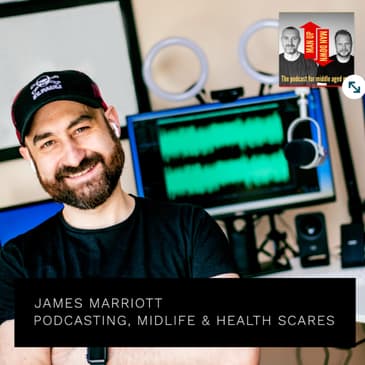
In this "Man Up / Man Down" podcast, hosts David Pawsey and Volker Ballueder are joined by James Marriott, who works in radio and media and edits the podcast. This episode dives into the experiences and insights from James's life, especially focusing on his journey around mindfulness, alcohol use, and personal growth.
James shares his recent decision to buy a house and the financial commitments that come with it, joking about the economic climate's impact on his lifestyle. He also touches on his passion for Eurovision, revealing plans to travel there, blending his interest in cultural celebrations with his professional life in media.
A significant part of the discussion revolves around James's sober journey, initiated by a health scare involving hypertension. This moment of crisis led him to evaluate his lifestyle choices, particularly his alcohol consumption, which was culturally and socially ingrained but not excessive. James's decision to stop drinking was not only a health choice but also a profound personal revelation, discovering that he is essentially a person who thrives without alcohol.
The conversation also delves into the role of mindfulness in dealing with life's stresses and pressures. James, along with the hosts, discusses how mindfulness techniques have helped them manage personal and professional challenges more effectively, promoting a balanced and reflective approach to life's ups and downs.
Furthermore, the hosts and James explore the broader implications of personal choices and societal norms on well-being. They discuss the pressures of maintaining social habits like drinking and how mindfulness can offer alternative ways to manage stress and social engagement.
This episode not only highlights personal transformations and the power of mindfulness but also emphasises the importance of introspection and personal growth in mid-life, offering listeners insights into managing health, stress, and personal development in more fulfilling ways.
You can find out more about James on his website www.wearesoundmedia.com or touch base with him via LinkedIn https://www.linkedin.com/in/james-marriott-podcast/
Hosted on Acast. See acast.com/privacy for more information.
[00:00:00] Welcome to the Man Up Man Down podcast presented by Volker Ballueder and David Pawsey. We discuss the pressures and challenges faced by men approaching middle age that we're often too embarrassed to speak about with our friends. You can find us online at www.manupdown.com.
[00:00:25] Enjoy the show and don't forget to subscribe and leave us a review. Welcome to another episode of Man Up Man Down. And you know, we seem to say this a lot, but this is a very special episode for a number of reasons.
[00:00:44] Often when we have guests on we all sort of get a bit tongue-tied or go down a conversational cul-de-sac and then we suddenly say, oh James can you cut that out?
[00:00:56] And the guest gives us a blank look and then we have to explain that we're not like Derek Acora with Sam our spirit guide, that James is our editor slash producer, which is why so many people tell us how professional they think the podcast sounds.
[00:01:13] Well on that note, delighted to welcome James Marriott. I'll give him a small intro and then I'll let James fill in the blanks. I mean James is the host of several podcasts himself.
[00:01:24] I believe he's worked in radio, in other parts of the media, which I'm sure he'll fill in. In our sort of pre-episode conversation he just mentioned that he was going to be away at Eurovision,
[00:01:36] which was something I was going to ask him about because I've seen some activity on his social media feeds in previous years, which suggests that yeah, he is a Eurovision fan. I mean Volker did a podcast before this and James is the producer on that.
[00:01:54] And James, well you do seem to spend a lot of time travelling around Europe, partly to follow a German football team. Welcome to the podcast James, fantastic to have you on here. Thank you. You've made me sound thoroughly more interesting than I really am with that introduction.
[00:02:13] Particularly now because this year I bought a house for the first time, so trips to Europe not really on the cards any time soon because I've saddled myself with a ridiculous mortgage. So thanks to Liz Trust for that one.
[00:02:26] I was very impressed how you kind of said something like activity on his social media alerted me to that. You made me sound really sinister when you talked about Eurovision. I was impressed with that. No, thank you for having me. It's good to be here. It's thoroughly weird.
[00:02:42] It's really strange because obviously I don't know if I'm the only person that has heard not just every minute of every podcast that you've done, but several additional minutes, probably additional hours that you've done that's been removed from broadcast episodes,
[00:02:58] which I'd like to show you I've kept all on a separate tape used for blackmail purposes at some point in the not too distant future.
[00:03:06] I mean that was weird. When we did our live event in November and I was like James help, how are we going to do this? And you gave me some advice. But I had a moment I went wow, this is the first time that I think we've actually,
[00:03:22] or sorry the second time that we'd spoken face-to-face. And I said you probably know me better than many other people do. It's always really weird that because obviously people that I work with and obviously listeners will have gathered from the intro of this,
[00:03:38] that I edit your podcast episodes for you. So I kind of feel like I know everything about you guys and keep thoroughly up to date with everything that you're up to and the conversations that you've had.
[00:03:50] But I'm aware that that's kind of it's a little bit of a one-way street that isn't it? Because I hear all the stuff that you do, but you don't kind of hear about everything that I'm up to.
[00:03:59] So it's kind of like it's a weird sort of relationship that I have particularly with clients because I get like a real insight into them and their lives.
[00:04:08] But less the other way around. So it's always really nice when I kind of get the chance to jump on a call with people and kind of offer a little bit back and reflect on some of the stuff that they say.
[00:04:20] And particularly relevant for you guys because I'm a big fan of what you do. I'm a big fan of the show. I think you do some really, really important content.
[00:04:30] And I do when I kind of send you episodes when they're done and sometimes I'll add a comment about, yeah, I was nodding really hard when you were talking about such and such or this bit really kind of engaged and connected with me.
[00:04:42] And that's really true because I'm in my mid 40s coming into my mid 40s now. I guess I'm fairly sort of like prime target audience for you anyway in terms of where I'm at in life.
[00:04:54] Yeah, you know, I do find myself really kind of agreeing and engaging with a lot of the content, a lot of the great guests that you have on but don't always get the chance to kind of tell you that.
[00:05:03] Well, you know, that was obviously why we invited you on so you could just flatter us. Yeah, I just sort of thought I'd make that out of breath. So my favourite bit was none. Did I just see another invoice coming through?
[00:05:17] You are paying me for this, aren't you? No, I'm kidding. It's brilliant to have you on. I mean, it's just if I say as David said, right, we're recording this obviously with audio, but you know, we're looking at the video.
[00:05:33] It's just weird, right? Hearing your voice and seeing you at the same time and actually talking. You have the whole insights, right? You've seen and heard more of the podcast than anyone else and probably more than us, right?
[00:05:48] Because back in the days, I remember when I edited my own podcast before, before I employed you, you go over it and then you do a quality control and, you know, you spend two or three hours on one episode,
[00:05:59] which is so nice that we don't have to do that anymore. So it's just I don't know how you do it. Everyone's a winner. Everyone's a winner in this equation. Exactly.
[00:06:08] I don't even do the quality control anymore. I know David listens to every podcast before it goes out. You'll be pleased to know, by the way, that I find editing myself one of the most uncomfortable things. Editing other people is fine. Editing yourself, you second guess everything.
[00:06:27] So yeah, editing this would be a particularly unpleasant experience for me. I'll just when people listen to this and they'll be like kind of like why are they just talking to each other? Why is there no guest? I'm just going to chop out everything that I say completely.
[00:06:39] It'll just be you two having a conversation. As much as I'm sure everyone would love to hear about James editing skills. I mean, you know, you sort of touched on this, this, but you know, you've sort of said to us,
[00:06:52] oh, after listening to that episode, as you say, I tried that. I did that. And, you know, and it was sort of from these conversations. It was like, actually, we should get James on because, you know, you are.
[00:07:03] I don't want to upset my friend Josh, but, you know, I guess you are the number one fan. And, you know, as you say, you get you. You yeah, you're forced to listen to it all. What has what has made your life better, James?
[00:07:16] I mean, you sort of mentioned there that, you know, you haven't drunk for a while. I mean, was that something that you were doing before? Because, I mean, we've done, you know, obviously done a few episodes on alcohol.
[00:07:28] So, yeah, there's a lot of stuff that you've that you've done that's super relevant for me, whether it's kind of necessarily inspired me to go on and do something or whether it was just at that point of my life, the timing was really, really perfect.
[00:07:43] So over the course of the last a lot of this kind of goes back to the early days of lockdown, really, when, you know, it was kind of all right to start thinking about things differently and trying new things and thinking all bets are off.
[00:07:55] All rules are out the window. It's all right to start living a bit differently. So I started doing things like yoga and started doing Tai Chi online and started kind of getting into mindfulness and exploring stuff around meditation,
[00:08:10] which I've never done before and stuff that, you know, you would if you were to take a step back, you would say it's not it's certainly up until that point. It's not normal for guys in their 30s and 40s to talk about meditation.
[00:08:25] Right. It's not that, you know, that no one does it. It's just it wasn't particularly widely spoken about the obvious stuff like mental health. We've all been through something over the last four or five years, haven't we?
[00:08:37] And, you know, kind of like the ability to discuss that, to be honest about that. Certainly during lockdown was was was there. What's interesting for me is, well, what about now?
[00:08:49] Like have people just gone back to where we'll keep it all kind of built up like back to normal? There was this phrase, wasn't there about can't wait to get back to normal? Like what? Which bits of normal? What's the though?
[00:09:00] There were good bits of normal, but there's some really shit bits of normal as well. And so all that kind of stuff really connected with me.
[00:09:06] But a lot of stuff changed for me in January twenty twenty three because I had a I guess what you class as a health scare, which meant I had to make some lifestyle changes.
[00:09:19] And I say had to in terms of the fact that, you know, this was a you've got to do this. And a lot of that stuff started to come together in terms of the mindfulness, in terms of a lot of the mental health stuff.
[00:09:32] And that led me to a point of like this stuff that I've had to do actually maybe is quite is quite a good thing. And maybe I'm coming out of this as a better as a better person,
[00:09:45] certainly feeling like I'm in better shape physically, but maybe mentally as well. And a lot of that probably kind of tied in quite neatly with, you know, certain episodes that you did at certain times talking about things. One of those things is alcohol.
[00:10:00] So I know David, obviously you did a year, didn't you? Off off off booze. I wouldn't necessarily say that I was a heavy drinker, but beer was a pretty big part of my life. So I used to do technically still I'm involved with a beer podcast.
[00:10:16] So, you know, kind of craft beer going to beer festivals and being involved with the craft beer scene in Sheffield, which is where I'm based, which is quite well known.
[00:10:28] I think around the country has been one of the cities where craft beer kind of the birthplace of real ale,
[00:10:35] you know, well known as having a really good craft beer scene, which I was kind of like a really kind of in the middle of and a key part of.
[00:10:41] So wouldn't necessarily say that I was a heavy drinker, but beer was a really big, important part of my life. So stopping drinking was kind of a big deal. And in a lot of ways, it should have been something that was quite difficult.
[00:10:57] And yet it was probably the easiest thing that I've ever done because I was so ready for it. I was so ready to do it.
[00:11:05] But I'd listen to you talking about it and reflecting on it a lot and other people you've had on talking about it and reflecting on it and talking about alcohol and understanding alcohol, what it does, what difference it makes when you're not putting it in your system anymore.
[00:11:19] And so I was just much more informed, confident maybe around what I was doing and the decisions that I was making off the back of some of that as well. So what triggered it to give up alcohol?
[00:11:33] I was thinking about this the other day because I know we were probably going to talk about kind of having a health scare and what that will mean. And I kind of thought, you know what?
[00:11:43] For people that are kind of in the core target audience for this podcast, which is what? Probably guys around the same sort of age as us three. Chances are this is around the age.
[00:11:55] So for me coming into my 40s, heading now into my mid 40s, that's probably fairly typical for around the time that someone's going to have their first health scare. Someone that's maybe out of shape might happen before that. Someone that's in really good shape, it might not happen.
[00:12:10] We all I think we all go through some kind of health scare, some kind of health situation in our life. I mean, crikey, I suppose, you know, death is the biggest health scare that there is and everyone goes through that.
[00:12:22] So like at some point we all go through something, don't we? Yes. So I just over a year ago, I was staying at my sister's actually. And I got a bit of an issue. So every so often I've kind of a flare up with expe.
[00:12:37] I used to have expe really bad when I was a kid. Every so often it just very randomly just flares up. And so I needed to get some kind of specialist cream off the doctor.
[00:12:45] But at the time it was like a four or five week waiting time to get a call back from the doctors to be able to get a prescription.
[00:12:51] So my sister said, oh, well, certain things you could just order online and they'll prescribe it for you if you describe your symptoms. But you've got to provide certain information to be able to do that. And one of it was your blood pressure.
[00:13:02] So my sister said, I'll take your blood pressure for you. Took it. And it was really high. And I said, oh, it's probably it's probably just give it 10 minutes. It'll calm down.
[00:13:10] I took it again and it actually got up in the time that I'd just been sat doing nothing. And my sister said that's my sister's an occupational therapist. She's worked in health her whole life. She said that that's really, really high.
[00:13:22] James, you should probably call one one one and just out them about that because that's quite it's quite worrying. Like you've just been sat on the sofa. There's no reason for your blood pressure to be so high.
[00:13:33] So I spoke to one one one who said, all right, just take it easy for a few days and make sure you call your doctor first thing on Monday morning, which I did. And by Monday morning, it got to it was 180 over 120 when I spoke to my doctor.
[00:13:47] Right. Which is right on the cusp of you need to go to any right now. And he hasn't my so my GP said, how quickly can you get to the surgery? And I said, well, I'm like five minutes down the road. I can come straight away.
[00:14:01] And they said, right, drop whatever you do and get here right now. So I went straight to my doctor's surgery and they'd start doing some more tests.
[00:14:08] And she was not literally but figuratively she dialed two nines and she was debating whether to dial the third nine to call for an ambulance there. And then she said this is like, you know, I wasn't particularly overweight. I wasn't particularly unhealthy.
[00:14:24] There was no like really obvious reason as to why I would have high, high blood pressure. And that's what kind of kicked off this this journey. Didn't go to hospital and thankfully have never had to other than just routine stuff. So I booked in for loads of tests.
[00:14:42] I was put on medication quite quickly. And basically that my doctor said, here are the things that you can do overnight that will start to make a difference in terms of your blood pressure. One was giving up alcohol.
[00:14:54] And it's not something I particularly considered up till that point. Alcohol, as I said, was was a pretty don't misinterpret this when I say alcohol was a major part of my life. I wasn't an alcoholic. I didn't drink excessively.
[00:15:05] But, you know, going to the football, my trips to Germany, it seemed functional. All these things would kind of they'd revolve a bit around like being with friends, drinking kind of quite casual stuff, maybe a bit of binge drinking and stuff and stuff like that.
[00:15:19] But so in that sense, it was a pretty major part of my life. And a few other things as well where the other other kind of changes and things that I needed to do.
[00:15:28] But I think alcohol was the big one that I said, right, well, that's it then. I'm just going to stop drinking and just and just did like literally in that instance, I had no idea how ready I was to give up alcohol. I had not considered it.
[00:15:44] But yet just overnight found it the easiest thing in the world to do. And then over time, it got to a point where my blood pressure came down. I don't said, look, you're in the normal range. Those things that I said you really shouldn't do. You're fine now.
[00:15:59] You can kind of go back to doing pretty much whatever you want. And I kind of sat there and thought, why would I? Why would I now go back to drinking when I feel so much better in myself?
[00:16:12] I love not having that worry waking up in the morning thinking, should I be driving this morning and all those little worries about like my mum's not in the best of health? What if I get a call overnight that she's got into hospital?
[00:16:25] And I've drunk a shed load the night before. I should really be driving like all those kind of things. All that's gone away. Why would I want to go backwards now? Why would I do that?
[00:16:35] Yeah, you know, there's been there has been a few occasions probably probably count them on one hand.
[00:16:41] Things that I had arranged with friends like beer festivals and certain things where I said, all right, yeah, I'll drink tonight and just didn't do really feel like I got anything from it and sat there thinking, I really don't understand now why.
[00:16:54] I would want to go back to that. And so, yeah, this leads us to where we are now, which is I said at the start of this year that really is it. You know, I would consider myself to be completely sober now.
[00:17:07] And that doesn't mean that I, you know, I completely avoid anything with alcohol in it. Shoffa Hoffa 2.5 percent. Lovely. I'll have one of those. That's fine. But in terms of like, you know, drinking, drinking, I'm just totally done with it. Hello, it's Volker here.
[00:17:26] I hope you enjoy this episode. You might not realize that I have been coaching for almost a decade through both third parties and private clients. During that time, I've worked with brands such as General Electric, Imperial Brands, DHL and Pepsi.
[00:17:44] However, this year I'm putting a big emphasis on growing my private coaching practice, improving lives of middle aged men in leadership positions. So if you hit midlife transition point and you might be a bit stuck or looking to improve your work-life balance, your career or productivity,
[00:18:02] you want to build a new habit or you just want to become a better version of yourself. Please hit me up. You can reach me on volker.natus. That's Volker at obnat.us or LinkedIn, whatever is easiest. Thanks. And now back to the episode.
[00:18:23] As you know, and thanks for sharing that, William Porter who also did a lovely, I don't know, just showing it, a lovely calendar. So yeah, it's a naked calendar. It's called this sober sexy calendar, which I bought. I do not hang it up. I just...
[00:18:46] Just keep it in your drawer. Get it out for special occasions like this. Exactly. Sharing it with friends, right? Joking aside, I mean, William Porter did this great episode with us and I think in terms of downloads still ranks number one.
[00:19:01] And I had this discussion with him and we both had the discussion, although I think David wasn't drinking at the time, if I remember correctly. But to your point, alcohol is a big part of my life. And what does it mean? No, I'm not an alcoholic.
[00:19:14] I don't classify as an alcoholic, but I do like my glass of red. Yeah. And, you know, I give you a very recent example. Last night, I met a friend after work, had two pints, went on the train home, which for me is about an hour, got home.
[00:19:30] By that time, you know, you're sober after two pints, right? You don't notice that you had booze. And then I shared a bottle of wine with my wife, right? As you do, you know, just sitting there at the end of the day. Do I notice it today?
[00:19:42] A little bit. I'm more tired because I went for an 8K run this morning, right? In the gym. But it's part of your life. And William and I were arguing in the podcast saying, you know, but what else would I be doing?
[00:19:55] When I come home from work, I put my feet up, you know, I relax. I want to have this glass of wine. I want to have that routine that I mentioned to him. You know, the fire is on and the dog lies down in front of the fire.
[00:20:08] Right. And it's this whole environment. And I think that, you know, I have no ambitions to give up alcohol because it's the last thing. You know, my last vice. But from a pure logical point of view, I think you're 100 percent right. It doesn't make sense to drink.
[00:20:24] Right. As you say, you might have to get up in the middle of the night to help your mum or, you know, anyone really. Right. Or you, you know, like myself, I go into the gym, the 8K this morning.
[00:20:34] We're a lot harder than the 8K on Tuesday when I was completely sober. Right. And why do we put ourselves through it? It doesn't make any sense, but it is a societal pressure. Right. It is this going down to the pub with your mates.
[00:20:48] It's going to beer festivals. It's having a good time, you know, and it is associated with alcohol. And it's, you know, that's a bit sad. But, you know, unfortunately, that's how the world works.
[00:21:00] And I remember when we first talked and you said you're some polyfan and go to Germany regularly and you love the German beer. Right. You are dead right. And the thing is, like, what's not changed for me is that I still like beer.
[00:21:14] Like I've got incredibly passionate and really kind of got involved with the alcohol free beer scene. And there's some I'll give a plug to Mash Gang, who are a really interesting brewery who only make alcohol free beers.
[00:21:27] Well, not point five percent beers, but making the kind of stuff that you would expect to find in a normal beer shop, like weird and wonderful kind of craft beers, but they're all alcohol free. So that's not changed.
[00:21:39] So the idea of like sitting down on a Sunday and watching like Super Sunday on on the telly, watching the match and having a beer or maybe even Saturday night watching a film, having a beer. That's not actually changed.
[00:21:50] What I've done is just substituted normal beer for an alcohol free beer. But I also think this is something that's just really, really personal. And the worst thing about most people when they give up booze is that they become really preachy and they start trying to convert people.
[00:22:08] And they start saying, oh, you're wrong for this and you're wrong about that. And that doesn't help anything. So I've always said I will chat to anyone about my experience. I'll chat to anyone about how I found the process.
[00:22:21] I'll chat to anyone about what I do instead of having booze now and stuff like that. That's fine. I'll never try and convert anyone. But any of my friends and a couple of my friends have have have tried to give up alcohol themselves and I've helped them.
[00:22:37] And turns out they maybe weren't ready at that point in their life. And that's fine. Maybe they've cut down a little bit and just, you know, they do things a little bit differently. And that's also fine. But, you know, we are all entirely individual.
[00:22:50] And the way in which alcohol works within our life is different. There's only us that could be honest with ourselves and sit down and think, is this a problem? You know, that's not like in terms of am I an alcoholic? Is it a problem?
[00:23:05] But like, am I struggling to get up and go to the gym the next morning after I've had a drink or am I driving knowing really I probably shouldn't be or something else? Like, you know, is it is it causing a problem? And can you change that?
[00:23:22] The thing that was the most rewarding for me, none of us really sit down and really think about, OK, is my relationship with alcohol problematic in whatever form? Is there an issue there? None of us really sit down and think about that. And I never had.
[00:23:39] I knew that I wasn't an alcoholic, but I had no idea. Like, did I have a reliance on alcohol, whether that's a social dependency or something, something else? So the fact that I could click my fingers and just stop and not have any problems.
[00:23:53] One of the most rewarding things about that was knowing, right, I didn't have an issue with alcohol. Right. I'd managed to avoid that. And I didn't know that until that point. That was really interesting.
[00:24:07] That kind of knowledge that my relationship with alcohol had never strayed into something that had become problematic.
[00:24:16] And that's very personal to me and for everyone else, it's very personal to them in terms of being able to take that little step back and just think, OK, is this problematic? Should I be making some changes?
[00:24:30] I mean, it's sort of interesting, you know, in that phrase problematic because I think, you know, for me, I well can see the problem. I mean, well, so as James said, you know, I went I think it was 15 months.
[00:24:44] I started off, I was like, I'm going to do try a 90 day challenge. And, you know, and I thought I might get to day 50. But yeah, and then I sort of got to it was one of those things. I'm not going to go this far.
[00:24:55] I might as well go to this point. And then and like you said, I was I almost sort of said, right, I'm going to give most this is going to be a bit of a stressful situation in terms of this is where I'd normally be drinking.
[00:25:08] So I might, you know, I'm going to give myself permission if I have a drink tonight. It's not the end of the world. And then it was almost like giving myself permission to get there and I actually I don't want one.
[00:25:18] I think there were a couple of things where I started to falter. One, and it was during my 40th birthday or my friend's 40th birthday. So I was going to all these events. And as you say, you get to, you know, get to a certain point.
[00:25:32] What's this conversation we had before we started recording? But you get to a certain point and, you know, people repeat themselves and, you know, you sort of think this is the natural time to go home.
[00:25:44] And I think, you know, it's like if you met for a coffee, you know, after two hours, that probably would be the natural time. You're like, all right, great to catch up. See you later. Yeah.
[00:25:55] I mean, I sort of found that I thought, you know, if I could do all that, but I don't know, I finally got to a point where it wasn't getting easier and I wasn't going out as much.
[00:26:05] And, you know, it was almost like my social life started to suffer. So then I was like, right, I'm going to start trying Chandi's rather than sort of alcohol free.
[00:26:15] Because I mean, that was, I mean, another thing that I found was basically, so do you do alcohol free beer? Oh yeah, we got Becks. It's like, well, I hate Becks, you know, and it's dreadful.
[00:26:27] And I mean, as you say now it is very different and I'm going to give a shout out to Nirvana Brewery. They're another one. But yeah, I mean, there's some incredible, like now there is sort of a lot more of a range.
[00:26:40] And then I sort of, you know, I guess got to a point and, you know, during the pandemic, I guess that's where for me, I was drinking a lot, which was every weekend. And it was almost like, well, this is how I need to break up the week.
[00:26:54] Yeah. And then I sort of. Pretty exceptional circumstances though, isn't it? I think anything that any of us did, particularly the start of the pandemic and certainly depending on people's situations, our world's got thrown upside down.
[00:27:08] I don't think any of us need to beat ourselves up over stuff like that. Yeah. Pandemic was weekend or be ground, wasn't it?
[00:27:15] I mean, the amount of booze we went through in May 2020, I think is probably as much as we go through normally in like half a year. It was the only pleasure we had left in life, wasn't it? Yeah, it was. I think it generally was.
[00:27:30] Sorry David, didn't want to interrupt you talk about Shandice. We had that discussion on Tuesday. Sort of last year, I was like right, I'm going to, yeah, would have been last year. I was like, right, I'm going to have another sort of crack at a decent stint.
[00:27:45] And I did 90 days and then basically like dad died. And then I sort of made it through like a week after he died.
[00:27:55] And I mean, like on the sort of night when he was ill and I spent the night with him and I was sort of having to literally carry him around. And sort of, I mean like a couple of years ago, we'd had to move him downstairs.
[00:28:11] So the dining room became his bedroom. Basically, the drinks trolley was still in there and I was just there at like three in the morning, like just staring at the drinks trolley thinking, fuck you know, I could do with a drink right now.
[00:28:23] But yeah, then sort of Easter was not long after. And I think on that Thursday I was like, right, I need to go to the pub for a drink.
[00:28:32] And, you know, and I'm like, so yeah, I've been, you know, I guess probably drinking more over the last year than well perhaps since I had since, you know, the pandemic. And, you know, as Volker mentioned, we went out on Tuesday and met Mark who we've interviewed.
[00:28:51] And, you know, and as I sort of said that, it's like, well if we'd met at lunchtime, he probably would have had coffee. But, you know, it's like the evening is I mean, I was there was my sort of first unsupervised trip out.
[00:29:03] So I was I was a bit anxious, you know, sort of saying to Volker after like two months of when my existence has pretty much been again, it's almost been like a lockdown for me.
[00:29:12] You know, sort of I've been, you know, it wasn't the first time I've been out. But, you know, suddenly I'm like, oh, I haven't got on a train and I haven't been surrounded by people, you know, in sort of two months, you know, eight weeks.
[00:29:27] So, yeah, I was I was like, oh, yeah, you know, I need a drink.
[00:29:31] It's an easy, easy thing to well, it is like you've sort of said there's lots of things that you can do to sort of relax yourself at the end of the day such as mindfulness.
[00:29:43] But, you know, it's I think, you know, as human beings, you know, we sort of we look for the easy option and, you know, having a drink.
[00:29:52] And well, you know, I sort of said to Volker, I'm like, oh, after I think we had the perfect amount where, you know, we got we were quite creative, you know, but I didn't feel awful the next day. But yeah, I mean, like you had Sundays anyway.
[00:30:09] Yeah, Volker's got a real issue with lemonade tops because I like to have a lemonade top. Does it make any sense to me? I tell you, you don't. Well, you know, it's an inclusive society. There's there's room for lemonade tops.
[00:30:25] It's just it's just a radler to you, isn't it, Volker? Yeah, yeah, it is. Yeah. Why would you drink radler? Never got it. Never understood it. Man Up Man Down is sponsored by Well Doing.
[00:30:37] As someone who has seen a counsellor for a number of years, I think their approach is great. They want you to find the mental health professional who is right for you.
[00:30:44] You can filter your search to highlight therapists with expertise where you need it or you can pay to use their personalized matching service.
[00:30:52] The people who run Well Doing are experts in mental well-being and they also have loads of posts and interviews to keep your mental health in good shape. Take a look at WellDoing.org.
[00:31:02] But we're drifting into beer discussion now, but it's interesting what you said as well, James, in terms of health scare. I had health scare last year and I know it was alcohol related. So essentially I had palpitations.
[00:31:14] Because what I like to do, I like to, you know, after a good session of booze, I like to go for a run early in the morning. And to be honest, I'm waiting for my palpitations to start today. I mean, it wasn't that bad last night.
[00:31:28] But generally speaking, you get to this point where you question yourself, right? Is it actually worth it? And I gave up alcohol for I think 100 days until I got all the results back and it was all good.
[00:31:40] But yeah, I mean, can we maybe let's talk about mindfulness for a minute because that's just my I mean, do you use mindfulness to actually calm down at the end of the day? Is that kind of like a ritual you have or do you more?
[00:31:56] I wouldn't necessarily say ritual. So I do some meditation every day. It's not something I've gone like hugely deep into. I've got a couple of apps that I use.
[00:32:09] I've learned enough of the basics whereby, you know, I can now just lie down on my bed and listen to my breathing and something changes. Like I'm in a different zone. And that can help me with certain things, particularly if I'm in a stressful day or whatever.
[00:32:25] But I definitely think that, you know, kind of practicing mindfulness has helped me hugely in terms of just taking things that happen in my stride, if that makes sense. Yeah. So I'm self-employed.
[00:32:43] You will both know, hopefully people that are listening, there'll be quite a few of them that will immediately know what I mean in terms of the fact that it's just it's such a roller coaster. Right. You have a week that's absolutely brilliant.
[00:32:54] And then you have a week that's absolutely fucking disastrous. Like everything that can possibly go wrong does. And it's just like it is a real roller coaster. It's a journey and it's the best thing and the worst thing about it.
[00:33:09] And so, you know, kind of learning those those occasions, those times when things really aren't going the way that you want. How do you deal with that? You know, what what do you do to be able to take that stuff in your in your stride?
[00:33:24] I'm going to take you all the way back actually to when this first started. So as I say, start of lockdown, I started exploring some some new things, you know, kind of opening my eyes to things like meditation, things like mindfulness.
[00:33:38] And I had a little bit of a I guess I had a troll on on LinkedIn. So it was someone that can be quite vague in how I say this in case this person listens to this podcast.
[00:33:52] But it was someone that runs a similar kind of business to me. And for whatever reason, they just decided they really don't like me. And rather than just thinking he's a prick, ignore him.
[00:34:06] What this guy did was anything that I posted on LinkedIn, he would argue with say you're wrong because and just be really critical of anything that I did. And I was learning my credit. I didn't really know what I was doing.
[00:34:16] I was just trying new things, you know, trying being controversial on LinkedIn, having an opinion about stuff. You know, it was always going to some people were disagree with it. But literally everything you're finding fault with picking stuff to pieces. And it really starts bothering me.
[00:34:30] It really started to affect me. And what I thought then, and I must have learned this somewhere along the mindfulness journey was all right. So that's happening. Let's stop. Let's take a moment and let's think right. What's the positive in this? What's the positive from this situation?
[00:34:48] The first thing I did was just completely block it. Now he might still comment on everything that I posted on LinkedIn. I've got no idea. Don't care. Couldn't give a shit. Not remotely bothered. What I thought is right.
[00:34:56] I now know who I don't want to be, regardless of how successful or otherwise my business becomes. I do not want to become that horrible, bitter person that gets the kicks from criticizing others.
[00:35:08] So if I see something on LinkedIn or anywhere, someone doing something and I don't agree with it, I'm just going to move on. I'm going to ignore it. I'm not going to take the time to tell them. I don't agree with it. Someone asked for my opinion.
[00:35:18] I'll give it. But I never want to become that person. And actually, from being quite down about you, suddenly I was like, this is brilliant. I've learned so much about me from who I know I don't want to be.
[00:35:32] And so anything now that comes along, any challenge, anything that happens, I allow it in for a minute. That panic, that worry, that stress, whatever it is. And then I stop and go, OK, let's put the brakes on. Let's take stock. What's the positive in this?
[00:35:46] How am I going to turn this around? Because nearly anything that happens, some stuff's just really shit. That's just the way it is.
[00:35:53] But most things that come along, if you stop and you don't allow it to get on top of you, you get on top of it and say, right, what's the positive in this? How am I going to make this into something that ends up being a good thing?
[00:36:10] This takes us all the way back to health scare. Right. How do I take stock of that and actually turn it into something that I come out of it thinking, what a great thing that was to happen? Sounds ridiculous, doesn't it, saying that.
[00:36:21] But genuinely, that's how I feel looking back at being diagnosed with hypertension is that I think what an amazing thing that happened in my life because I might turn that into something positive.
[00:36:32] And it sounds quite airy-fairy, doesn't it, when you start talking about turning things into a positive?
[00:36:37] But that for me is the mindfulness journey that I've been on, is now that those things that happen, I'm able to almost remove myself from my own body, kind of like float above myself and look down and see things so much more clearly and think this is how I'm going to deal with this.
[00:36:53] And this is how I'm going to come out of this seeing this as a positive rather than a negative. I feel like I went off on a bit of a tangent there, but I hope that made some kind of sense.
[00:37:02] No, I mean that's sort of the, there's two things there. Like one, I don't know if you've read, I think it's Steve Peters, but the Chimp Paradox. It sort of talks about how the chimp is kind of like the emotional, irrational part of you.
[00:37:19] And sort of it gives you the example of like you're driving to work and someone cuts in front of you or something.
[00:37:27] And it's like, you know, you can either kind of hold that resentment for the rest of the day or you can just go, well, perhaps they're in a hurry. You know, I don't know their situation.
[00:37:39] I mean, I remember sort of like when we had the petrol shortages and I was like sitting in a queue of traffic to get some petrol.
[00:37:51] And then someone sort of pulled right along to the front of the queue, wound down the window, had a little chat and then pulled in. And some people started beeping. And I almost sort of got on the horn myself.
[00:38:04] And I'm like, wait a minute, you know, I don't know if that guy's got his pregnant wife in there, you know, that they need to get to hospital. And, you know, so I don't know their situation.
[00:38:15] You're right though, by the way, because like, you know, being stressed about something, being angry, being worried about something, they're all options. They're all choices, right? People say, oh, I can't stop. I can't help myself being worried about this. I'm like, you absolutely can.
[00:38:29] I'm no expert in any of this stuff, by the way. This is just me talking about my experience and what I've done. But, you know, I say it to friends all the time. I'm like, oh, I'm so stressed about such and such. Am I all right? Why?
[00:38:41] What's stressing you about it? Like it's all a choice. You have the choice to just be moping around, being miserable because you feel stressed about something. Or you can give yourself permission to park that and move on to something else. Yeah, you know, you're absolutely right.
[00:38:56] It's all a choice. But I've remembered the other point I was going to make just sort of about the, you know, finding the silver lining. Well, sort of in your situation, as you say, it's like you could have literally dropped dead, you know, found out too late.
[00:39:11] Or, you know, found out in more dramatic circumstances. But I mean, you know, obviously I've sort of had quite a bad injury. And, you know, when I was in hospital, I, you know, I was, I was, you know, struggling to find the positives.
[00:39:27] But, you know, I was like, well, I had an amazing trip to New York over Christmas and, you know, I'm like, I played a couple of matches in December.
[00:39:34] So, you know, I could have quite easily have had that and I wouldn't have had this amazing trip to New York.
[00:39:40] And, you know, there was a guy in the bed next to me who'd been like someone went through a red light to come off his motorbike and he'd already been in for two weeks.
[00:39:49] And he had like, you know, these this cage, you know, like in in and around his leg and they were waiting for the swelling to go down so they could operate. And, you know, he'd already been in there two weeks waiting for the swelling to go down.
[00:40:02] And there was another guy who he I mean, again, this thing of like he kept calling out nurse nurse and I was like, mate, you've got a buzzer. He's like, well, I can't press it. And it's like, oh, actually, yeah, he obviously, you know, unable to move.
[00:40:18] And I'm like, well, so, you know, why three gratitude things are, you know, this could have happened and ruined my trip to New York. You know, I could be in I was in and out and 48 hours. It felt a lot longer than that.
[00:40:32] But, you know, I'm like, yeah, I could have been in there for weeks. And, you know, it's, you know, a bad injury, but I'll recover from it. You know, it's like I don't know where that poor guy, you know, might be in a wheelchair for life.
[00:40:46] I thought I'd end on a nice positive note there. But it's putting things in perspective. And as you say, James, right? I mean, I'm a big fan and believer of gratitude journals, right? Sitting down once a day.
[00:40:59] And, you know, and I said I said that the other day in a video. And it's like, you know, if you have some shit to stay in the world and, you know, you mentioned earlier, right? I mean, we all freelancers, right? We all go to peaks and troughs.
[00:41:13] You know, sometimes you just have to write. Right. Running water, because I don't know how many percentages in this world still don't have this right.
[00:41:23] And it puts things into perspective, which I could now go on off on a tangent on the book I recently read about connectivity and so on globally. But I won't. In the interest of time, I won't.
[00:41:37] But no, my mindfulness is as you might remember, I teach mindfulness and, you know, what's meditation is usually a big part of mindfulness. I got into mindfulness or meditation as as a tool, essentially, right? Because all the successful people did it.
[00:41:53] So I'm like, I need to find out why they all meditate. And, you know, I've been doing it now for coming up 20 years soon. But, you know, mindfulness is something I see something else. It's part of of of maybe meditation is part of mindfulness, in my opinion.
[00:42:08] But it's about realizing that right being mindful. It's you know, and another phrase I often use is and Jerry Colonna brought that home with his podcast is compassion. Right.
[00:42:21] Which means with feelings of, you know, which leads to empathy, et cetera, where you where you start feeling for others. Right. There's a person in the queue, the person in the car or whatever. You know, you start feeling for these people and then have compassion for yourself. Right.
[00:42:37] So from from Buddhist belief, because you want to feel for yourself as well. And I don't know if that's, you know, maybe we can we can end it on that kind of note. Right. But is that something we only realize in midlife?
[00:42:49] You know, does it does it take us, you know, 40, 45 years on this planet to to get to that realization that we need to show compassion and empathy and, you know, connect more to our inner self? Oh, I don't know.
[00:43:02] I think there's there's still plenty of people in their mid 40s that don't display their attributes. But sorry, I jumped in there ahead of you, James. No, no, a lot of this, though, is just about being comfortable in ourselves, isn't it? And reaching a point in life.
[00:43:17] And I think when you're younger, you still figure it out who you are. I'll go back to the alcohol thing. Like I didn't realize that I am a sober person. It took me till 42 and something happened and I gave up drinking.
[00:43:30] I'm like, this is what I was always supposed to do. This is who I'm supposed to be someone that doesn't drink. And actually, I've probably been playing the role of someone else for the last however many years when I've been kind of doing things differently.
[00:43:42] There's something that comes with kind of midlife and feeling kind of a bit calmer about yourself. And you no longer necessarily feel the need to prove things to other people and stuff like that that allows you to really get on top of that.
[00:43:55] Things, you know, kind of about how you feel about things, about, yeah, you know, caring about others, compassion, things like that. That come with just being a bit more confident about who you are, a bit more at peace with yourself.
[00:44:13] And I think that just takes such a long time. And, you know, anyone that says, you know, 18 years old, they're completely at peace with themselves and they know themselves inside out. I'm not sold by that, because I think you've got to go through certain things.
[00:44:25] You know, you've got to have certain experiences in your life and see how you deal with things and look back. You know, I look back on so much that's happened in the past and think, why did I deal with that like that?
[00:44:35] But that's where I was in life at that moment. And it had to happen like that for me now at this moment to be able to use those experiences to know how I'm going to deal with things moving forward.
[00:44:45] And there'll still be things I get wrong and things that I learn from, but hopefully they're fewer and further between. You know, as we kind of get older and become more, I sound so wooly when I say this, but like more rounded human beings.
[00:44:58] And that's what it is for me. But I think you're spot on with that. And there's a book I finished this morning in the gym on the treadmill listening to it. And, you know, images of you running and reading at the same time. No, I can't imagine.
[00:45:18] I remember people used to do that. At uni, they used to do that going on the treadmill and then having a book in front of them. I couldn't. I mean, just wearing glasses these days anyway, right? So I could.
[00:45:31] But it's like you sometimes think, oh, if I'd known that years ago, you know, if I had had all that wisdom, if I had read that book years ago, but then years ago, it would have not resonated because you weren't ready for it.
[00:45:44] And I think that's such an interesting way of looking at it. You did right. And me sitting here saying, you know, it took me till 40 or to realize that I'm a sober person. That's probably not true, is it?
[00:45:59] Because if I never have drunk in my whole life, I'm sitting here thinking, I really wonder what it's like. You know, things do happen for a bit of a reason.
[00:46:08] And, you know, you go on the journey that you go on to arrive you at the point that you're at that given time. So, yeah, absolutely. You're absolutely right. But some people don't do it, do they?
[00:46:22] They just live at 100 miles an hour and never take stock and never think about like, what have I learned from this and stuff like that? So, yeah, it's interesting. I realize we're running out of time and I just carry on.
[00:46:34] I find this stuff really fascinating and I'm still learning about it, you know, kind of like hearing other people talk about how they deal with things and what they do with their lives is just so interesting. But that, I mean, that sort of the...
[00:46:48] If you want to get even more philosophical, you know, I guess that was sort of the big point for me. I almost thought, all right, I've done university. Now I work, you know, I've finished learning.
[00:47:02] And it's suddenly like, actually, you're going to be learning till the day you die, you know, and you still won't have all the answers. And, you know, the thing... And again, it's that acceptance of, I don't know everything and that's okay.
[00:47:17] But yeah, anyway, as you say, we didn't even get around to talking about Eurovision. So you said that you're off for two weeks. So is that work or is that a holiday?
[00:47:31] I could, there's a way I can answer this that makes it sound like it's work because I'm doing a little bit of kind of BBC local radio kind of stuff while I'm over there. But no, it's not. That's just, that's a side thing.
[00:47:45] So it is purely as a fan. So yeah, 10 days that I'm going over. It's in Malmo in the bottom end of Sweden, but I'm staying in Copenhagen, which is in Denmark. It's a very handy bridge that joins the two.
[00:47:56] I'm thankful there is because I recently got back into swimming, but not to that extent. So yeah, start of May, 10 days at Eurovision. I love anything that's a celebration of different cultures.
[00:48:10] And that's what Eurovision is for me, is just lots of like some of the barmiest cultures from the far out reaches of the continent that we live on and Australia. And actually people from all around the world that go to it.
[00:48:23] It's just a celebration of what makes us different rather than what makes us all the same. Awesome. That's awesome. Not just because you like the music then. The music's an added bonus. Did you know that? No, not that I'm a big music fan.
[00:48:40] That's probably most of you know, right? But that ABBA was actually won the Eurovision contest in Brighton in 1974 at the Dome. So that's just a fun fact that he died though. Yeah, absolutely. 50 years ago. There we go. Well on that, I'm sure.
[00:49:01] So I mean, if you know, I don't know what your workloads like at the moment, James. But if there's anyone that was any podcast expert advice, how do they get in touch with you?
[00:49:14] Best way to connect with me on LinkedIn, if you search for James Marriott, I've got a little pair of headphones next to my name, which are exactly the same as the headphones that I'm wearing. Obviously people can't see this. So that's a pointless comment.
[00:49:27] But I'm very proud of the fact that my little emoji actually matches the headphones that I own. Or if people want to take a look at my very out of date website, it's wearesoundmedia.com and you can get in touch with me through there.
[00:49:42] Always up for having a chat with people about podcasts and audio projects and stuff like that. Brilliant. Well, thanks. You know, as I say, James, for making it sound so professional and you know, for your feedback is always greatly appreciated. And it's my pleasure.
[00:49:59] Thank you for having me. And I think I said this to David when we were on a call not long ago. But like what you guys do is so valuable and it's so important.
[00:50:09] And I think some of the episodes that you've done, I genuinely think will save lives. And that's amazing. So big up to the two of you for doing what you do. Oh, thank you. Well, I guess those night hoods are just around the corner.
[00:50:25] Thanks for listening to this week's episode. Feel free to reach out to Folke or David via our website, www.manupdown.com or podcast at manupdown.com. With any feedback or to let us know what topics you'd like us to cover in the future. Hear you again soon.