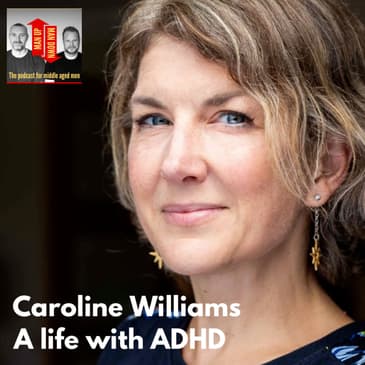
Caroline Williams is a medical journalist, who has written for a range of mainstream publications and medical journals, including The Atlantic, the BBC, The Boston Globe, The Guardian, New Scientist and The New York Times.
She is also author of Move!: The New Science of Body Over Mind.
However, David discovered Caroline after reading her article for the New Scientist, What’s behind the recent explosion in ADHD?. Not only was it very well written, but David was able to relate to the story behind the article – where Caroline had been diagnosed as having ADHD in her 40s.
While this led to some lively discussion between David and Caroline, Volker got completely lost as the conversation jumped around so much (which David was certainly unaware of – a great example of the difference between a neurotypical and neurodiverse brain!).
Through her career as a medical writer, writing about focus and concentration, and often finding herself distracted, Caroline realised she might have ADHD herself – receiving an official diagnosis at the tender age of 48.
She was often told at school and by her parents that she was overactive or couldn’t concentrate. Now that we, as a society, started talking more about it, she got more support to look into it.
Caroline went to the New Scientist to write about ADHD. She wanted to investigate whether, as some journalists have claimed, that diagnoses are rocketing due to private diagnosis, where it’s in the organisation’s financial interests. However, Caroline’s research has revealed that we are still under-diagnosing in the UK.
Volker still doesn’t understand ADHD due to lack of experience, but enjoyed David and Caroline having such an animated conversation.
Both Caroline and David just got on with life and what was thrown at them, thinking it was normal that certain things just take a bit longer. Caroline compared it to getting glasses when you suddenly realise that the world you are living in is blurred and that buildings have straight edges. Caroline is now on a test for medication to help her with ADHD.
For both it’s difficult to judge how long a piece of work might take; everyday things like parking and remembering where you parked, can be a challenge. Or supermarket shopping can be challenging too, resulting in increased stress.
They share a lot of tips on how to organise themselves. Whilst Volker is super organised, this adds another level of organisation even for him.
As Caroline points out, don’t beat yourself up for not doing everything 100%. It’s ok that there are things that might not work every time, and that‘s ok. Accepting your brain is different to a neurotypical person.
There is also a quicker route to get an ADHD diagnosis. Go to your GP and ask for a referral under the NHS right to choose.
And if you want to get in touch with Caroline please reach out to her or want to read or buy her books, please visit www.carolinewilliams.net or follow her on Instagram @carolinewilliams_science
Hosted on Acast. See acast.com/privacy for more information.
[00:00:00] Welcome to the Man Up, Man Down podcast presented by Volker Beluda and David Pausey.
[00:00:12] We discuss the pressures and challenges faced by men approaching middle age that we're
[00:00:16] often too embarrassed to speak about with our friends.
[00:00:20] You can find us online at www.manupdown.com. stalking. I tracked down the author Caroline, but Caroline's been writing for new scientists, telegraph, BBC, Guardian, Boston Globe, a number of publications for quite a long time. So, well, welcome to the podcast Caroline. Thanks for joining us. Thank you very much. Thanks for having me. Thank you to CyberStalking, mate. It's all good.
[00:01:43] It's chosen that my social presence is actually worthwhile.
[00:02:44] which is something we might come back to in terms of focus and hyper-focus.
[00:02:49] But yeah, I mean, you know, as I say, like you see, like you can take very complex topics and break them down.
[00:02:52] And so well, but and I'm jumping all over the place.
[00:02:56] But and we're talking about ADHD.
[00:02:59] Well, you've recently had ADHD diagnosis yourself, haven't you, Caroline?
[00:03:03] I have.
[00:03:04] Yeah.
[00:03:05] So I'm kind of more aware.
[00:04:06] good starter there. I'm not going to ask how old you are, but I think we are. 48.
[00:04:07] So we are at a similar age. I think at the risk of glowing my own trumpet, I struggled
[00:04:17] to focus at school, but I was a relatively good student. I wasn focus in some lessons. If I had to write notes, I'd make sure I'd write down every single word that teacher said, and that's the way I kind of kept my brain on task. So you wouldn't have spotted it at school. I got kind of pretty good grades. I apart from my report say she was chatty, she's too easily distracted by her mates. But apart from that, it wouldn't show up necessarily.
[00:06:41] I know, Vogue is looking shot. You should.
[00:06:42] I think looking back, I'm like, what?
[00:06:43] That wasn't a nice thing to say.
[00:06:45] But like, he basically was like, well, you're really bright.
[00:06:48] Why are you so stupid?
[00:06:49] You know, it's that kind of thing.
[00:06:51] Like you can be really clever and still be a space cadet.
[00:06:55] I mean, yeah, I sort of, the way that I often look at it
[00:06:58] is like, you know, it's like being the fastest sprinter
[00:07:02] in the world, but not having no sense of direction.
[00:07:05] So, you know, it is like.
[00:07:07] And the bricks at work, right?
[00:07:08] Yeah. because there's so many people talking about it. And then people said to me, well, you can't have ADHD because that's just a fad and everyone's a little bit ADHD, aren't they? And at that point, I sort of lost my kind of, lost my rag, really, and said, OK, I need to look at the science to see, you know, where are these all coming from? Does everyone have ADHD? Or how have we got it all wrong?
[00:08:22] You know, are these people trying to encroach
[00:08:24] on other people's territory?
[00:08:25] And or are we over-diagnosing? I thought, hang on a minute. I want to know what's going on with me. I want to know what's going on in society. And, you know, so I want to look into the science because that's what I do. That's how I make sense of the world. And that's how I make a lifting. So I mean, can you sort of briefly give the answers to those questions that you were posing? I mean, I think, you know, as you say, it's that thing with lots of things, it, you know, it's like, well, is it, is it a trend?
[00:10:44] criteria, you would expect from these studies, and these have been done all over the world, and the numbers come out the same, you would expect around 5% of children and around 3%
[00:10:51] of adults to meet the criteria for ADHD.
[00:10:54] So then the question is, okay, well let's look at how many people are actually being
[00:10:57] diagnosed, and we can see whether we're over-diagnosing or under-diagnosing.
[00:11:01] And as you might expect, in the US, where, we are hugely under-diagnosing. There's all these cases are coming through, and it's because there's this awareness, people are going, oh, that's me, and then coming forward for testing, and elsewhere it might be going further, and there's complications involved in that. In the UK, we also have private clinics,
[00:12:21] and so you could argue that people are being done too quickly.
[00:12:25] That's one of the concerns of some of the scientists I spoke to,
[00:12:27] the people are being churn of nowhere and they've been completely functioning adults and doing fine and suddenly they've got ADHD and want to help. A lot of people have already been to their doctor and said, I'm struggling. I can't do this. I can't do that. And they've been diagnosed
[00:13:42] with anxiety or depression and sent away with antidepressants or told to go and do some But yeah, to watch you to having a conversation, it's fascinating. You know, it's just listening to the way you talk. It's great. You know, I mean, I'm used to David, right? So yeah, well, this is it. It's so funny. I've got, I'm speaking to a radio producer on Monday and he had an initial phone call.
[00:15:00] He's also got ADHD and diagnosed in his 50s and he phoned up.
[00:15:03] Anyway, we just had this conversation and even I, by the end of it was like,
[00:15:07] that was intense because we were both jamming. I either need to go back to bed for an hour and try later, or I need to go for a walk and get myself in a different state. I'd always need to give up for the day and remember that I can do it twice as fast tomorrow if I'm in the right frame of mind. So it's kind of like understanding yourself. And then you can say to other people around you who might be rolling their eyes and go while you like this, you can say, well, that's, you know, it's a neurodiversity thing, sorry.
[00:16:23] I mean, how you, well, as well, I think what Volker,
[00:16:26] when he sort of said or managing your energy levels. And again, you know, that thing of going to the doctor of depression or anxiety. And, you know, I think as you say, it's sort of, there is a lot more attention in the media than it is that, you know, you read I was listening to an episode of the one new feed. Oh, yes. Yeah. And the guest on there was a guy called Eric Tivers, I think, but he was talking about ADHD. And the moment that really clicked for me was he said, when, you know, when he
[00:19:02] tried medication, he said, for the first time I was able to read a page on a book
[00:19:07] and remember what I first got contact lenses. I used to wear glasses in class to see the board. And then I went, you know, when I was 18 and I went to get my contact lens and I walked out the opticians and I was like, trees have leaves. People across the road have faces. Like, and it was a completely new experience to me.
[00:20:21] Buildings have straight edges, you know, and everything was had been a bit fuzzy.
[00:20:25] And I can't, I can't vouch addictive drugs. We mustn't let these people become addicted. And if they have ADHD, the chances are that they're not going to be taking them because they'll forget anyway. And it's
[00:21:42] very low doses. And you know, as prescribed stuff to do and it's actually interesting stuff, but you cannot get your brain and gear to do it. And that's the kind of days when it's really a game changer thing. Because one of the biggest things for me work-wise is that I can be doing, you know, an article
[00:23:00] and then someone will come in or contact me and say,
[00:23:03] oh, can you do me a quick turnaround piece
[00:23:05] for tomorrow at four o'clock? budget and needs are expertly matched with just the right person. If you didn't already know, success in therapy is down to making a great match with your consular and the people at Well-Doing really know how to make that happen. Plus, they have loads of stories, videos and interviews to support your mental health.
[00:24:20] Take a look at Well-Doing.org.
[00:25:20] and they're doing something, they don't know how long it's taking.
[00:25:21] So my blind spot is like a 10 minute,
[00:25:24] if I'm cooking something,
[00:25:26] unless I set a timer,
[00:25:28] there's absolutely no way I'll go back in 10 minutes
[00:25:31] and check whether that's cooked or not,
[00:25:32] absolutely no way, I've boiled so many things dry.
[00:25:35] I can't do complicated recipes
[00:25:37] because there aren't enough timers in the world
[00:25:39] to keep me on track of it
[00:25:40] so that if it's got too many moving parts,
[00:25:42] it has to be like, put that in, take it out of this time,
[00:25:44] put it back in, add another ingredient, boom.
[00:25:47] And so there's this kind of understanding So it's really difficult. I mean, that's what I meant in terms of taking three weeks in that you'll make a great start. Oh, well, and as you say, then something else comes in, you're like, oh, well, I'll quickly do that. Then they'll come back to it. And then a week passes you're like, Oh my God, I've been carried on with that. But yes, I mean, sort of let's sort of talk a bit more about sort of symptoms because,
[00:27:02] you know, you sort of or not as the case may be. So I always park in the same row in the supermarket always. So I know, I don't know where it is on that row, but I know it's in that row somewhere. And I get very cross if that whole row is completely taken up because I'll be like, oh damn, I'm going to find out what the bloody car is. Yeah.
[00:28:20] What if you go to a new car park?
[00:28:22] I park as close to the door as possible.
[00:28:24] But you know, thank goodness nowadays you've do. So I set off on this sort of quest to go round the world and say, okay, can you improve my skills on this, this, this, this, and this, and throw the best science you've got at me? And the things I chose were sustained attention, anxiety, creativity, perception of time,
[00:29:43] and number skills.
[00:29:46] And all of those things,
[00:29:48] this is way before my diagnosis, and just absent money crossing something off or crossing the wrong thing off. So just little things like that. It doesn't sound like much and people can think, oh you're making a big fuss. But it can make life really stressful because you're like, where's the car? Or do I forget, get home? Ah, I forgot the chicken and you're back down to supermarket again and it can just make life a lot harder than it needs to be.
[00:31:00] I mean, you know, and I think that's the know that there's a reason for these things and you understand yourself a bit better and then you can sort of not beat yourself up, not have this constant internal chat up. I forgot to say you're such an idiot, you know, all the time because negative self talk is really bad for your mental health. I mean, well, again, there's a couple of things you've hit there, a shopping list. I put it on my phone and I have on my notes on my phone. You can put it so it has little blobs that you tick. When you've ticked them off, I do that. I just check it. I also, I was called out by my neighbor for potentially being really rude because I'm so focused when I'm shopping. There's no time for chit chat.
[00:33:41] My neighbor came over to me and said,
[00:33:43] are you ignoring me for a reason?
[00:33:45] I was like, no, I'm just,
[00:33:46] he said are you genuinely focusing that hard on crisps? ADHD, right? Because I, you know, and anything is out of place. It drives me nuts. It got better over the years. I've got more relaxed about it. Let's say someone grabs the pair of scissors out of my drawer, which is absolutely fine as they need to pay off scissors. But don't give it back. I hate that. If I, you know, it has to be in the top drawer. And if it's not there, it drives me potty. So I'd rather buy my wife a new pair of scissors if she needed one
[00:35:03] than hers using mine.
[00:35:04] And this is not because I'm possessive because I've got my stuff.
[00:35:07] Yeah. If I need one, I want it to be here, right?
[00:36:03] Well, this stuff isn't dirty, but it's not clean either. So I can't put it back in the cupboard and it's not ready to go in the basket.
[00:36:06] And they were like, yeah.
[00:36:08] So what I did, I got myself two extra baskets because I've identified that there are two
[00:36:12] different categories of clothing.
[00:36:14] One is the dog walking clothes, which can be worn all weekend, even if they're a bit
[00:36:18] dirty.
[00:36:19] And some of the just, you know, I'll get another day out of that jumper.
[00:36:21] So I now have two baskets under my bed.
[00:36:23] I put the kind of cleanish clothes under things over the years that I've bought to try and organize myself. And yeah. And, you know, again, it's sort of almost like the story of my life. You know, the first week go in there with great intentions and bang on it.
[00:37:44] And then, you know, it's almost like it doesn't take much.
[00:38:47] Things that help whatever they may be even if they change because then that frees up your mental bandwidth for the stuff that you you do want to be doing
[00:38:54] Yeah, I've forgotten that second I've remembered I've remembered that second point that I forgot
[00:38:55] Excellent gone. I hear it It was just coming back to that like you were saying about your stepdad's comment
[00:39:00] You know if you had a brain you'd be no, as long as I'm up by six, I'll be fine. I have to literally, and then I have to refer to it multiple times.
[00:40:21] Otherwise I'm stressed about what time I need to leave.
[00:40:23] So, whereas before I used to think I'm stupid,
[00:40:27] I can't remember that,
[00:40:27] I will now just write it down and just refer to it that doesn't also fall under totally normal human behavior. So it's not about, you know, if you have these symptoms, or if you've experienced these behaviors and these things that that automatically means you have it, it's about the impact. So you have to, to get the diagnosis, you have to have five or six symptoms
[00:41:40] that have been there since childhood
[00:41:43] and they have to be mild to moderate.
[00:41:45] So they have to affect your life enough could have taught for hours about this, but we are pretty much coming to the end of the episode. I mean, if to sort of perhaps summarize, so I guess your advice would be, you know, if there are things that are bothering you, go and get a diagnosis, sorry, what's- Or at least try. Well, yeah, sorry. It's not easy. What's the six month route again?
[00:43:02] It's called NHS Right to Choose. And I think yeah. And if people want to find more of your articles or buy some of your books. Oh yes, they can very well conspire my all my books yes. So my websites caroline williams.net so there's links to articles on there and yeah you can
[00:44:22] find me on Instagram Caroline Williams underscore science. Brilliant. I would to listen to these rumblings, please click here. Yeah, so I hope it's helpful to some people because it, you know, we joke about it, but it's a real pain in the neck and, you know, to have to struggle with everyday stuff that you're supposed to be able to do as an adult. Am I a terrible adult or do I have ADHD? Discuss. But that could be the title of your next book. Yeah, well, I've got another one
[00:45:43] in the book. Well, you can often say yes, you're a terrible adult. Yes, you're a terrible adult. Move