Another first for Man Up / Man Down. Our first returning guest.
Andy Delderfield runs the Alcohol Free Runners Facebook community and also coaches those interested in the alcohol-free lifestyle, but need one-to-one support.
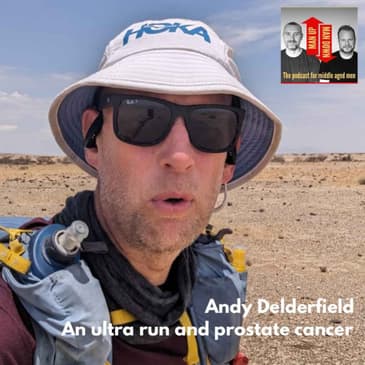
Andy came on the podcast last year to tell is about his amazing transformation from booze-guzzling rugby fanatic to alcohol-free (4 years and counting), vegan, ultra runner.
Sadly, at the time, Andy had also been recently diagnosed with prostate cancer. But rather than taking it easy, while receiving intensive treatment, Andy decided to enter a 250km multi-day, ultra event. Running across the Namibia desert.
Andy explained that it had been an eventful year, and that it had only been two weeks since his diagnosis when we recorded the first interview, so he had still been processing the diagnosis.
Andy spoke about the range of emotions that he’d felt at the diagnosis: fear and uncertainty; confusion anger.
He said one of the issues was that he’d gone for a check up to see precisely how healthy he was after many years of “clean living.”
As expected, his blood pressure, cholesterol and all other health indicators were fine. However, the tests revealed the possibility of prostate cancer, which proved to be correct.
Andy said that men do need to be a lot more proactive about getting screened, particularly as men don’t visit the doctor as much as women; for a variety of reasons.
However, he said his experience as a Positive Psychology Coach helped him through – sticking to the advice he’d give to his clients when they’re overwhelmed.
This was to “control the controllable.” Obviously, he couldn’t control what was going on in his body lots and lots of different emotions that kind of came through um when I got that diagnosis. But he could control how he reacted.
Andy said he was overwhelmed with information, which goes into a lot of worst-case scenarios. Essentially, he was left with two options – have the prostate removed (which would require invasive surgery) or targeted radiotherapy.
While the radiotherapy had its own side effects, this was the option Andy went for – mainly because he’d already entered the Desert Ultra and didn’t want his treatment to rule him out!
Andy then told us about the Desert Ultra. Despite training in Spain (where he lives), Andy said the heat impacted him more than he was expecting and thought he might have to give up mere kilometres into the race.
He said that the negative thoughts entered his head – that he shouldn’t be there, that he didn’t deserve to be there.
Thankfully, after intense rehydration, Andy got past that first check post and completed the race.
To hear the full account of Andy’s hugely inspiring battle against cancer and the blistering heat, check out the episode.
He is also raising money for Prostate Cancer UK, so please donate here.
You can also see his brutally honest video diaries in his Facebook group and Instagram account.
Hosted on Acast. See acast.com/privacy for more information.
[00:00:00] Welcome to the Man Up, Man Down podcast presented by folk of Beluta and David Pausey.
[00:00:12] We discuss the pressures and challenges faced by men approaching middle age that we're
[00:00:16] often too embarrassed to speak about with our friends.
[00:00:20] You can find us online at www.manupdown.com. Most amazingly, he's just completed a multi-day ultra marathon event in the desert. So thanks so much for coming back, Andy. Welcome back for me as well and congratulations on the latest achievement, which we've got to talk about, right? Bit of running in the sun, right? Just a little bit. No, well, thank you for having me back.
[00:01:40] I didn't realise I was the first person to have a second appearance here.
[00:01:43] So that's was to start to control the controllables. I couldn't control what was going on in my body. I couldn't do anything about that and stop that from happening. I'd already made some massive
[00:03:04] decisions in my life with giving a alcohol, going plant-based. And really, it was to feed my ego a bit, and it was like, as I do enough alcohol, I'd gone plant-based. I just wanted to be told that I was in amazing form, an amazing shape. And to be fair, that was the general diagnosis, that I was pretty damn good. I was, yeah, yeah, good weight, healthy, hard good,
[00:04:20] all the things, all my levels kind of calcium,
[00:04:23] to cholesterol, and all those things,
[00:04:25] we'll spot on.
[00:04:26] But as a result of it things were going to have to be turned to the sideline and not happen. And with research, I find out they were by the options and radiotherapy was one of those with a very similar success rate. So I went down that route and I mean, you sort of mentioned about how, as you say, like with women, there is sort of, you know, for one of the better word, various touch points.
[00:07:01] And I guess, you know, that is to do with the fact that, you know, they have a menstrual
[00:07:04] cycle, but obviously cervical snares. been 11 years old. It's like, well, how much would they learn about that age? And I forgot the second point that I was going to pick up on. Oh, I know what it was. It was the, you sort of said about the controllables and the information. And I know that, from our we in bladder prostate, sexual functionality is all kind of covered within that category. And there that field there is very much removed your prostate as in that that was their opinion. And then you've got the oncologists, which then deal with the this don't get it in their late forties, they get it in their early seventies. So clearly in conscience is something as men we're going to have to deal with as we get older anyway potentially. So the stats were also skewed by this age factor and I wasn't the norm. So it was very difficult to get a clear understanding of what the potential was. But the other side
[00:11:03] was erectile ductus dysfunctionality. If they's corollary enough and all those things, as if it's done, it's cleanly done. Both gave me the same outcome. What the long term outcome obviously is, I don't really know, and that's the problem, is I don't know what the 10 year, 15, 20 year is, because that information doesn't seem
[00:12:21] to be available.
[00:12:22] That was quite difficult.
[00:12:23] But equally, if I had the prostate removed, which was mid-October. Then I decided to run across the N in November. I just completed that in the last... Listen, a week ago, I was doing it this time
[00:13:43] last week, wasn't I? Yeah, so planning. So saying, when can we do it? What's it going to look like? And all those things in getting that information. And I explained to her that what I wanted to do and then could I do it?
[00:15:03] Was it possible to do it? the knock on us thanks were minimal. And I was able to have my, I've got a coach, someone called Claire McCaskill that I work with. And we basically sat down and was like, let's just plan it as if this isn't happening. Let's just have the plan as if the treatment isn't happening. Clearly we've got to work out that, yes, I need to get to a peak in my training
[00:16:21] before I had the radiative therapy in case I wasn't until the last, I suppose, week of the radiotherapy that I started getting some side effects. That was mainly just annoying. I was going A for a run and I have to pee every kilometer because the pressure of it changed. That just pissed me off more than anything. It wasn't that it was painful. It was just exactly. Often I would then feel the need to pee, but then couldn't we. So there wasn't anything really
[00:17:44] to come out. So it's just that kind of feeling. and I did the marathon there. Yeah, I think we kind of said I was in the vogue of I could get near four hours. That would be amazing. My PB is three hours 33. So it was kind of, we used it as a training one towards Africa. But I tweaked a little bit going into it. I was meant to have done some
[00:19:01] back-to-back runs going in and I decided to take a little bit more into it. And I managed to run lost Andy. Lost yes I have. Yeah. Yeah with the you know lock by basically he's a character for people that watch as much TV as me basically like a plane crashes on an island and lots of weird stuff happens but basically one of the passengers is in a wheelchair which you find out sort of use a marathon as a training, training, we're talking distance. So fill us in. Yeah, when it's a multi day, supported ultra event across the desert in Namibia, in the Namid desert, the oldest desert in
[00:21:42] the world. And yeah, I did this epic, which they called the grind on day five, which was 92 kilometers. And based on it, I only ever moved my body to 64 kilometers in a day before that, which was on the ice. And in my training, I got, I think I did 350 K runs
[00:23:00] in my training building up to this. There was a huge amount of unknown about ever, as of about 47-48 and on three occasions went into the late 50s and it wasn't just for a short period that it got into those temperatures. It kind of would build and build and build through the day and get to about half-12 and just suddenly it would just go bang and then would be like that for a good three to four hours that you were battling in those temperatures and what it does
[00:24:21] to your body is just unreal. It's fairly scary.
[00:25:24] As in, it was a real, there was a real shock on day one, to be honest.
[00:25:25] So if I go into a little bit of detail of whatever happened,
[00:25:28] is that we'd obviously as a group,
[00:25:30] there was only 28 runners, so it was a very small field
[00:25:33] as well, which that scared me in itself,
[00:25:35] because there was just no way to hide.
[00:25:36] There was no way to kind of just pretend you weren't there.
[00:25:39] It was, you were one of those 28.
[00:25:41] And I had no idea of what, as an asset race,
[00:25:46] did I go into as a race?
[00:25:47] Yeah, that's an what was happening to me. I ran the first 14 kilometers fairly hard, which was a mistake. Just because of the excitement, the adrenaline, and it was a bit cooler. We started at 7.30 in the morning, went through checkpoint one really quickly.
[00:27:01] Yeah, it probably didn't stop there to get a bit of energy back.
[00:27:06] And then that was a 14K by 6. And by the time I got to chat points to you, I remember being so angry and just so upset that this was it. I wasn't going to continue any further. I literally ripped my backpack, heavy backpack. I was carrying 13 kilos on my back, which was heavy in comparison to other people, just because I really didn't want to cut the food because I have to carry all my food for five
[00:28:22] days.
[00:28:23] So in my pack, I've got my sleeping bag.
[00:28:25] I've got a self-sufficient race. They'll tell you what kit to take, but they don't necessarily guide you in huge detail of how to use that kit. We were told to hydrate, we were told to take salt tablets and that we needed that, but they didn't tell us how many, how often. It was very much for us to learn how our bodies,
[00:29:40] and they were very much, everyone is different.
[00:29:42] So we can't tell you.
[00:29:43] But 20 kilometers in, I got up,
[00:29:45] we get that rude awakening and realized that, yeah, in that happening. So how could I run? I need to change my complete expectations of this. And suddenly the goal was just literally to get one checkpoint at a time. And that's what it became about. It was mad. You've touched on a few things there, primarily how a 4-5K run in one set of conditions is
[00:31:04] completely different. For my humble break, I'm going to run with you because we didn't know each other's abilities, especially at the start. It seems very much all, you know, you go out on your own and then find your place within the field. But as in, yeah, I think on the first day, I was on my own day of the change of what it looked like, I suppose to me, that I had to change my expectations around it. I did believe that part of it was connecting with other people as well and sharing my story. So I was very open, very vulnerable,
[00:33:42] shared about the fact that I'd only how much will the dehydration go exactly exactly exactly. The medics did say to me, how have you still got tears 20%, you're only using 20%, Goggins reminds us, we are always in that 20%, I've got 80% more to give, run, you can run, you're shanging at myself, you're walking, you've And do you know what? That set me up amazingly for the last day because it suddenly made me believe that I could do it and change my mindset. So when the alarms went off at 2am on Saturday morning, last Saturday with a start at 4am in the morning, it was going to be cool for the first however many hours
[00:37:42] and I just went for it. I ran 35k on the last's like it's chasing you. Yeah, it is run by the Rangers which you look after the game reserves in Kenya to stop the poachers and they actually run it and they line the route and you've got a helicopter a plane flying over you. They moved the obviously the dangerous animals away. It's from
[00:39:02] Dust Hill Dawn. I don't don't or dusk so on the experience. And I think I think we talk about this. We live in a very materialistic world, but experiences of what we remember. We don't remember the nice car. We don't necessarily need the big oat. But the experiences of what we take on and what we're remembered for hopefully and the legacy that we leave behind us. And I think this is what for me is very much about is about
[00:40:23] inspiring other people, not to run across deserts to inspire people to get their trainers when you're not, you've been through, your body's been through so much. Yeah. How, I mean, how did they feel? And also, I mean, did you tell them about sort of day one, how, you know, what happened? I mean, we were basically in a, it was a digital detox.
[00:41:40] So we had no internet.
[00:41:41] So I wasn't able to contact anyone
[00:41:43] for the duration of the race. up afterwards. So when I came back into civilization, I picked up this message and she was devastated because she thought I dropped out because the information they were getting as well wasn't clear. So yeah, so from their side, it's really scary. And I do understand that. But I think, do you know what? It's a bit like, I think we talk about it with being alcohol-free, isn't there? There's there's there's there's positives that we perceive of drinking. The when we give up drinking, we kind of,
[00:44:05] But all that pain and all that difficulty is just eclipsed by the achievement of what I've done and hopefully they're beginning to see that this isn't just about me feeding
[00:44:12] my ego.
[00:44:13] This is about me inspiring other people and to be their light-hakes and just show what's
[00:44:19] possible.
[00:44:20] I am a normal guy, whatever you will think.
[00:44:21] As a whoever, I can kind of look at the outside.
[00:44:24] I am just a normal guy. dip afterwards and you hit away almost like and yeah you I don't know whether that's because we're interviewing you so fresh off it but you don't seem to be in that place no you know you're sort of you know and and yeah you know you're
[00:45:40] still sort of I don't know you've seen rejuvenated whereas last time it was Yeah, well, of course, our free runners that we started back in May 2022. So it's still very much in us early days and clearly with everything I've had going on this year has probably out to be put slightly on the bat burners. But what I've been able to do with it is it's a free community. It's always going to be free. I think we've changed my mind on this a few times, but the main community is going to
[00:47:03] be a free of it. And you're trying to feel that running for me is the, yeah, this is the gold kind of stamp of the two things coming together for me is that that is what gives me my superpowers. So it's a space for that. It's a space where you can
[00:48:24] just come in and sit in the background and not of providing group coaching towards 10k, half marathons and marathons, which is slowly building. We just started a 10k group, just had the Zoom initial Zoom last week.
[00:49:40] And they're going to be building towards a 10k towards the end of January.
[00:49:44] So the idea of that is to And everyone who's kind of likewise just described, welcome to come into the community. Amazing. So if you're a New York marathon package,
[00:51:04] let me know. Yeah, okay. Still on my bucket list. do, something about is really scary, but you'd much prefer to be in a situation where you're in control of it rather than it being in control of you. So yeah. And we put all that in the show notes as well. So anyone who wants to donate and should donate, so I should donate. So a simple one. Thank you.
[00:52:20] But I mean, you know, well, we'll have to hook up either in London or Amsterdam or New York, wherever, thanks very much. Wow, thank you.
[00:53:44] Thanks for listening to this week's episode.