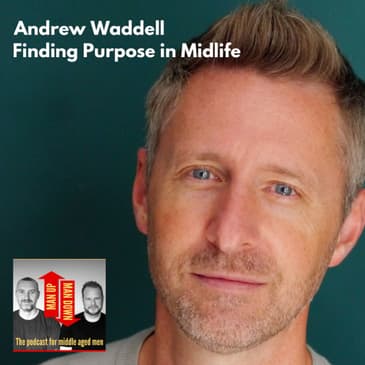
After 20 years in advertising agencies working with lots of well known, and highly demanding, brands, Andrew suffered severe burnout. Andrew re-found his direction and purpose in life through therapy and coaching. This resulted in him leaving the corporate world, taking a Masters in Organisational Psychology and qualifying as an Associate Certified Coach with the ICF.
From there he set up The Midlife Coach focusing on supporting men struggling or stuck in midlife. For the past three years he's worked with a wide range of midlife men. This includes those on the verge of depression, desperate to rediscover the joy in life, to energetic self-starters looking to build their own meaningful legacy through work and family - and everything in between.
They come from all backgrounds and professions with very different needs and goals. What unites them is that they have reached the realisation that they are stuck in a rut and cannot break out of it alone.
Andrew speaks about his background in advertising which led to a breakdown, with him crying on the kitchen floor, going through therapy, dealing with grief and eventually discovering what he wanted to do as a new career.
He said that the main takeaway is The massive learning was that he could change his life. Comparing life to a swimming pool, he says you cannot change where you jump in, but you can swim down the lane and change direction.
He set up his own coaching business in order to help people changing their life. Our generation starts figuring out what the term ‚being a dad actually means. Our fathers didn‘t show emotions or spoke about what they wanted in life necessarily. As a result our generation is figuring out what it really means to be a dad that is in touch with our emotions – learnings that we can pass on to our children to be better parents than we were.
We discuss legacy and how even organisations today try to be more ‘wholesome‘ and make a difference. That legacy seems to be a common theme in middle aged men.
We also discussed how there is a trade between any role that we take up – if we want to spend more time with our children, that might require a financial sacrifice. However, if we’re working all the time, to provide a better life for our family, that means we might not necessarily see them.
It‘s not only about balance in life but more about having control and being choiceful of what we want to do with our time. However, it‘s about making a conscious choice rather than compromising.
Burnout, according to Andrew, comes from reactivity and losing that control in life.
David quotes Benjamin Disraeli, that: “Action may not always bring happiness; but there is no happiness without action.”
As Andrew says, we shouldn‘t feel regret of things we did in life, and we shouldn‘t be paralysed by our dreams. In coaching he can utilise his experience and help others to get unstuck, and understand mid life. Mid Life is about making decisions and taking control back in your life. And often, time is all kids need from us.
You can find Andrew as the Midlife Coach on Facebook, LinkedIn or www.midlife-coach.co.uk
Hosted on Acast. See acast.com/privacy for more information.
[00:00:00] Welcome to the Man Up, Man Down podcast presented by folk of Beluta and David Pausing.
[00:00:12] We discuss the pressures and challenges faced by men approaching middle age that we're
[00:00:16] often too embarrassed to speak about with our friends.
[00:00:20] You can find us online at www.manupdown.com. life. So, a topic is Zilissa's law very close to our hearts. So, for the past three years, he's been working with the right range of middle life, midlife men, from those on the verge of depression, desperate to rediscover the joy in life, to energetic self-starters looking to build their own meaningful legacy through work and family, and everything in between. So, they come
[00:01:42] from all different backgrounds and professions with very different needs and goals. What unites but I don't want to take any further away. So tell us about your story. Yeah, so well firstly, thanks to everyone on the podcast. We're really pleased to be meeting you guys. So yeah, I mean, the world of advertising, as everyone will know, is there's a lot of smoke and mirrors to it. There's a lot of glamour in sort of inverted commas. And I guess, you know,
[00:03:00] 20 years, I'm right, that's certainly enjoyed a lot of it. I loved the agency worlds. It was
[00:03:04] great fun. There was lots of energy access to, I think, in the agency world, to what they can and can't solve. I guess I just got sick of the BS. I got sick of not being authentic. But in truth, what happened in the end was just to burn out. It was a
[00:04:22] classic midlife experience. It was a combination was a massive advocate of therapy, not because I had any big trauma in my life, but just because I don't think I had the tools to deal with my life
[00:05:44] and to recognize who I was. in swim lanes, that's your lived experience. That's all of the influence around you. That's all of the sensible austerity, all your self-limiting beliefs. Everything is driving you into that single lane. And midlife is being half way down the pool and looking around and going, shit, there's a massive pool here. There's a massive pool and I seem to be on a linear journey
[00:07:02] from my childhood to my death and it's just, it off with the people around us. So that was really fascinating. And then I got into coaching and just from there I think realized that I found my North Star and also, you know, something that was genuinely going to help people and felt that I had a societal value, felt
[00:08:23] that somewhere I could be both good at but get something out of. And that's mind sort of talk about your story and then, you know, perhaps speak more generally. But, I mean, you said that, you know, you felt that you weren't doing well in anything at work, you know, well, whether that was like as a leader, as, yeah, and it was utterly kind of... it wasn't a position that I had to do it. It was, you know, some of it, I'd go out to it. So it wasn't a lack of compassion on her side at all. It was, I took it on because I thought that's how I would deal with it.
[00:11:02] I mean, my dad died six months ago and, you know, I think the fact certain age and they don't need you as much. Yeah. Yeah. I mean, I think the other thing that I picked up on was, you know, you sort of talked about your legacy and, and I think that is something, I mean, it's something that I've talked about in therapy quite a bit. You know, it is sort of, yeah, how, how do I sort of leave a mark?
[00:12:20] And, you know, and, and does that need to be a physical thing?
[00:12:23] Or, you know, can that be how you bring your children up?
[00:12:27] But, yeah, I mean, he talked about his idea of, I think he was asked, whether he's pointing this sort of questions in an interview, are you a good dad? And he was just like, well, I'm both a brilliant dad and a terrible dad. And the reason for that is our generation of dads
[00:13:40] are trying to figure out what being a dad means
[00:13:43] for the first time.
[00:13:44] You know, we around love and support and there was no anger expressed. It was just an absence of emotion So the fact that dads are now trying to define a role that has an emotionality to it But struggling with it. That's okay because we're the ones who are trying to do that And we don't have the role models to to necessarily leave back up So I hope I've got two sons that our sons result will be better dads even though we are because this is the this is the nature of the beast
[00:15:04] So but that that was isn't the limit in the limit is based the limitless are those people who are
[00:16:04] will send it on that journey. So they're kind of the two sides of think that I see
[00:16:10] in that midlife experience right now. I think I've fallen to the letter camp, I have to say. So we sort of wanted to talk about my duties as well, my experience.
[00:16:16] My last foot on job was actually with an agency. Yeah, I probably shouldn't say
[00:16:21] all the podcasts, what happened. But there was't compare ourselves to others anyway, that's probably a different topic. But I sometimes find I'm 46 now. So when I turned 40, I mean, who listens to us regularly, David and I,
[00:17:40] I think it wasn't the kickoff episode for the podcast. We talked well, I kind of got rid of the burden in terms of expectations. So, you know, this podcast is actually very timely because my parents were here this weekend. And we discussed a couple of things that my kids might want to do. And one of the things was like, but he can't earn a lot of money with that. And I'm like, there it starts again, right?
[00:19:00] You know, what I went through, that it was all about money in my career,
[00:19:04] which I realized at 46, I should have not listened to my I think it's brilliant because it sums it up, right? We get so much stuff preload us from our parents and then you rightly said, and then I stopped my last point. When we get to midlife, we realize we don't want to fuck up our children. We actually want to be better than our parents' generation. I'm not saying everyone got fucked up, but a lot of us did.
[00:20:23] So yeah, is that why we get into midlife crisis?
[00:20:25] Is it halfway?
[00:20:26] I think it's clarn was 28. My oldest clarn was 67. And I would say that both of those people with a midlife mindset and what I mean by
[00:21:41] that, I think for me, it's not, it's not about midlife in terms of a moment
[00:21:44] of ties.
[00:21:44] It's a mindset of reflection of is I've got a fun amount of time and I want to feel at the end of it. Whenever I am on my deathbed, whenever the age is, I want to be able to go back and feel like that I had value, that I am part of the value somewhere in this world. That was a point to it.
[00:23:00] And so I think that idea of the middle of crisis, I think, though, is a really unfortunate
[00:23:06] term.
[00:23:07] And one that I try not to use, I try not to's about the next generation, nurturing the next generation. And it gets mistaken for parenthood, because often it comes at a similar time, it was lives. But actually, in people who don't have kids is also present. As a moment you move from the narcissism of being young, of being 20, whenever you just want everything to serve your needs. And this realization that actually you
[00:24:20] have the benefit, you have the ability to give back and to
[00:24:23] make things better for next generations. And for me, that's
[00:24:26] what midlife is, is all about, you know, really, you know, an imperative for organizations in the future is how do we, how do we allow people to bring their wholeness to work? So I think, you know, legacy is an interesting one, because absolutely that's part of it. And it's different for different people. I guess one of the challenges I have around legacy in me, coaching classes, Austin. And I don't know if it's a social construct
[00:25:43] or it's to, or it's an output of humanity, you know, why just stop with our kids. Med Up, Mendon is sponsored by Well Doing. It's a great platform for finding a therapist or counselor. They only accept verified professionals if they does it actually want to do? I earn money in a certain way, I guess there's other ways, probably nice to earn money from speaking to interesting people like you. And I look at my friends who I think
[00:28:20] well if I hadn't sort of become a stay at lot about, you know, it's a phrase that one of my clients used to use, which I hated and I now use it, which is one of my own corporate clients back in advertising days, which is his word, choicefulness, which is not a real word at all. But I like this idea of being choiceful about what we're doing. And I think a lot of midlife is around compromise. And a lot of the stuck people have the stuckness
[00:29:45] is because they feel like they are just reacting to external agendas. between everything. And that is a place of helplessness. And look, you know, a place of self judgment as well. I mean, I sort of, well, yeah, kind of went through exactly what you're talking about in the, you know, I'm like, well, my social life effectively revolves around
[00:31:00] taking my son to football.
[00:31:02] You know, and I'm like, well, there was,
[00:31:04] there was just like one Saturday where
[00:31:06] I was sort of sitting in actually, well, yeah, recognizing when it's time to change lanes, I guess, is, you know, and that. And I think again, you know, it sort of, it doesn't necessarily have to be quitting your job, and, you know, starting up a, you know, like an art to say in all bakery, you know, it'd be sort of relatively small changes.
[00:32:24] Um, I mean, it reminds me of the, in the last stages of my therapy, when I was kind of in a much more forward facing sort of positive, very mind. And I loved the process of therapy, but I'd be fascinated by it. And I remember saying, I think I would be a therapist. I think maybe that's my future as a trainer to the therapist.
[00:33:42] And she said, you absolutely, that may be where you go,
[00:33:45] but what about the 20 years experience don't want to look back and I don't regret my time in advertising. I had lots of good experiences. I learnt a lot of stuff and I don't believe for a second I would have got where I got today if I hadn't gone through that process. But I can also see I can take the learnings from it. But I think what regrets is that it's so much again, a mid-life can end up at a backwards-facing regret. That's one of the most things about coaching, which
[00:35:00] is that it tries to take all that learning experience we've got and turn it into stuff
[00:35:04] we can use moving forwards as opposed to kind place where we take the pressure away from having to make a decision like quitting my job tomorrow and training to be a, you know, a hairdresser or something. And it's like, no, okay, what can I just play with? Let me just play with those potential futures. And so we'll create a space in which we, you know, we'll journal it, we'll talk about it, we'll explore it. Like literally, what would it be like? What would a day in the life of me as a hairdresser look like? What am
[00:36:23] I want my interactions? What am I getting out of it? Where's the energy in it? Am I getting
[00:36:27] energy from it? Is it drink? What's the morning as well. I read somewhere, I think someone just got diagnosed with cancer and has two months left and he says, it's not what we, you know, we don't regret what we did. We regret what we didn't do. Yeah. Right. So, so if you always wanted to get the sports car, right?
[00:37:41] Like, like one of the reasons I got it was because I wanted to have it
[00:37:45] for years and years and years and that had financials because I had a really industries that pay really, really well, right? And probably too well in my opinion. But again, that's a discussion for another time. And you jump into something like, let it be coaching or therapy, right? So once a sudden you have a difference in income, right? And you have the school in Kate, right? At 40, 45, you know, once you have the kids and you have
[00:39:01] the sports car and you have the big cows and you know, you've got to a point where you just lost reality, you lost the sense of your choice, your lifestyle is defining your choices. And we all live to our lifestyle, of course, we do. But I think then the next conversation becomes around value. You know, it's like, what is the value of this life for you? And the day to do by, you know, every year is the most important thing, then that's okay. So I'm not, I'm not sitting in judgment of anyone's decisions. But if the obstacle to life of a value that could come from something else, like helping people is being stopped because of these decisions that we do, you have
[00:41:42] control over, you know, it's this sense of being done to you've
[00:41:46] got to get out of this mindset of somehow I have this lifestyle you know, your family will be like, oh, well, it's lovely. The dad's happy, but I want my holiday to buy, you know, it's, yeah, how, how are you? Again, you know, it's that balance, but when, yeah, as you say, when, when there's a group involved, you know, you don't, you know, it's not as simple as, oh, will I be a lot happier being a sheep farmer in Wales
[00:43:02] or a beekeeper? Yeah.
[00:43:04] Yeah.
[00:43:04] You know, is your family.
[00:43:05] I think that's
[00:44:24] one to go out and say about here, people want to find out more about you, do you operate me in your online or certain locations? Yeah, I'm mostly on LinkedIn.
[00:45:41] I've got a lot of content on LinkedIn.
[00:45:43] I know I know, but also under the midlife coach.