
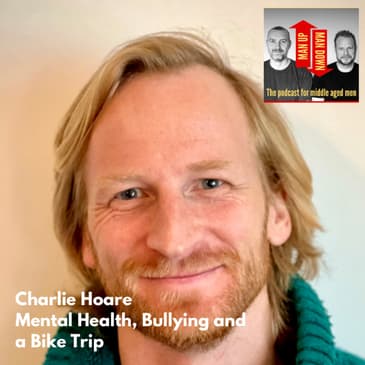
Charlie Hoare – Mental Health, Bullying and a Bike Trip
Man Up / Man DownFebruary 08, 2024x
17
44:5041.07 MB

Charlie Hoare – Mental Health, Bullying and a Bike Trip

In this podcast episode of "Man Up / Man Down," Charlie Hoare, an executive coach and author, discusses his personal journey dealing with anxiety and depression, which inspired his book on male mental health.


Charlie talks about how our parents’ generation had a very different upbringing, with the mantra of “a stiff upper lip” and not really expressing their emotions. Despite having a close, loving relationship with his own parents, Charlie expresses this is not the way he wants to raise his own children.


Like Man Up / Man Down, he wants to encourage the next generation to be more open about their emotions and mental health, to further destroy the stigma of discussing these issues.


He shares his experiences transitioning from working in the food and drink industry to coaching, focusing on wellbeing and performance.


Charlie also recounts his experience of bullying, which had a major impact on his life. This resulted in him reaching out to his bully years later. They met up and Charlie describes how his bully had been holding regret about his behaviour at school.


Charlie also reveals how he and his now wife, decided to cycle from Malaysia to the UK. This was despite not really having any cycling experience. Although the early stages of the journey resulted in tension and a few arguments, it ultimately proved a transformative experience that brought them closer together.


Charlie says that the epic cycling trip gave him a greater appreciation of kindness in the world – coming across strangers who had little in the way of material possessions but offered food and hospitality when they needed it.


He emphasises the importance of defining personal success and adapting to life's challenges, underscoring the evolving cultural understanding of mental health across generations.


You can find out more about Charlie on his website https://www.charliehoare.com


Hosted on Acast. See acast.com/privacy for more information.

[00:00.000 --> 00:12.720] Welcome to the Man Up, Man Down podcast presented by Volker Ballueder and David Pawsey. [00:12.720 --> 00:16.840] We discuss the pressures and challenges faced by men approaching middle age that we're often [00:16.840 --> 00:20.520] too embarrassed to speak about with our friends. [00:20.520 --> 00:26.800] You can find us online at www.manupdown.com. [00:26.800 --> 00:33.800] Enjoy the show and don't forget to subscribe and leave us a review. [00:33.800 --> 00:39.920] Okay, welcome to another episode of Man Up, Man Down and we welcome Charlie Ho today to [00:39.920 --> 00:41.960] the podcast. [00:41.960 --> 00:46.880] So Charlie is an executive coach and author of Man Down, that's how we found him to be [00:46.880 --> 00:47.880] honest. [00:47.880 --> 00:52.440] So a man's guide to mental health, which is also endorsed by Russell Brand amongst other [00:52.440 --> 00:53.440] people. [00:53.440 --> 00:57.560] I hope he should actually say that this day and age that was for us on Brand, but we can [00:57.560 --> 00:59.240] talk about that in a minute. [00:59.240 --> 01:04.640] Previously, Charlie co-founded TAPT, which is a birch water, having worked for Innocent [01:04.640 --> 01:10.800] Drinks, Asia and startups in London, Hong Kong and Malaysia, from where he cycled the 10,000 [01:10.800 --> 01:16.600] miles home for mental health charity, saying, so there are lots to talk about, Charlie. [01:16.600 --> 01:19.600] So first of all, welcome to our podcast. [01:19.600 --> 01:20.600] Thank you very much. [01:20.600 --> 01:22.200] Pleasure to be here. [01:22.200 --> 01:28.520] So do you want to give us a quick overview of what you're doing now and then also what [01:28.520 --> 01:35.120] you have done, and then we can maybe dive into the book you wrote, so I say that's how we [01:35.120 --> 01:36.120] found it. [01:36.120 --> 01:41.520] I have a copy here so I can quote things out of the book, so I read it when we were first [01:41.520 --> 01:46.480] in touch and I really enjoyed reading it, so thanks for writing it. [01:46.480 --> 01:47.480] Pleasure. [01:47.480 --> 01:48.480] Thanks for having us. [01:48.840 --> 01:54.080] So I am an executive coach, that's what I spend most of my time doing, working mainly [01:54.080 --> 01:59.240] with business people, kind of on their own well-being and performance as well as the [01:59.240 --> 02:01.600] teams that they're leading. [02:01.600 --> 02:06.120] I also, as you said, I wrote that book on the male mental health a few years ago as a result [02:06.120 --> 02:10.480] of my own personal experiences with anxiety and depression, just as kind of wanting to [02:10.480 --> 02:14.800] put something out there to help other people and make a difference. [02:14.800 --> 02:16.960] So that's kind of where I am now. [02:16.960 --> 02:21.840] My background is, as you mentioned, I've actually come from the food and drink industry, richly, [02:21.840 --> 02:22.840] innocent drinks. [02:22.840 --> 02:29.320] I now bought an owned by the run by the co-color company in London and then we moved over to [02:29.320 --> 02:33.160] my then girlfriend now, wife, I moved over to Hong Kong and Malaysia, spent a couple [02:33.160 --> 02:37.280] years out there working, I should end up in four years working for startups. [02:37.280 --> 02:42.000] We plan to give her a year and it turned into four plus one for the five in total with the [02:42.000 --> 02:43.000] bike trip home. [02:43.040 --> 02:47.120] It's a great place, lots of opportunity, really exciting, flying all over the region, working [02:47.120 --> 02:48.720] for these startups. [02:48.720 --> 02:53.880] And then erasure in, so I ended up working for a startup airline in Guam, of all places. [02:53.880 --> 02:59.720] It's the US territory on the Asian side of the Pacific, it's a bit like Hawaii, but on [02:59.720 --> 03:01.280] the Asian side. [03:01.280 --> 03:06.440] And then, like I said, erasure, the largest lake was carrier in the world, actually. [03:06.440 --> 03:09.560] And then we did this big bike trip home, we kind of wanted to realise that we wanted [03:09.560 --> 03:14.760] to spend a lot of time with friends and family, having been away for four years then, that [03:14.760 --> 03:18.200] was becoming more and more important than we wanted to, you know, kind of settle down, [03:18.200 --> 03:20.280] I guess, and have a family. [03:20.280 --> 03:26.800] So I wanted to win one day, said to my then girlfriend, what about cycling home? [03:26.800 --> 03:30.840] And she is a bit mad and thought, okay, she kind of said, yeah, why not? [03:30.840 --> 03:33.720] Off the bat, she was like, yeah, that sounds quite fun, let's look into it. [03:33.720 --> 03:36.160] So were you a cyclist already? [03:36.320 --> 03:40.400] Well, I've done good on cycling, I've done triathlons and all that kind of thing. [03:40.400 --> 03:47.120] She had never done any more cycling than between lectures and university, so no, but [03:47.120 --> 03:48.480] she's quite gone home. [03:48.480 --> 03:54.720] And yeah, so she was up for it, and about four or five months later, we set off, we got [03:54.720 --> 04:00.800] sponsored by AirAsia and to do it, and they obviously raised money for mental health [04:00.800 --> 04:02.800] charity, saying this as well, conventions. [04:02.800 --> 04:08.960] So we had a wonderful year-long cycle back from Kuala Lumpur through South East Asia [04:08.960 --> 04:16.880] and China and Central Asia and back through Turkey and Europe, and ended up back in front [04:16.880 --> 04:20.560] of Big Ben on the 23rd of December, 2014. [04:20.560 --> 04:25.880] So a really wonderful, kind of life-changing trip, and then ended up going back and selling [04:25.880 --> 04:30.560] up a startup with an excellent colleague of mine, having had that kind of startup experience [04:30.560 --> 04:35.600] in Asia, gave me a little taste for it, and ran that for four and a half years, and my [04:35.600 --> 04:37.120] business partner, she still runs there. [04:37.120 --> 04:42.720] I then, in that time, was having some mental health challenges, I've had done for years [04:42.720 --> 04:47.280] before, but I guess I was addressing them and getting therapy and health in many forms, [04:47.280 --> 04:53.360] and that then culminated in me doing a master's in positive psychology and coaching psychology. [04:53.360 --> 04:57.440] Yeah, and that's where I found coaching, and I just kind of fell into it very naturally. [04:57.440 --> 05:01.920] It was something that I had no intention of doing, I didn't know anything about until [05:01.920 --> 05:06.480] I started the master's, and I just absolutely loved it and found it unbelievably powerful. [05:06.480 --> 05:08.720] And yeah, me doing that ever since. [05:08.720 --> 05:14.960] I mean, sort of on the interview, what I mentioned, I found the interview sort of that you gave [05:14.960 --> 05:19.840] during the pandemic around the time that the book came out, and then you sort of said about [05:20.560 --> 05:24.000] the years, you know, you'd experienced anxiety. [05:26.160 --> 05:29.600] I mean, I don't want to tell your story for you, but you were able to sort of [05:30.480 --> 05:37.040] a lot of your behaviors or reactions, you managed to sort of tie back to experiences as a teenager. [05:37.680 --> 05:43.840] So, I mean, enough to say, sort of, I focus, said he's read the book, I have to confess, [05:43.840 --> 05:49.520] I haven't read your book, but from what I've sort of read and found online, [05:49.520 --> 05:56.240] there was a lot of the resonated sort of, for me, I guess, you know, the term anxiety and put [05:56.240 --> 06:04.400] that in a verse of commas, you know, it's sort of, now I can look back to, you know, teenage years, [06:04.400 --> 06:09.120] and I'm not all right yard anxiety, whereas at the time, you know, I guess it was like, oh, [06:09.120 --> 06:12.720] this is how everyone feels. And, you know, you just get on with it. [06:13.440 --> 06:21.120] And then, you know, sort of, well, yeah, now, I guess, sort of having reached a certain point [06:21.120 --> 06:26.880] and realizing, you know, that, well, I wasn't well, something wasn't right. I needed to make changes, [06:27.600 --> 06:32.400] you know, and it's almost like I can, I can then sort of, you know, look back and say, all right, [06:32.400 --> 06:39.360] well, I was experiencing anxiety sort of as a teenager. I mean, I remember a job I had where, [06:39.360 --> 06:45.760] you know, like, my stomach would be churning before I went in. And yeah, at the time, I couldn't, [06:45.760 --> 06:51.040] you know, I was just like, why, why do I sort of react like this? So yeah, I mean, could you just [06:51.040 --> 06:58.080] sort of tell us about your sort of journey of, well, you know, sort of discovery, and yeah, [06:58.080 --> 07:05.280] how you kind of realized something wasn't right, and how you then put that right? Sure. Or, well, [07:05.280 --> 07:09.120] say, and I'm sorry, the other thing I want to say, you know, I say, put that right. I know that [07:09.120 --> 07:15.280] the other thing that you sort of mentioned is, it is a constant, you know, is an ongoing thing that, [07:16.000 --> 07:20.400] you know, sometimes you need to manage yourself better than others. And, you know, other times, [07:20.400 --> 07:26.720] it affects, I'm going to say you, I mean, one, yeah, how do you sort of embrace the good days and [07:26.720 --> 07:35.120] manage the bad days? Sure. So I mean, I probably had about 10 years of suffering from anxiety [07:35.200 --> 07:39.520] in a couple of hours, depression from those teenage years that you mentioned when I was [07:39.520 --> 07:45.760] badly bullied for two years. And during that 10 years, I had symptoms of depression and anxiety, [07:45.760 --> 07:50.960] but didn't realize what it was. And as you said, you just kind of get on with it and you're young [07:50.960 --> 07:59.440] and you just kind of think of it's part of life. And then I guess in my 20s, I started having very [07:59.440 --> 08:04.960] physical symptoms where I was getting huge amounts of tension in my body. I had like [08:04.960 --> 08:11.120] fallen chest pains. I had huge tension in my back, constantly pulling muscles in my back. [08:12.320 --> 08:16.400] And this is not nothing I wasn't doing anything physical that was causing these symptoms. [08:17.440 --> 08:22.160] So I think it was really that point that I started realizing that something was definitely a mess. [08:22.960 --> 08:28.640] And I think the fact that the debate and the conversation around mental health being in the [08:28.720 --> 08:33.520] mainstream and being in media and all the PR around it and the famous people getting involved and so [08:33.520 --> 08:39.040] on probably had a large part to do it as well. So I started understanding what it was. And [08:39.040 --> 08:44.640] yeah, and actually going to my GP and doing counseling. And I spent so 10 years suffering, [08:44.640 --> 08:50.160] not re knowing that about 10 years of self discovery, I would call it of wearing out what was going on. [08:50.160 --> 08:56.960] And I for that 10 year period, I was looking for something to fix me. I thought I would find some [08:57.520 --> 09:04.400] therapist or some pill, I ended up taking antidepressants, certifying an SSRI. I was thinking that something [09:04.400 --> 09:09.600] will sort me out, whether it was the pill or a therapist or a yoga retreat. I was on a silent [09:09.600 --> 09:14.880] bit passing a meditation retreat. You know, I did just about everything. Everything and [09:14.880 --> 09:20.880] possibly could get my hands on, I tried. And I was just hoping that something would fix me. [09:21.360 --> 09:25.760] And I definitely learned in that in that process, as you kind of touched on there, that [09:26.320 --> 09:31.760] it is an ongoing process, mental health, your psychological wellbeing, just as your physical [09:31.760 --> 09:38.720] wellbeing is an ongoing process. You can't just eat one healthy meal, go to the gym once and expect [09:38.720 --> 09:43.600] to live a long and happy life. It's you need to be constantly exercising, you need to be constantly [09:43.600 --> 09:48.160] eating well. The same thing goes to your mind, you need to be constantly doing things that will [09:48.720 --> 09:53.920] they will build your resilience that will manage your psychological health. And so I think in that [09:54.000 --> 09:57.520] 10 year period, I tried all these things and I picked up different bits and pieces. And what I [09:57.520 --> 10:02.880] would say is that I created a toolkit that allows me to manage the ups and downs of life, because [10:02.880 --> 10:12.400] we all go through bad stuff, difficult times, things happen. And I think my ability to catch [10:12.400 --> 10:20.880] myself before I go down is much better now. And so my kind of baseline resilience is much higher [10:21.440 --> 10:26.080] than it ever has been. And it's like I said, it's an ongoing process. So I don't always have [10:26.080 --> 10:33.200] good days, but I'm just better at managing them and recognizing how I'm feeling and implementing [10:33.200 --> 10:39.680] things that will keep me on a more even keel. Hello, it's Volker here. I hope you enjoy this [10:39.680 --> 10:45.760] episode. You might not realize that I have been coaching for almost a decade through goals, [10:45.840 --> 10:51.600] third parties and private clients. During that time, I've worked with brands such as General [10:51.600 --> 10:59.600] Electric, Imperial Brands, DHL and Pepsi. However, this year I'm putting a big emphasis on growing [10:59.600 --> 11:04.320] my private coaching practice, improving lives of middle-aged men in leadership positions. [11:05.360 --> 11:10.320] So if you hit mid-life transition point and you might be a bit stuck or looking to improve your [11:10.320 --> 11:16.320] work-life balance, your career, all productivity, you want to build a new habit, [11:16.320 --> 11:22.320] will you just want to become a better version of yourself? Please hit me up. You can reach me [11:22.320 --> 11:32.800] on Volker.Nartos. That's Volker at O-B-N-A-T dot U-S or LinkedIn, whatever's easiest. Thanks, [11:32.800 --> 11:41.280] and no, back to the episode. I mean, you sort of mentioned there, well, A, that you had your [11:41.280 --> 11:48.000] work for some very high-profile organizations. I mean, how open were you in the workplace about [11:48.000 --> 11:55.600] your struggles and, well, did you just kind of put a face on it and, you know, yeah, just, well, man up. [11:56.320 --> 12:02.640] Yeah. I mean, in that first 10-year period, absolutely not, you know, I certainly didn't, [12:02.640 --> 12:06.240] like, when I was an innocent, I was in my early 20s, my first kind of graduate job. [12:07.600 --> 12:14.320] And yeah, I didn't really know what was going on. And then it was kind of during that time, [12:14.320 --> 12:19.520] and then went out to Asia. That was when I first started kind of seeking help. And I think I was [12:19.600 --> 12:26.240] probably open to a some degree. And at least I was talking to my then girlfriend. I was [12:26.240 --> 12:31.120] starting to see therapists, and I was starting the journey of opening up. But in the workplace [12:31.120 --> 12:38.400] specifically, it probably wasn't until maybe eight years ago, something that I started to be a bit [12:38.400 --> 12:43.920] more open by then I was running my own business anyway. So it wasn't really a, I've never really [12:43.920 --> 12:48.880] been in a large organization where I've had to be very open about mental wellbeing. [12:49.520 --> 12:54.320] But yeah, I appreciate it. It's a real challenge. It's really down to the organizations to create [12:54.320 --> 13:01.600] an environment where people feel they can. It's my turn, yeah, David. What inspired you to write [13:01.600 --> 13:07.840] a book then? Your own experience? Yeah, I mean, to be perfectly honest, I was approached by a [13:07.840 --> 13:14.080] publisher because basically I obviously had done this masters, and I've been public about [13:14.080 --> 13:19.440] some mental health challenges. I wrote an article that was published in Telegraph about [13:20.000 --> 13:24.800] meeting, I met up with a guy who believed me 20 years after. Well, [13:25.920 --> 13:29.280] so I've already asked about that. And I've been quite open, I guess, [13:29.280 --> 13:34.720] publicly about my struggles and things. I had that story around being bullied and meeting up [13:34.720 --> 13:41.280] with a guy. And I think they were quite interested in, you know, I guess publishers find market [13:41.280 --> 13:46.880] trends, don't they? And it was like a book on mental health specifically targeted towards men. [13:46.960 --> 13:50.960] Okay, let's find someone who would be appropriate to write that book until they approached me. [13:50.960 --> 13:57.440] So I was very lucky in that sense. And then it was, I wrote it, and it was very well received. And [13:57.440 --> 14:02.720] just having good reviews and so on. But yes, it was inspired, I guess, by the publisher. [14:02.720 --> 14:10.880] But as a result of my credibility as having the masters and being open about my own mental health [14:10.880 --> 14:16.480] struggles. I mean, since you wrote a book, do you think, I mean, there's this probably other [14:16.480 --> 14:21.120] things we can talk about than just mental health? But do you find things have changed in terms of [14:21.120 --> 14:27.200] awareness for mental health? When you wrote a book in 2020, right? It was published in 2020. [14:27.200 --> 14:34.080] Yeah. So almost five years on, right? I mean, do you think things have changed? Things have [14:34.080 --> 14:40.640] improved? Yeah, I think it's improving all the time. I think people feel frustrated with [14:41.600 --> 14:47.360] how workplaces, for example, as we were talking about, aren't maybe as accepting of mental health, [14:47.360 --> 14:52.880] but it is changing and the dial is moving. And the fact is, I'm talking about a major cultural shift. [14:52.880 --> 14:58.160] You know, I talked, if I talk to my parents' generation about this kind of stuff, it's, you know, [14:58.160 --> 15:02.080] it's like a foreign language to them. Whereas I believe that, I mean, I've got a three-year-old [15:02.080 --> 15:07.840] and a 10-month-old. I'm sure by the time that they're growing up on it, I mean, it's part of the [15:07.920 --> 15:14.960] school curriculum, right? It's well-being. Mental health is discussed. So cultural shifts take time. [15:14.960 --> 15:20.480] It doesn't happen overnight. So for sure, things are better than they were five years ago. But, [15:20.480 --> 15:27.200] you know, it takes time. So I've just got to ask about, so you met up with the guy that bullied [15:27.200 --> 15:34.160] you. I mean, was that almost like part of your therapy? Was that a chance meeting? And I mean, [15:34.160 --> 15:42.080] did he realize what he'd put you through? Yeah. I mean, it was absolutely an arranged thing. So I, [15:42.080 --> 15:48.560] as part of mine, the journey of self-discovery, I guess, I did this kind of, let's call it a personal [15:48.560 --> 15:56.480] development weekend and realized in that that I had unresolved stuff with him. I kind of understand [15:56.480 --> 16:03.280] it. You know, I used to have dreams about beating him up and slashing his car tires and smashing [16:03.920 --> 16:09.120] and I'm not a blind person. I've never punched him in my life. But there was obviously some deep [16:09.120 --> 16:15.120] kind of subconscious wring anger there within me. So I recognized I knew to get in contact with him, [16:15.120 --> 16:21.440] not to actually do that and be trying to beat him up. Well, smash these windows or slash his car [16:21.440 --> 16:28.000] tires, but just to talk to him. And so it was a strange thing because I found him on Facebook [16:28.560 --> 16:35.440] at home, I messaged him and he was actually abroad at the time. And we were living in London. And [16:35.440 --> 16:38.880] within about 10 minutes, less than 10 minutes, he messaged me back. And I just said, [16:40.400 --> 16:45.200] look, I'm going through some stuff. I've got some hang ups, basically, that what happened 20 years [16:45.200 --> 16:50.000] ago. Would you be able to conversation with me? Like I said, he replied within 10 minutes and said, [16:51.120 --> 16:55.600] yeah, absolutely. Whatever you need. Whatever you need. What are we talking now? And I was like, [16:55.680 --> 17:00.800] oh my God, I'm about to talk to this guy who I believe he 20 years ago. I left the school [17:00.800 --> 17:04.720] that resulted everything. I haven't seen him. I've been in contact with him at all since that. [17:05.680 --> 17:09.280] And tried to avoid thinking about it as much as possible. And then, yeah, so I then had this [17:09.280 --> 17:15.360] quite intense conversation for, I don't know, five, 10 minutes. And me explaining why I want to [17:15.920 --> 17:21.840] turn to him and him being hugely apologetic about what happened. And then I put down, [17:21.920 --> 17:25.760] it was a weird one, I put down the phone, we arranged to meet up, but we glazed up for a drink. [17:25.760 --> 17:31.440] I put down the phone and I literally just like crumbled into a very, I was just [17:31.440 --> 17:37.760] bawling my eyes out crying on the floor. Like, I've never had that kind of experience before. [17:37.760 --> 17:45.840] I was just so intensely, I don't know if it was sadness, but it was just like a very deep emotion [17:45.840 --> 17:49.760] that was, it was, it was, it was hard to handle. To be honest, then it was like, it was having me [17:49.760 --> 17:56.800] in absolute tears. I was sitting like on the floor, I called my girlfriend and to kind of explain [17:56.800 --> 18:02.080] what had happened, how I'd spoken to this guy. And, and she literally, I couldn't get the words out. [18:02.080 --> 18:05.760] I couldn't speak and she thought that my son had died. I mean, she was at that level of [18:05.760 --> 18:10.480] kind of concerned about me. Anyway, so I then, that was an intense experience. And [18:10.480 --> 18:15.040] the only way I can think about that now is that it was like I was taken back to my 13 year old self. [18:15.840 --> 18:20.160] It was like I was all that because I used to slot myself in the toilets at school and [18:20.160 --> 18:25.760] cry, you know. And that was a kind of safe space for me, right? So I guess it kind of took me back [18:25.760 --> 18:30.960] to that hearing his voice and thinking about those experiences and so on. Anyway, so I think, [18:30.960 --> 18:35.280] I guess that contacted him. I then met up with him for a drink about a week later. [18:36.000 --> 18:41.200] And we had an amazing conversation about a couple of drinks and he was so profusely apologetic. He, [18:42.000 --> 18:48.800] it was very, you know, he really regretted what had happened. And obviously I asked him what he could [18:48.800 --> 18:54.000] do. And he talked about why he thought he'd done what he'd done. Yeah, it was just, it was a very, [18:54.000 --> 18:58.720] very powerful conversation. For him as well as me, because it allowed him to let go. [18:58.720 --> 19:02.960] Interestingly, when I said to him, you know, could I contact, could I speak with you? He said, [19:02.960 --> 19:09.440] he, I said, I bet you didn't remember me. And he said, oh, no, I absolutely do. I've been thinking [19:09.520 --> 19:16.480] about contact to you for the last 10 years. Wow. Wow. So he'd, he'd been going through his own kind [19:16.480 --> 19:22.080] of, yeah, mental torture. And, and I said, you know, and, and I said, well, I didn't, he said, [19:22.080 --> 19:25.520] well, some of the other people that in the group that he was in, the friends, they said, [19:25.520 --> 19:29.200] just let me know, he's got on his life. Just let that sleepy dog slide. I let it go, kind of thing. [19:29.200 --> 19:33.520] And then he started listing out everything I'd done. It basically listed up my TV. So I know about [19:33.520 --> 19:39.040] your bike trip. I know about, you know, this business or whatever you work for. And it was, [19:39.040 --> 19:44.640] it was like you'd been basically following me on LinkedIn or whatever to make sure we hadn't [19:44.640 --> 19:49.120] completely screwed me up. So it was like, hairs on the back of my neck, standing up, [19:49.120 --> 19:55.360] going, that's just weird. But like I said, it did therefore prove very helpful for him as well, [19:55.360 --> 19:59.200] because yeah, there's nothing wrong with the guy. He's a perfectly nice bloke. You know, [19:59.200 --> 20:04.960] I'm a firm believer in that everyone is good at their core, but we all have stuff that happens [20:05.040 --> 20:11.120] to us in our lives conditioning effectively, socially, culturally, for me. And we end up making [20:11.120 --> 20:16.640] bad choices as a result of some of that conditioning. And he made bad choices. He's a perfectly nice [20:16.640 --> 20:25.120] guy. You know, yeah, I'm, wow, yeah, no, I'm sort of quite blown away by that. Creepy, isn't it? [20:25.120 --> 20:30.960] That he followed you around and didn't mean it's interesting because it's actually really interesting. [20:30.960 --> 20:38.640] So I don't know if you want to hear that anecdote, but I, when I moved to the UK, I still had, [20:38.640 --> 20:43.840] you know, at least from my perspective, unfinished business with, you know, ex-girlfriends or, you know, [20:43.840 --> 20:49.680] other, you know, say, you know, non-girlfriends and people in Germany. And I decided to write [20:49.680 --> 20:55.920] them all a handwritten letter, you know, to reconcile for myself, you know, to say, okay, you know, [20:55.920 --> 21:00.080] and I would have never dreamed of saying, I'm stalking someone for 10 years and see if I, [21:00.080 --> 21:04.000] you know, I don't think I bullied anyone. I know I didn't bully anyone, but you know, [21:04.000 --> 21:07.520] I don't think it was anything severe. It was more for me to say, okay, these are the feelings [21:07.520 --> 21:14.320] I have towards you and it's a shame how we left it. And so it's interesting to hear that he wouldn't [21:14.320 --> 21:19.600] even, if I say pick up the phone or send you an email or even a letter, right? But she stalked you [21:19.600 --> 21:25.440] for 10 years. And I mean, I thought stalking sounds like a bit of a strong word. Then having [21:25.440 --> 21:29.760] external gratification saying, you know, I don't need to contact him. His life is [21:29.760 --> 21:34.480] perfectly fine. I mean, at what point do you, you know, obviously I don't know him. So I, you [21:34.480 --> 21:41.600] know, I can't just a situation. But I mean, it was all good, right? I think, you know, I don't know. [21:42.160 --> 21:44.560] It was on your letters that you write. [21:44.560 --> 21:48.560] Well, my next girlfriend did. Yeah. Some, some other people did. I mean, I didn't send like [21:48.560 --> 21:52.640] 10 different letters, but like three or four, right? But one, one old friend of mine, [21:52.640 --> 21:56.240] unfortunately, I never heard back from him. And you know, you just have to let it go, right? [21:56.960 --> 22:00.720] But yeah, yeah, one, one, one ex girlfriend replied, which was really nice, actually. [22:01.520 --> 22:05.360] Be consigning that. I guess, as you said, it was actually mainly for you, just the [22:05.360 --> 22:09.440] gun cathartic experience of getting it down, paper and sending it. It didn't almost matter if [22:09.440 --> 22:14.400] they got a few other response. Yeah, although it was nice to get the response. So similar to [22:14.400 --> 22:19.920] that situation, that's why I was thinking of it. But yeah, it's 10 years is a long time. [22:19.920 --> 22:26.320] So, I mean, are you still in touch with them? Are you like friends now or? [22:26.320 --> 22:32.000] Well, not really. I mean, you know, no, I mean, I've been in touch with him once or twice over [22:32.000 --> 22:37.200] the years, actually, when I was approached by which publication it was, some of the approach [22:37.200 --> 22:42.080] through saying, would you do an interview? I think it was actually a TV thing as well. [22:42.080 --> 22:47.360] Like an interview with him, maybe doing some focus on bullying, it found my story. [22:47.440 --> 22:50.880] They were wondering whether they could get him and me in the same room as a TV thing. [22:52.640 --> 22:57.040] And I messaged him just saying to him, totally understanding we don't want to do this. But [22:57.760 --> 23:02.480] if you were trying to spot light on bullying, you know, here's an opportunity to do so. [23:03.120 --> 23:07.920] And, you know, I would take respect to his decision to say that that was not, you know, [23:07.920 --> 23:12.800] it's you're very public. I've been very careful not to mention his name anywhere. [23:13.360 --> 23:16.800] Because it's not fair, you know, it's a 13 year old boy. [23:17.520 --> 23:19.920] I mean, you know, and that's the thing, isn't it? [23:20.640 --> 23:24.800] Like, you know, sort of, for cause like, oh, you know, you were stalking you, whereas I'm like, [23:24.800 --> 23:31.200] well, you know, yeah, you know, we all do things to survive, you know, that you're sort of a [23:31.200 --> 23:38.320] human instinct. And as we get older, we realize that, you know, but I think when you're that young, [23:38.320 --> 23:43.680] you know, you, I'd dread to think what I might have said to people at that age, you know, and I [23:43.680 --> 23:49.920] wasn't a bully. I guess I was, well, you know, I was bullied, but my defense was humor. So, [23:52.160 --> 23:59.520] you know, and I, well, I say humor, but I know that I probably said some pretty nasty things to, [23:59.520 --> 24:05.760] you know, to people as a defense mechanism that I, you know, sort of think about, you know, I mean, [24:05.760 --> 24:09.520] that was sort of one of the reasons why I sort of asked about, you know, you getting in touch with [24:09.520 --> 24:17.440] them and stuff, because and whether he sort of, you know, realized, you know, the ups, well, the [24:17.440 --> 24:22.880] trauma that it caused, because, you know, you sort of, on one hand, it could have been, you know, [24:22.880 --> 24:26.800] he might have been like, oh, no, sorry, you know, I don't remember that at all. And you know, [24:26.800 --> 24:32.480] and I sort of wonder what that had been worse than him. I don't know, was there a reaction that [24:32.480 --> 24:38.720] you were expecting or wanted? So I'm sorry, I know that we kind of like suddenly zero focused [24:38.720 --> 24:45.760] on this one-like incident. Was there a reaction I was expecting from him? You're asking, no, [24:46.720 --> 24:53.600] it was more for me to try and release from that, I guess, the release, the, the negative feelings [24:53.600 --> 25:00.000] I had towards him and the experience. If I wasn't really expecting any particular reaction from [25:00.000 --> 25:07.520] him at all. Med Up, Med Down is sponsored by Well Doing. It's a great platform for finding [25:07.520 --> 25:13.760] a therapist or counselor. They only accept verified professionals if they make it really easy to [25:13.760 --> 25:20.400] find one who is right for you. You can also use a personalized matching service so your availability, [25:20.400 --> 25:26.320] budget and needs are expertly matched with just the right person. If you didn't already know, [25:26.320 --> 25:32.000] success in therapy is down to making a great match with your counselor and the people at Well Doing [25:32.000 --> 25:38.640] really know how to make that happen. Plus, they have loads of stories, videos and interviews [25:38.640 --> 25:42.720] to support your mental health. Take a look at Well Doing.org. [25:45.920 --> 25:52.400] Okay, well, so sorry, I'm gonna move it on now. So, I mean, so you sort of got to a place where, [25:52.400 --> 25:57.280] you know, you realize that, well, you were on that journey of self discovery. I mean, [25:57.280 --> 26:03.360] can you sort of tell us about how, well, the anxiety would manifest itself and you know, [26:03.360 --> 26:07.600] you sort of talked about depressive episodes. I mean, again, it's something that I've been banging [26:07.600 --> 26:14.800] on about, but it's like the Robbie Williams documentary on Netflix and he talks about depression. [26:14.800 --> 26:20.000] And there's this bit where he's rehearsing before like this huge gig that he's doing when he's at [26:20.000 --> 26:24.720] the, you know, the top of his game. The interviewer says, oh, so are you excited about, you know, [26:24.720 --> 26:29.760] tomorrow's gig? And he's like, well, I've just come out of like a four week depressive episode [26:29.760 --> 26:34.480] where, you know, I couldn't get out of bed. So, you know, to be honest, I can't get excited about [26:34.480 --> 26:38.800] anything. And you know, the reporter just faces, just goes blank. And he's like, do you want me [26:38.800 --> 26:43.760] to do a cheery one and tell you how excited I am? But I was just like, well, you know, for me, [26:43.760 --> 26:49.360] that perfectly sums it up, you know, that, you know, it doesn't matter who you are or what you have. [26:50.000 --> 26:55.280] When you're sort of in that hole, you know, you can't find joy anywhere. [26:55.920 --> 26:59.440] It was just like a numbness. I think it's probably the best way of describing it. It's like, [26:59.440 --> 27:03.040] it's certainly depression for me. And everyone has their own experience of it. It's just like [27:03.040 --> 27:09.680] a complete numbness. You don't really feel anything. The things that used to bring you joy just don't. [27:10.400 --> 27:15.440] I remember eating food, for example, that I normally love like, you know, ice cream or chocolate [27:15.440 --> 27:20.080] or something. And I've just completely numb to it. Just not. It didn't do anything for me. [27:21.120 --> 27:25.200] Doing activities that I would normally enjoy, hobbies and things just didn't do anything for me [27:25.200 --> 27:30.240] for long periods of time. And then, yeah, the kind of standard thing of really struggling to [27:30.240 --> 27:35.360] get out of bed and so on. And that's when I actually took the antidepressant surgery, [27:35.360 --> 27:40.560] which was really helpful. It kind of got me on to an even key altar. It took about six to [27:40.560 --> 27:45.600] eight months, just so I could kind of deal with the day to day. I could keep working in whatever I [27:46.240 --> 27:54.400] and then I was able to do therapy and kind of start to figure out. I don't think for me anyway, [27:54.400 --> 28:00.880] those kind of pills are a long term tricks. I think they're very much a kind of like deal with [28:00.880 --> 28:05.440] getting into a place where you can cope life. And then what you really need to do is actually talk [28:06.400 --> 28:12.240] and basically become more emotionally aware. I'd like to explore the areas as well. But if you [28:12.240 --> 28:19.280] say we didn't want to get you on to talk about bullying and mental health side, that's why I [28:19.280 --> 28:25.840] thought we could change track. I'd like to talk a little bit about your journey on the bike as well, [28:25.840 --> 28:32.800] because I think it's a fascinating story. So in terms of the cycling you did from Malaysia all the way [28:32.880 --> 28:39.840] back to 10,000 kilometers. It's a little bit of miles. Okay, so 60,000 kilometers, even even [28:39.840 --> 28:48.000] longer, longer way. So what was the trigger for that? The trigger for that was Lydley and Malaysia [28:48.000 --> 28:53.920] wanting to get home over land just to do something a bit different. We always talked about [28:54.560 --> 29:01.600] going back over trains and then I read about people doing long distance bike trips. [29:02.400 --> 29:10.000] Yeah. Like I mentioned, I asked my girlfriend if she'd be up for it. And she crazily said, [29:10.000 --> 29:16.320] yes, because I'm not sure I would have done it on my own. Okay, she was she was up for it. And we [29:16.320 --> 29:19.120] thought, why not? I mean, let's give it a go. And to be honest, we didn't realize if we're going [29:19.120 --> 29:24.400] to make it or not, we just thought we'll try. We'll do our best shot. And you know, various points, [29:24.400 --> 29:29.920] we didn't we almost didn't make it like about two or three weeks into the trip. We were in [29:29.920 --> 29:36.320] Northern Malaysia, going cycled up from Kuala Lumpur. My girlfriend basically had a complete [29:36.320 --> 29:39.680] meltdown inside of the road and threw a bike into a ditch and was like, you pick the wrong [29:39.680 --> 29:46.080] girl, I'm not doing this. And we ended up, I mean, a conversation that lasted a while to try and [29:46.080 --> 29:52.160] get her back on the bike to carry on going. And, you know, given that Malaysia was pretty flat, [29:52.160 --> 29:57.600] actually, I was thinking how on earth are we going to get across Central Asia if we're struggling [29:57.600 --> 30:02.080] in Northern Malaysia? But you know, like anything often, just getting going is the hardest bit. [30:03.520 --> 30:07.280] And those first few weeks, weeks, although it was quite flat, were pretty brutal because we [30:07.280 --> 30:12.560] hadn't really trained in getting on a bike, having not really been sitting in a desk for [30:13.200 --> 30:18.160] years and suddenly doing that every single day as if it's a job, you know, like seven days a [30:18.160 --> 30:23.600] week, you're assigned to six hours a day. Then it becomes, you know, it's quite a sort to start with [30:24.080 --> 30:29.520] and she hadn't really cycled. And so it was particularly impressive that she managed to [30:29.520 --> 30:33.520] kind of carry on. And she actually still actually references something that I sent to her when, in [30:33.520 --> 30:38.320] that moment of her kind of resigning from the trip on the side of the road in Northern Malaysia. [30:39.280 --> 30:47.440] So her that, I said, this is not a physical challenge, but this is a mental challenge. And [30:48.160 --> 30:53.040] like I said, she still references that today because it applies to many things. In many kind of [30:53.040 --> 30:59.040] difficult things you have to get through. If, you know, and she is a mentally strong person and [30:59.040 --> 31:04.080] she's all of like, if I can sit at a desk and work every day, then why can't I sit on the bike and [31:04.080 --> 31:10.800] just treat this as a mental and she's not something that I'm physically having to go through. I'm [31:10.800 --> 31:15.440] about to change that complete mindset on it. So did you have a bike each or did you have a [31:15.440 --> 31:21.120] tandem? It was interesting. I suggested a tandem because I'm a much like us and she is. And she [31:21.120 --> 31:24.320] said no way because I'm not going to get home and everyone's going to say, you just pull me [31:24.320 --> 31:31.520] up all the hills. Brilliant. She said, I'm not giving you that, that, I was satisfaction. [31:32.400 --> 31:38.320] Yeah, we had a huge, got these very good, uh, surly long wool trucker, solid steel bikes that [31:38.320 --> 31:42.160] could be fixed anywhere. So you're in the middle of cat's arm and that one of the four snaps you [31:42.160 --> 31:47.040] need to be able to fix it with a welder. You know, you can't, I mean, you're more carbon bike, [31:47.040 --> 31:51.840] but it's going to be shot if you crack the frame. So and the bikes were heavy, right? We were [31:51.840 --> 31:58.720] carrying a lot of kit, all our camping, water and all the rest of it. So how long did you say it took [31:58.720 --> 32:05.520] you? A year. A year. Yeah, you need to carry a lot of kit. I mean, I suppose you, you know, [32:05.520 --> 32:10.160] there are things you can, obviously you can wash it side of the road, but all your clothes and, [32:10.160 --> 32:14.320] you know, different climates as well, right? For a year. Yeah. But it's amazing how little you need [32:14.320 --> 32:17.920] actually. I mean, like we started a lot of stuff and then a number of times where they just ditch [32:17.920 --> 32:23.440] stuff or sense it home on the trip, you just, you start to like whittle down what you actually need. [32:23.440 --> 32:26.960] Basically, you didn't want to change your clothes. That was it. And as long as you have water [32:26.960 --> 32:33.040] proofs and some kind of jacket to keep you warm, then it was, it was fine. I was going to say, [32:33.040 --> 32:39.200] did that almost sort of change your mindset of, you know, kind of being sort of boiled down to the [32:39.280 --> 32:46.560] bare minimums? Like, you know, this is all I need. You know, in the actually, I mean, you know, [32:46.560 --> 32:52.720] I guess that the sort of the physical endurance of it is going to sort of change your view on [32:52.720 --> 33:00.080] things. But yeah, just, you know, the like, we don't need this, you know, this, this is, well, [33:00.080 --> 33:08.480] yeah, superfluous for cycling. So yeah, I mean, is that sort of something that you kind of brought [33:08.560 --> 33:14.400] into life after that. I mean, I have two kids now, right? So we have so much stuff. It's ridiculous. [33:16.240 --> 33:19.120] But definitely it makes you realize what you've actually need, which is very little. [33:19.920 --> 33:23.680] What? And I love the simplicity. This was one of my favorite things about, like, [33:23.680 --> 33:31.840] true. Literally, all we had to do was cycle, find something to eat, find somewhere to sleep. [33:31.840 --> 33:36.000] And that is it. Literally. That's all we had to do every single day. And we just did that day [33:36.000 --> 33:40.560] of the day. Life was incredibly simple. People often say, Oh, my gosh, this must be so hard. [33:40.560 --> 33:47.920] That bike through daily life is much, much harder in, you know, because we have stuff [33:47.920 --> 33:54.320] responsibilities. Time is being, you know, strain, boil sorts of things. We had so much time, [33:55.200 --> 34:01.520] you know, and literally it was just we had no internet connection. And so we had been to cycle [34:01.520 --> 34:06.080] for me to be, find something to eat, find something to sleep. And that was it. Do it all again. [34:06.080 --> 34:09.680] Wonderfully simple experience. Highly recommend cycle touring to anyone. [34:11.200 --> 34:16.720] Did it? I mean, did the experience sort of get better? And did you kind of become closer together? [34:18.880 --> 34:23.440] I mean, you sort of talked about the tantrum and, you know, and I'm sort of, yeah, I'm sort of [34:23.440 --> 34:30.560] thinking, well, would my, would my marriage survive such a trip? Yeah. I mean, can you sort [34:30.560 --> 34:36.400] of talk a bit more about? It's a good telly. Yeah. Definitely a good test relationship, [34:36.400 --> 34:41.680] you know, spending 24 hours a day and you're definitely in highs and lows, literally and [34:41.680 --> 34:47.680] metaphorically. And yeah, of course, we, you know, we definitely had our fallings out and made with [34:47.680 --> 34:54.800] cycle, you know, five meters of a kilometer away from each other for a bit. But no, but generally [34:54.880 --> 35:00.560] speaking, you know, it was, it was a great, like, we definitely feel that having gone through that [35:00.560 --> 35:05.040] together, it's like we can deal with having children together, we can, we can deal with [35:05.040 --> 35:10.000] life, phrase it as, because of how much we learned about each other and how we handled stress and [35:11.520 --> 35:16.800] and so on. Yeah, it was, it was a very kind of bonding experience to do. And it's definitely [35:16.800 --> 35:20.880] something I mean, I used to travel a lot when I was younger and I've done, I've been very fortunate [35:20.880 --> 35:24.880] and traveled a lot, it's been a major passion of mine. When I was 18, I took off of the rock [35:24.880 --> 35:31.680] sack around South America on my own. And it was great. But I didn't share those experiences with [35:31.680 --> 35:37.040] anyone. I just did it on my own, which was, you know, maybe give my independence and so on, right? [35:37.040 --> 35:40.480] I don't know how I don't want to think about like experience with or talk about this experience, [35:40.480 --> 35:45.840] but I can say I was there people. But when I talked to my wife about it, it's like, [35:45.840 --> 35:51.120] there's so many incredible experiences that we had on that trip that we often referenced [35:51.120 --> 35:56.800] still today, you know, almost. That was going to be my question, like, how often do you kind of, [35:56.800 --> 36:01.920] you know, refer back to it? Or, you know, like you'll be in a situation like, well, at least it's not [36:01.920 --> 36:06.400] like that time when it's more, it's more about the positive experiences we had to be honest than [36:06.400 --> 36:12.240] most of those experiences around people, particularly in Central Asia, you know, the Islamic countries [36:12.240 --> 36:18.960] were just so warm and welcoming. And, you know, in the Quran, it has a thing that talks about the [36:19.920 --> 36:24.640] guests should be treated as a gift from God. And they really take that quite literally. [36:25.200 --> 36:31.440] We were pulled off our bikes and pulled into an Uzbek wedding in Uzbekistan. We were given [36:31.440 --> 36:37.280] all sorts of meals, picnics on the side of the road in Kazakhstan, being given shots of vodka, [36:37.280 --> 36:44.080] and then trying to cycle off. And, you know, end up in a town one night where we couldn't find [36:44.080 --> 36:48.400] anywhere to sleep. It's the worst thing you could try camp, trying to, you know, end up in a town. [36:49.040 --> 36:53.120] Couldn't find anywhere to camp, couldn't find anywhere to stay, you know, like hostels or hotels, [36:53.120 --> 36:58.160] whatever. And then just some random people just came up to us and said, oh, you obviously lost all [36:58.160 --> 37:02.960] looking for a place. How can we help? Why didn't you come and stay with us? You know, just amazing [37:02.960 --> 37:07.440] hospitality made up statement for three or four days, I think, a really wonderful family. [37:07.440 --> 37:13.760] So yeah, I mean, it really kind of reaffirms a belief of the fundamental people are good. [37:15.040 --> 37:20.560] So, you see, I made my last question because I'm time conscious as well, because we haven't [37:20.560 --> 37:25.360] talked that much about midlife yet, right? We talked about your book and we touched a lot on [37:25.360 --> 37:29.680] mental health. And then this incredible journey, which to be honest, every time I speak to people [37:29.680 --> 37:33.440] that have done journeys like that, or as you say, right, traveled around South America, [37:33.440 --> 37:37.520] with a rock sack, you know, as I say, you shouldn't have any regrets in life. At least it's kind [37:37.520 --> 37:41.600] of my opinion. But that's, that's, you know, if there was one, it would be that I never traveled [37:41.600 --> 37:45.680] much when I was younger. So I always hope when I'm old, I'm going to be traveling, right? But [37:46.560 --> 37:51.760] who know, we'll have a man up, man down, world backpacking tour, because I didn't travel [37:51.760 --> 37:57.360] lead the Volcker. So maybe that's a goal for the next few years, right? Yeah, life event in [37:57.440 --> 38:02.000] other countries or something. I'd have it a lot with work, but it's different, right? So [38:02.000 --> 38:08.560] experiencing cultures, which, you know, I always enjoy it. So I lived abroad and stuff and obviously [38:08.560 --> 38:16.320] no one lived abroad the last 22 years. But in terms of midlife, just maybe as a final question [38:16.320 --> 38:22.480] for my end, what is your key learning from all that experience and what you went through [38:23.040 --> 38:28.640] that you've taken into midlife? And do you think, you know, that makes me as an executive coach, [38:28.640 --> 38:38.720] you know, as a father, as a midlife person, I don't know, that's the term. What's the key takeaway? [38:38.720 --> 38:48.720] Big question. Sorry. No simple one to finish on. Yeah. And I think, I mean, the first thing [38:48.720 --> 38:54.240] that comes to mind for me when you ask that is, is around defining your own success. [38:55.600 --> 39:03.120] Like I, you know, I'm in my 40s now, I have friends who are doing all sorts of different [39:03.120 --> 39:07.520] things. I've got friends who are working for banks in London, earning a fortune. I've got [39:07.520 --> 39:12.320] friends who are artists, friends, you know, and from different water life, the places I've lived, [39:12.320 --> 39:17.840] and so on, right, doing different things. And capacitors, the thief of all joy, right? [39:17.840 --> 39:21.840] As they say, and we'll do it, right? We will have back how I could have done that, [39:21.840 --> 39:24.640] and I could have been earning as much money or could have been doing that, having those [39:24.640 --> 39:30.880] experiences or whatever. And I think for me, what I've realized that defining your own success is [39:30.880 --> 39:34.560] so important, because when you're clear on that, it doesn't really matter whatever else does. [39:35.520 --> 39:39.040] So I definitely as a younger person used to compare myself a lot. [39:41.360 --> 39:46.720] And you know, I actually realized over the years, was that the most important thing to me [39:46.720 --> 39:52.640] above everything else was ever found me. And I now have a wife and two wonderful children, [39:52.640 --> 39:57.440] and I feel like I've won. I feel like I've won the Austrian life, you know? So that was my [39:57.440 --> 40:04.240] definition of success. All these other things that I had around me to earn extra money or to [40:04.880 --> 40:09.440] run with big business or whatever, it was all conditioning stuff that had put on me from my [40:09.440 --> 40:14.480] family, from my friends, from society. It wasn't actually me. But I boiled it down. [40:15.200 --> 40:21.200] There are much more simple things that I want. Of course, I have a career and I want to have a [40:21.200 --> 40:26.720] career. I love what I'm doing. But my focus, my absolute focus is my family. [40:27.280 --> 40:30.800] And that is my definition of success is having a family. It's been time. [40:32.400 --> 40:38.000] I mean, oh, this is, you know, phrased that comes up a lot. You know, in the, [40:38.800 --> 40:44.000] I feel like we're only just sort of scratching the surface. So I'm going to have one last [40:44.000 --> 40:48.720] question. I mean, you sort of said about talking about mental health with your parents, [40:48.720 --> 40:54.320] you know, is sort of like talking about completely foreign concept. And, you know, [40:54.320 --> 40:59.360] you sort of said what you felt, you know, what success looked like when you were younger, [40:59.360 --> 41:04.720] you were now like, that's, yeah, my definition of success is, you know, a close family. [41:04.720 --> 41:09.920] I mean, so has, has there sort of been friction between you and your parents in, [41:10.000 --> 41:17.600] you know, as in, don't say disappointment, but are they happy for you being happy? [41:17.600 --> 41:21.760] Or do they kind of see success as different, I guess, as well? [41:21.760 --> 41:25.120] I mean, my parents are amazing. They're wonderful people. And they've always been [41:25.120 --> 41:30.480] incredibly supportive of me. You know, I love them both dearly. And I'm very lucky to have a very [41:30.480 --> 41:35.920] supportive place family. No, so they've always supported what I've done. I think the reference [41:35.920 --> 41:40.000] I was making before was was just around generate that generation. Generation. Okay. [41:40.000 --> 41:46.400] Sorry. Apologies for enabling your people. They just struggle more with the concept of [41:47.200 --> 41:52.960] mental health, right? And it's just, it's a pretty foreign concept. And they're like the [41:52.960 --> 41:56.800] other end of the spectrum compared to my children who are just going to grow up. It's going to be [41:56.800 --> 41:59.360] part of the lexicon, right? You're just going to talk about mental health. It's usually what [41:59.360 --> 42:07.040] was about. They didn't even think that mental health was a thing, right? So it's just understandably [42:07.040 --> 42:13.200] there's a different understanding. My dad passed away at the end of March. And I mean, [42:13.200 --> 42:19.360] my parents divorced when I was quite young. So I didn't have a sort of, you know, a typical [42:19.360 --> 42:25.120] relationship with him. But, you know, sort of, you know, talking about regrets. He'd sort of [42:25.120 --> 42:30.960] talk about, you know, it would take him a while to sort of recover after he'd first woken up. And, [42:31.680 --> 42:36.480] and I'll be, you know, and I've never sort of really, well, I guess I'm like, always he talking [42:36.480 --> 42:41.680] about the same anxiety that I often wake up with, you know, and that it takes, you know, [42:41.680 --> 42:46.480] like a bit of breathing and, and also, I mean, like my grandma, I remember her sort of, [42:47.520 --> 42:52.080] now be described as having mental health issues. But, you know, at the time it was, well, [42:52.080 --> 42:57.120] grandma's going a bit loopy or, you know, or it's, you know, they're, they're, they're a nervous [42:57.120 --> 43:04.240] person or, but yeah, you know, it's sort of interesting, as you say, that it's, it is becoming [43:04.240 --> 43:10.240] the thing to talk about rather than, oh, we don't want to talk about Uncle Frank, you know, who's [43:11.120 --> 43:16.320] had a breakdown, you know, it's sort of all gone, you know, he's had to, I could throw out all sort [43:16.400 --> 43:21.040] of like updated sort of terms, outdated, sorry, in terms and things. [43:21.040 --> 43:24.320] It's not wonderful though, isn't that wonderful that we're living in a society in a world [43:24.320 --> 43:28.960] where people are much more open, and there's much more of a dialogue around the stuff, [43:28.960 --> 43:34.560] and families don't have to hide that a member of their family has got a mental health challenge. [43:35.200 --> 43:38.640] So, yeah, I think it's positive, right? There's a lot to be optimistic about. [43:39.520 --> 43:46.240] Okay, we've sort of talked about a lot of things where Charlie, but, you know, I guess if people [43:46.240 --> 43:50.240] want to get in touch with you or want to buy your book, so if you want to get in touch with you [43:50.240 --> 43:54.960] about your coaching, how do they find you and if people want to buy your book or, you know, [43:54.960 --> 43:57.920] consuming any of your other content, how do they find you? [43:57.920 --> 44:05.280] So, the best is probably on my website, charliehore.com, so that's H-O-A-R-E, much better [44:05.280 --> 44:10.800] spelled than it sounds. Yeah, that's the best place and my books are over on Amazon and in [44:10.800 --> 44:15.600] board of stones and so on. Brilliant. Well, thanks a lot for your time and, you know, thanks for [44:15.600 --> 44:22.320] being so open and honest and, you know, sort of being, well, ahead of the game, I guess. [44:22.320 --> 44:25.760] Well, thanks for your invitation, and it's been nice talking to you guys. [44:29.680 --> 44:34.560] Thanks for listening to this week's episode. Feel free to reach out to Volga or David via our [44:34.560 --> 44:42.640] website, www.manupdown.com, or podcast at manupdown.com, with any feedback or to let us know what topic [44:42.640 --> 44:50.720] you'd like us to cover in the future. Hear you again soon. Transcription results written to '/home/forge/transcribe2.sonicengage.com/releases/20240207164437' directory