
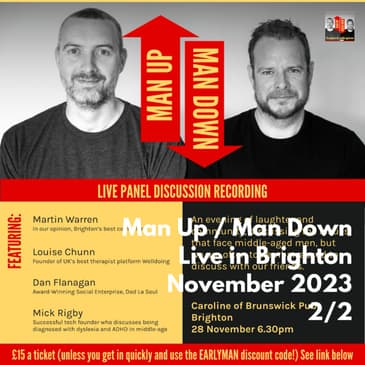
This is the second part of our live recording, which took place in Brighton at the end of November.
Our panel included Louise Chunn, CEO of our sponsor Welldoing, Stewart Cumming, head of operations at Dad La Soul and Mick Rigby, CEO of Yodel Mobile (who recorded a great episode with us in the first season, discussing his dyslexia and ADHD diagnosis in his 50s).
We weren’t expecting so much engagement from the audience (which we were absolutely delighted with), so apologies if the audio isn’t as clear when it comes to audience discussions – this will certainly be improved for future events.
The audience expressed a range of views and charged the debate.
These were the views of individuals and not necessarily ones that represent Volker and David, but it was clear that there is a lot of confusion about what exactly a man’s role is in 2023/24.
Topics that were discussed were:
· Why do men not talk as much as they need to?
· Do men still feel weak discussing their vulnerabilities?
· Is it a weakness to discuss vulnerabilities?
· What is the role of employers in helping men and women with mental health support?
· How easy is it for an employee to raise concerns about their mental health or neurodiversity issues?
· What role does social media play in causing confusion in the role men play in modern society (should we be more masculine, more vulnerable, a better financial provider, provide more emotional support)?
· What emotional support do we expect from our partners as “traditional male/female roles” become blurred?
· What impact did the pandemic and lockdown have on us?
· What responsibility do we need to take for our own mental health?
A big thanks again to our sponsors Fat Fish Digital Infigo and Welldoing and everyone that took the time and money to join us for the event.
Keep your eyes peeled for the next one in 2024!
Hosted on Acast. See acast.com/privacy for more information.
[00:00:00] Welcome to the Man Up, Man Down podcast presented by Volker Beluta and David Porsy.
[00:00:12] We discuss the pressures and challenges faced by men approaching middle age that we're
[00:00:16] often too embarrassed to speak about with our friends.
[00:00:20] You can find us online at www.manupdown.com. Well, there's quite a lot, looking for couples counseling, because that midlife is a crunch time, I'd say for men and women, that would be one thing, and I suppose depression would be, would be, certainly it seems everyone talks a lot about anxiety, but I think anxiety is, seems to be more among young people.
[00:01:42] And I think depression is more,
[00:01:45] or certainly with people coming to well doing, I think men because, and I would argue, biological, but any of that's a different conversation, oh, struggle more to open up. By default, they are more each other. I don't believe anybody in this room had an experience with any mode between 10 and 20, where they were really deeply vulnerable regularly.
[00:03:00] You might have had one off,
[00:03:01] because somebody did pass away or something,
[00:03:03] but I don't think there's a commonality.
[00:03:05] Therefore, everybody that then reached lockdown you don't need to be in the room with people really. I'm sorry, I'm sorry if you put myself on account I think that there's just a new addiction. We've had addictions for 70 years. I mean, you know, most of my mates were addicted to co-we, drink or porn. But they're the way that you can connect with people without the old actually being there,
[00:04:20] chatting, you know.
[00:04:21] But without them, we wouldn't have had WhatsApp groups.
[00:04:24] Yeah, no, the WhatsApp group is nature of this is hell in a heart. Even just when it's one on one, that when they're just, No, not one on one. One second. In a group. But then if they come to a group and they don't know anybody, then that seems to be the magic kind of thing. It's just like, well, and not least, certainly what we've found is the minute they come
[00:05:41] on more of my occasion,
[00:05:43] they've already heard somebody else do that.
[00:05:45] Yeah.
[00:05:45] And then he's like, and he's this,
[00:05:47] I mean, there I said to him, I know you're not gonna come for ages. I won't see this guy for ages because I said, you won't put yourself first. No, whenever comes the first time they see Dad and say, oh, they're like, oh, the wife's doing something. Oh, the kids. So, you know, and it's going, because you don't think it's important. You don't think it's important. And I joked to this guy, I'll see you in three months. You know, I said, I'll see you in three months because that's when it'll come. And then like, for some of you, they come and like, it was the same before.
[00:07:02] With a young lad come, you know, he's a young lad, got a young daughter.
[00:07:06] And he's bossed basically made him come. and that sort of something that I've found has been by massive for me and it's not part of it as the exercise but it's a tribal thing and it is physical. I guess it's sort of coming back to the discussion
[00:08:22] I guess it makes me feel like a man.
[00:08:25] It's communal as well as it's the first year of lockdown. And that includes by the way everything's going on at the moment. That was genuinely like... I don't know, but the other thing I'd say is there's a lag. I think the other thing is the reason coming back is that I was being fooled.
[00:09:41] No, we don't, at least to some degree, maybe's too much, I guess, and some of the older generation, if you thought you were a little bit confused, you might read a journal, you might read a magazine, and before you know, you'll forget about it. And actually, you know, I'm not that confused. Oh God, go and get there, go and get the kids or something like that, whereas now we get sort of almost drawn into this, right, well I need to find out, am I confused? All right,
[00:11:03] I'm confused. Oh, I'm not only confused about in particular. I'm looking around to be as individuals. OK, what do you think is forcing you? Well, the perception of what good, bad, right, wrong, female, female, confused, not confused, is too much information.
[00:12:21] Too quickly.
[00:12:22] I hear from where?
[00:12:23] Where's the perception coming from?
[00:12:25] Everywhere.
[00:12:26] Right.
[00:12:27] Too often.
[00:12:28] Is that social media? And how we compute that is where the anxiety piece comes in of, I'm just fucking confused. What is it? What am I? I mean, I think, yeah, it's just that constant bombardment of, well, it's almost like you learn the latest process or whether that's business or... But it's changed.
[00:13:40] It's the change.
[00:13:41] But literally the next thing, there's a new bit from here.
[00:13:44] Yeah, it's right.
[00:13:45] Around the same thing. are problems of lack of self-awareness. We're not encouraged enough to start to develop our self-awareness and to start to claim responsibility for everything that we do. And I think this is brutally important because, yes, it is very, very noisy but it is my choice to consume that.
[00:15:02] And I don't see enough of us taking responsibility for our choices That's how I see it. There are masculine traits and feminine traits. I'm not talking about men and women, we all have both. Mascaling traits being clear, being directive, taking direction, strategy and so on. Feminine traits being kind, being compassionate, being self aware, whatever. We all have those traits and in that scale, on that scale,
[00:16:23] each one of us has our comfort zone somewhere.
[00:16:26] There is the Donald Trump, which is is sponsored by Well Doing. There's someone who has seen a counsellor for a number of years I think their approach is great. They want you to find the mental health professional who is right for you. You can feel to your search to highlight therapists with expertise where you need it, where you can pay to use their personalised matching service.
[00:17:40] The people who run Well Doing are experts in mental well-being and they also have loads
[00:17:43] of posts and interviews to keep your mental health in good shape. That's my new brand which I will launch next year. I have five packages available. So hurry and let me know before the year's out. Thank you very much and have a Merry Christmas. I mean that raises some other interesting questions.
[00:19:02] I mean, well, I'm going now is very much about who you are, what's important to you, what's your purpose and just confidence in yourself. And that transcends everything else about the problems you face and how you deal with them and how you respond to those pressures. The pressures are all around us that save everyone, to be honest. It's how
[00:20:20] you react to them.
[00:20:22] Well, on that, I think that hits a of really again what I think we're playing out of now. You know why my dad had no supportive capacity from me and my brother would be good up. That didn't come back in the ball. You know, very shapeless. Well I mean you can see the fucking stuff.
[00:21:40] You've been a very very different situation than you need resources and all the products I might not be part of the problem, but I am part of the solution. And that's really, really, really good to remember. When I heard that, I was like, yeah, so hopefully that can encourage someone who feels that he or she, we're talking about men here, and the dark side at the moment. I think you had a point on who is in control and who's responsible.
[00:23:02] I think my young friend over here in the. And I think we're heading that way.
[00:24:20] And I think who is in control and who is taking charge
[00:24:23] of who we are as a society, whether it be government
[00:24:26] globally or whatever it is. But it just wouldn't happen, where that is completely allowed to go online, go onto my wife's Instagram page and say your wife is fat. And if I went to that, find that guy the next day to do what I would do in two minutes street, I would be thrown under a bar. And I think this freedom of everything needs to be a little bit more in control.
[00:25:45] It's interesting you would just say that, you know, the responsibility sits with you, you know, by finding that, you know, sorting it yourself, sorting it out yourself. But I think the problem is there's so many, and certainly for a younger generation that coming through there, that perhaps they don't have the structure, they don't, they're not
[00:27:01] helped and taught and encouraged to find a solution in themselves. every night, you're going to lunch, you're creating a situation where you're building rapport, you're learning from other people, you have that support group to an extent, you'd never open up but you have people there around you. You see a lot of these kids in their 20s are getting into work now and they might only be in that environment four or two days a week.
[00:28:20] They've come down from where ever from Leeds, I mean I'm not, I think two or three days a week, way better than none, the problem. I'm not sure if that's as bad, the problem is the people that have just normalised four and five days from eight, because it's easier or less stressful to get it comes back to this whole list. Less stressful, I know. I'm happy you go, no, no, you're a system that needs stress.
[00:29:42] You need to get stress, but they're not getting any.
[00:29:45] And then you get anxious about the one night Well, I mean, I've got a lot of no teachers, I've got a friend in HR, and you know, they're both said that, well, A, there's a certain year group at school that are pretty wild, proud to say my daughters in that year. But we're sort of going round to secondary schools for my son, but all the teachers are