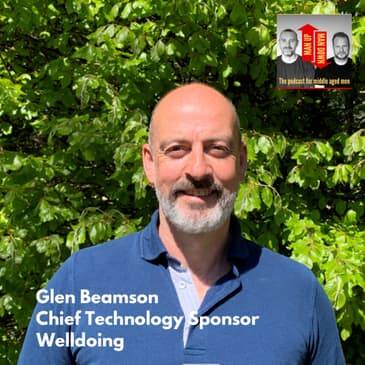
In this episode of Man Up Man Down, David and Volker host Glen Beamson, the Chief Technology Sponsor at Welldoing, a platform that matches individuals with the right therapist or coach. Welldoing, known for its support of mental health and self-improvement, has been a long-time supporter of the podcast. Glen, with a background in helping start-ups scale through technology and experience in big tech, is also a qualified executive coach with a passion for mental health and self-improvement. An interesting fact we discovered about Glen was his participation in the Desert Ultra, highlighting his adventurous spirit.
Glen shares his journey from working in big tech and international roles to seeking a more fulfilling path in start-ups focused on social impact, particularly in conservation and mental health. His move was driven by a desire for direct involvement in socially impactful work, contrasting with the indirect impact of his previous roles in banking and technology.
A significant part of the conversation revolves around Glen's unexpected venture into running an ultra-marathon, despite being advised against long-distance running due to his physical build. This experience, driven by a challenge and a sense of proving oneself, reflects a broader theme of overcoming obstacles and setting personal goals.
The discussion also touches on societal changes, the importance of having adventures, and the impact of technological advancements on employment and personal fulfilment. The role of AI in therapy and the potential for new job creation in areas yet to be imagined are explored, highlighting the dynamic interplay between technology, society, and individual aspirations.
Glen's reflections on his upbringing in a mining community and the impact of industrial closures on his family and community underscore the conversation. This personal history informs his views on the importance of work, community, and the pursuit of meaningful, impactful endeavours.
Overall, the episode delves into themes of resilience, the pursuit of personal growth and fulfilment, and the evolving landscape of work and technology. It reflects on the importance of adaptability, the pursuit of passions, and the significance of addressing mental health openly and supportively.
You can find out more about our sponsor Welldoing on www.welldoing.org
Hosted on Acast. See acast.com/privacy for more information.
[00:00:00] Welcome to the Man Up Man Down Podcast, presented by Volker Ballueder and David Pawsey.
[00:00:12] We discuss the pressures and challenges faced by men approaching middle age that we're
[00:00:16] often too embarrassed to speak about with our friends.
[00:00:20] You can find this online at www.manupdown.com.
[00:00:26] Enjoy the show and don't forget to subscribe and leave us a review.
[00:00:34] Welcome to another episode of Man Up Man Down.
[00:00:38] Today we welcome Glenn Beanson.
[00:00:39] Now, Glenn wears many hats so there will probably be some achievements and accolades that I miss
[00:00:44] out here.
[00:00:45] However, I involve can know him as the chief technology sponsor at Well Doing, a platform
[00:00:50] that matches you with the right therapist or coach, but you'll probably know that name
[00:00:54] as they are our long time supporters.
[00:00:57] Some on hand, Glenn has a lot of experience helping start-ups scale through technologies
[00:01:02] also worked in big tech.
[00:01:04] Unsurprisingly he's also passionate about mental health and self improvement and is a qualified
[00:01:09] executive coach himself.
[00:01:10] And as I was doing some research, I also found some pictures online which appears to show
[00:01:15] him competing in the desert ultra, which seems to become a bit of a prerequisite for guests
[00:01:21] on Man Up Man Down recently.
[00:01:24] There's a lot to discuss and I'll say probably lots of missed out there.
[00:01:27] So welcome, Glenn.
[00:01:28] Thanks for taking the time to join us.
[00:01:30] Thanks very much for having me.
[00:01:32] Excited to be here.
[00:01:33] Yeah, well, welcome to the podcast.
[00:01:35] Another ultra marathon runner.
[00:01:38] No idea.
[00:01:39] Well, I would call myself a little truerther and I took part in an ultra marathon but I'm
[00:01:43] certainly no run-rider I think.
[00:01:45] So you've done one antic too box or have you done several?
[00:01:48] So is I?
[00:01:49] No, I'm doing that.
[00:01:50] So basically I'm a bit of a kind of magpie anyway.
[00:01:55] So I like trying loads of different things.
[00:01:57] I'm quite happy to be, you know, average out a lot of things and tries many things like
[00:02:02] it.
[00:02:03] And years ago, like a lot of people I thought, right, I'll try the London marathon and
[00:02:06] every time I trained, I got to about 12 kilometers and then got shin splints every time.
[00:02:12] And eventually I went to a podiatrist and they put me on the running machine, you know,
[00:02:15] and they put these little things on your knees and they watch you run.
[00:02:18] And she basically finished and said, yeah, you're not cut out to run.
[00:02:22] Your legs are just a one key shade.
[00:02:24] I've got legs like I could sit on a horse and my ankles with me.
[00:02:26] I've got very bandy legs.
[00:02:28] And she said, you're not cut out to run.
[00:02:31] You can't do a marathon.
[00:02:32] So I said, okay, fine.
[00:02:33] So I put that to one side, did lots of different sports.
[00:02:35] And then when I was in my mid 40s, I was sitting around a campfire in the middle of the desert
[00:02:42] fun enough.
[00:02:43] I was working out in the middle east and I was somebody had just completed the marathon
[00:02:47] day.
[00:02:48] So I said, yeah, I'd love to do that.
[00:02:50] And they said, well, why don't you do it?
[00:02:51] That's actually I'm going to run.
[00:02:53] Why not do that?
[00:02:54] And then I can mention the tick off like, you know, at the time it was caught as the toughest
[00:02:58] ultra in the world.
[00:02:59] I thought, I'll tick that off and that's what he done.
[00:03:02] So I signed up.
[00:03:03] It's a ballot.
[00:03:04] It came through saying, yet you've got the place.
[00:03:06] So I thought, okay, I better start training.
[00:03:09] And I actually went to see a running coach.
[00:03:11] And I said, look, I'm thinking of doing this.
[00:03:14] What should I do?
[00:03:15] What's the training plan?
[00:03:16] So what's your normal marathon time?
[00:03:18] And I said, yeah, I've never done a marathon.
[00:03:20] He was like, okay, what's your normal half marathon time?
[00:03:23] Nope.
[00:03:24] Okay, well, what's your 10k pace?
[00:03:26] What's your race pace?
[00:03:27] Never done a 10k.
[00:03:28] Five K?
[00:03:29] Nope.
[00:03:30] He said, you've got no chance of finishing that.
[00:03:34] So at that point, I was like, right, I'm definitely doing this now and I'm definitely
[00:03:37] finishing it.
[00:03:38] So that was that.
[00:03:40] So you're the self person that is motivated by people telling you, you can't do improving
[00:03:47] the wrong man.
[00:03:48] Yeah, I guess.
[00:03:50] Yeah, I always think if you want to do something like half of it is just keeping going.
[00:03:55] When everyone else gives up, it's just keep going and put a plan in place and just follow
[00:04:02] that plan really.
[00:04:03] So I basically was lazy and I started training.
[00:04:07] So the race is in April, May, I think.
[00:04:11] And round about December, I was at a Christmas party and I thought, do you know what?
[00:04:14] I really need to start this training because in whatever it is, 20 weeks time, I'm going
[00:04:18] to be running a marathon a day for five days.
[00:04:21] And so January, I put this plan together and I could see by week four, I was meant to
[00:04:25] be running something like 20k or week five.
[00:04:27] I was thinking, oh my God, you know, I'm never going to do that.
[00:04:30] You just slowly, slowly do it and it's weird.
[00:04:35] You go from like you get to the point where you're going out for a 20k run in the first
[00:04:39] five k as you warm up.
[00:04:40] You know, your head's in a totally different space.
[00:04:43] And a lot of the ultras, you walk a lot of them, especially in the desert unless you're
[00:04:47] really super fit after late.
[00:04:49] You know, you kind of maybe might walk for quarter of an hour, runs a slightly higher than
[00:04:52] its quarter of an hour.
[00:04:54] But I recommend these things.
[00:04:56] I mean, they were, it's like extreme camping with running in the middle of it.
[00:05:00] That's what it felt like.
[00:05:02] It's totally mental.
[00:05:03] More mental and physical.
[00:05:04] Yeah, you've almost kind of described how simple it is but also how difficult it is in
[00:05:13] the, you know, it is literally a case of putting one foot in front of the other.
[00:05:17] But as you say, I mean, I sort of have done a couple of ultras now, not in the desert.
[00:05:26] In the UK, it's a very different conditions.
[00:05:29] But I mean, I just remember like my friends, I'd started doing I think 10k's and I had
[00:05:37] a friend who'd started doing 10k's and then he'd done a half marathon.
[00:05:41] And he was like, well, I'm doing this half marathon.
[00:05:42] Do you want to do it?
[00:05:43] And I was just kind of like, nah, not really.
[00:05:47] And then, well, it was actually sort of near where a lot of family lived and I was like,
[00:05:51] yeah, I think I will sort of do that and start a training.
[00:05:55] And then I was like, actually, if I'm got to that level of fitness, I'm never going
[00:06:00] to be that fit to then do a marathon.
[00:06:03] So as I see it, I saw not for a marathon as well.
[00:06:06] And yeah, it is almost like, and so with my sort of ultras, I did the London's Brighton
[00:06:12] Challenge which I think it's 35 mile.
[00:06:16] I mean, you can do it all in one go.
[00:06:18] But I live at the, you say about extreme camping.
[00:06:22] There was like, you know, you could camp but I actually live in the village.
[00:06:25] They're the good ones.
[00:06:27] And it's like, yeah, so I was like, right, well, I'll, you know, just split it over two days.
[00:06:31] But, you know, if someone sort of came up to me and said, oh, you know, you should do
[00:06:36] that.
[00:06:37] I'd be like, no way.
[00:06:38] But then as you say, it's almost like incremental steps to building up to that level of fitness.
[00:06:45] Yeah.
[00:06:46] And I think it's funny like, you know, when I was doing it, it is a lot.
[00:06:48] A lot of middle aged kind of people doing it.
[00:06:50] I think your body is a bit more ready to do the long, slow and steady, the more the
[00:06:56] older you get because almost because you've got the patients.
[00:06:58] I think if I wanted to do that when I was 20 and someone said, you're going to run for
[00:07:01] four hours.
[00:07:02] I'm like, yeah, whatever.
[00:07:03] I'll go and run for half an hour and then go in the pub.
[00:07:05] Thanks.
[00:07:06] But, you know, when you get older, you've got more time to kind of do these things.
[00:07:08] Well, but again, as well though, is it almost like a mindset that we reach at that age
[00:07:14] of, you know, you sort of realize that actually it is more mental and physical.
[00:07:20] Yeah.
[00:07:21] I mean, you know, you talk about actually just listening to one of your last guests talking
[00:07:27] about, you know, middle-eyed crisis, obviously, it crops up a lot in your podcast tonight.
[00:07:31] I kind of dispute almost that word because I think sometimes I think it's middle-eyed choice.
[00:07:36] And I think when you have, you know, if you say, well, someone suddenly bought a fast
[00:07:40] car or some middle-eyed crisis, I'm like, well, maybe or maybe that's just now they're
[00:07:44] at that age where actually they've got the money that they can do it.
[00:07:47] They always wanted to do it, but they never had the money when they're younger and they've
[00:07:50] decided, well, this is probably my last chance to do this and enjoy it.
[00:07:54] So I'm going to go for it.
[00:07:55] And I think that maybe is all just a little bit like that as well.
[00:07:58] You suddenly got the choice.
[00:07:59] You can afford the time train.
[00:08:01] You can afford the cost of flying to wherever it is to go and do the training.
[00:08:06] It's not that you, I didn't feel at any point, I was in like a crisis like I must do this.
[00:08:11] And you feel like you got the choice to do it and change your life a little bit.
[00:08:16] I never had a burning desire to run a marathon, but at the same time I was like, I don't
[00:08:23] want to be in my 70s or 80s wishing that I'd done a marathon.
[00:08:28] And it's sort of, I mean, I've sort of went through a period where I sort of have set
[00:08:36] myself a big old, well, you know, an endurance challenge each year.
[00:08:40] So as the pandemic hit, I just signed up for 10 kilometers swim and they're suddenly,
[00:08:47] you know, the pool's closed down.
[00:08:49] You know, all the open swimming like places shut down.
[00:08:52] And I was like, all right, I've chosen the wrong event this year when I've got all
[00:08:56] the time I want to run in cycle, but I've chosen to swim.
[00:09:00] But yeah, I mean, I, and I keep thinking right, I need to sign up to another challenge
[00:09:05] because I've not done one for a couple of years.
[00:09:07] But then at the same time, I'm like, I've kind of, I've proved to myself that I can, you
[00:09:13] know, put my mind and body through that.
[00:09:16] Yeah.
[00:09:17] So where, you know, now I'm almost like, yeah, I don't know, I'm sort of in a stage of
[00:09:22] like, I want to do something like that again.
[00:09:26] But yeah, I'm not sure.
[00:09:27] I think I think you need adventures, you know, so interestingly enough, my wife's similar
[00:09:33] age to me and they're super about catching up, you know, her and her girlfriends.
[00:09:37] They're really good.
[00:09:38] And whereas me and my kind of guy friends that I've known since I was, you know, whatever
[00:09:42] 10, 15, 20 years old were terrible, you know, because someone's like, oh, I just can't
[00:09:47] make it.
[00:09:48] I've got stuck at work or I've got to do this.
[00:09:50] And so a few years ago, I said to them, listen, when was the last time any of you had
[00:09:53] like an adventure?
[00:09:54] You know, we used to have them all the time when we were kids, you know, you go camping
[00:09:57] or as you get older, you challenge yourselves to do different things.
[00:10:00] And so we've got a thing now where we said, like, well, once a year, let's do an adventure,
[00:10:06] you know, so we're going to try and swim to the out of white, for example.
[00:10:09] You know, and then maybe it's the next year after that we might go and do some chalice
[00:10:13] like a running challenge somewhere or something else.
[00:10:15] But something where you've got to target is once a year, you dedicate yourself to make sure
[00:10:20] you take that time off.
[00:10:21] And there's no pressure.
[00:10:22] You don't have to finish the race.
[00:10:24] It's, you know, and so I kind of think otherwise life just gets dull if you don't have adventures.
[00:10:29] You know, whether that's, you know, in your career or in your personal life, I do
[00:10:34] the sport.
[00:10:35] I think you have to do something and again, that comes back to a slot.
[00:10:38] You know, if people are doing these things in mid-life, it's not a crisis and it's just
[00:10:42] having adventures and doing things and keeping life interesting.
[00:10:47] So let me try to get a word in so we could talk about all these morathons that are run
[00:10:52] and all these ultra-sire dreamt of.
[00:10:57] They might be in your future though still.
[00:10:58] You never know.
[00:10:59] It's not about me to which of you are.
[00:11:02] My motivation for my first marathon was like, I always said when my wife did one, I'm
[00:11:06] like, if I start, I'm going to be addicted to it.
[00:11:08] I'm not going to start.
[00:11:09] And then she'd done one and I'll like shit, no, I have to do it.
[00:11:14] So I did tick the box.
[00:11:15] But yeah, I don't know what would I do more?
[00:11:17] I mean, let's maybe go back to your latest point you made about, you know, the mid-life,
[00:11:24] right?
[00:11:25] I think a lot of people get to mid-life and there's avoid, right?
[00:11:29] There's this space, you know, obviously mentally or physically in that sense as well.
[00:11:35] You've got like, shit, I'm not as fit as I used to be, right?
[00:11:38] So I want to go back to the gym or I need something new to do.
[00:11:42] I need a challenge like a marathon because once I was at you have time, right?
[00:11:47] Kids, kids are usually at an age they can look after themselves.
[00:11:51] You don't have to be around them all the time so you can carve out these 15, 20 K runs
[00:11:56] right?
[00:11:57] That's not half marathon you talked about, right?
[00:12:00] You can carve them out on a Saturday morning, right?
[00:12:02] You know, I used to go for a Saturday morning, six till age, right?
[00:12:06] You did your 21k done, right?
[00:12:08] We can done.
[00:12:09] It's, it's, I think that's life transition where you, you know, where you want to suddenly
[00:12:14] find yourself a small time, not maybe not as fit.
[00:12:17] I don't know if there's a stat for it but there must be one.
[00:12:19] I need to google it.
[00:12:21] I bet that middle aged men are the people that buys most road bikes in the UK for
[00:12:27] a bit.
[00:12:28] Yeah, that's it.
[00:12:29] Yes, it's like it's a typical one, right?
[00:12:31] They people getting to cycling everyone else is doing it.
[00:12:34] It's healthy and you can do it with other people as well.
[00:12:37] So to your point, right?
[00:12:38] You have this adventure.
[00:12:39] And I lost the idea of having an adventure once here because I think on, on Marloss
[00:12:44] Elastec juice we said, oh, we should do that every year, right?
[00:12:47] Oh yeah.
[00:12:48] That's about 10 years ago though.
[00:12:49] Yeah, you can't be just having a day out, can you just do something and then go to
[00:12:53] a pub and sit down at the chat and have a beer, whatever you're.
[00:12:57] Yeah, hello, it's Volker here.
[00:13:00] I hope you enjoy this episode.
[00:13:02] You might not realise that I have been coaching for almost a decade through both third parties
[00:13:08] and private clients.
[00:13:10] Do the time I've worked with brands such as General Electric, Imperial brands, DHL
[00:13:15] and Pepsi.
[00:13:17] However, this year I'm putting a big emphasis on growing my private coaching practice,
[00:13:22] improving lives of middle aged men in leadership positions.
[00:13:26] So if you hit midlife transition point and you might be a bit stuck or looking to improve
[00:13:31] your work life balance, your career, or productivity, you want to build a new habit
[00:13:37] where you just want to become a better version of yourself, please hit me up.
[00:13:43] You can reach me on Volker.navtus, that's Volker.et, obnaet.us or LinkedIn, whatever is
[00:13:51] easiest.
[00:13:52] Thanks and now back to the episode.
[00:13:55] Should we talk a little bit about what you're doing at well during?
[00:14:02] Yeah, yeah so we're in different business spots.
[00:14:05] Yeah, yeah so I guess like going back to the whole kind of midlife thing so I guess
[00:14:10] I started off in Big Tech, did a lot of kind of CTO, international CTO jobs.
[00:14:16] And it was actually quite a funny career so it was never something that I intended to do.
[00:14:19] I started off basically I grew up in the North East.
[00:14:22] I come from a mining community, 9.84, 8.5, of course the miners strike, everyone's out
[00:14:28] of work.
[00:14:29] Then I come from the East Coast Hardly Pool and the Doc Yards closed down.
[00:14:34] And you just see all these communities just crumble from really thriving communities to
[00:14:38] nothing.
[00:14:39] And I think I just thought like I don't want to ever be in a position where somebody can
[00:14:43] do that to me, you know, take my livelihood away and do something.
[00:14:46] So I did that kind of thing that we all tell our kids to do, you know, got my head down,
[00:14:50] worked hard at school and so on and ended up doing a PhD in when they were building GPS
[00:14:55] basically and helping to improve the orbits of GPS for climate change, looking at mean
[00:15:00] sea level rise while I can't think.
[00:15:02] Then very randomly I was in Canary Wharf working there when they were building Canary Wharf
[00:15:08] because we were measuring how much Canary Wharf sinks using satellites the first time
[00:15:12] that you could do that.
[00:15:14] And I saw a whole other guys going into a pub in suits and it was raining, I was on a
[00:15:18] building site and I thought you know what, I'm on a building site here in the rain and
[00:15:22] they're inside a pub, they're probably getting paid more than me.
[00:15:25] Maybe I'll see what they do.
[00:15:27] And so I went to this bank and I interviewed and I finished this interview and they said
[00:15:31] well what do you want to do?
[00:15:32] I said I have no idea.
[00:15:34] And they said well okay you've been an engineer and you can go to technology.
[00:15:38] I said okay whatever that is, I'll go and do that.
[00:15:41] And so I moved into banking into technology but it was 97 and so it was just at the
[00:15:48] kind of start as the internet was starting to bubble up.
[00:15:51] I literally knew nothing.
[00:15:52] I mean the first day I literally sat looking at this computer and couldn't even work out
[00:15:55] to turn the thing on.
[00:15:56] You know somebody came to my desk asked me for something.
[00:15:59] I said I've got no idea.
[00:16:00] They turned on my computer, wrote something down and warped off and that was my first
[00:16:02] day.
[00:16:03] I was like okay so of course this was before Google or rest of it, site to go and read books
[00:16:08] and books and books and books.
[00:16:11] And we was delivering a project and I said well look why don't we use this new thing
[00:16:14] called the internet?
[00:16:16] And everyone was like okay that's good rather than putting floppy disks in the machine.
[00:16:19] I said yeah you can log on to a browser and get this program.
[00:16:23] So we built this program on the daily roll we've meant to roll it out.
[00:16:27] This is to about two and a half thousand people.
[00:16:29] I realized nobody had an internet browser on their desktop.
[00:16:33] So I had to run out, send the team out to the local corner shop by a whole load of copies
[00:16:37] of computer shop in magazine.
[00:16:38] It's on the front they had a disk with internet explorer one on it.
[00:16:43] We went and we had to load the browser and then we delivered this project anyway that
[00:16:46] started to hold a whole kind of creating almost innovation so I saw the whole.com boom
[00:16:51] near the rise of mobile apps all the rest of it and basically spent you know kind of
[00:16:56] went from career change to career change in the bank.
[00:17:00] Just really having the time of my life you know having fun I was young and then at some
[00:17:04] point there were some politics going on I didn't like it so that's it I was on and I kind
[00:17:08] of it.
[00:17:09] Anyway, I went to an interview in this guy I said to him why did you leave?
[00:17:14] I said well there's loads of politics I thought it was nonsense so I left.
[00:17:19] And he said something that really kind of changed my life he said well because you left
[00:17:24] it means all of your team now got to deal it was basically a manager who was very much
[00:17:27] a bully.
[00:17:29] All of your team have to deal with that.
[00:17:30] He said if you actually concentrate on your career and became senior yourself then you
[00:17:36] set those boundaries.
[00:17:37] You can decide if there's bullies or not no that's your call.
[00:17:40] I thought yeah he's absolutely bang on the money you know because people talk about company
[00:17:45] cultures but that I contend there isn't really a company culture there's a culture of management
[00:17:50] and if the guy running the company is a bully no matter what the culture is the company
[00:17:55] culture says on the you know formally that's what the cultural be.
[00:18:00] If the guy running the company is actually a decent fair bloke the culture will be
[00:18:04] that you know.
[00:18:05] And so I went back into it and actually concentrated on my career and ended up being an international
[00:18:10] CIO basically for a bank and then a CTO for a sovereign wealth fund.
[00:18:15] And at one point I was 46 I think I was sitting in a meeting I just suddenly thought what
[00:18:23] am I doing here?
[00:18:24] I've done what I wanted to.
[00:18:25] I was financially secure which had always like I say word me for my childhood saying
[00:18:29] my dad getting put out of work and everybody I knew you're getting put out of it.
[00:18:33] I thought nobody can affect me in that way and I thought now that achieved what I want
[00:18:38] to do.
[00:18:39] I've ran some really large teams and built the culture that I thought was very kind of
[00:18:44] caring and kind but at the same time very very professional we got a lot of work done.
[00:18:48] But I kind of felt like yeah in my head I kind of almost ticked off what I was in this
[00:18:51] career for so now I want to go and do something really go back to the roots go back to like
[00:18:57] code and go back to working with startups and in things that have got social impact.
[00:19:01] So of course you know working in a bank you know there there might be some positive social
[00:19:05] impact through you know the money then gets put into good cause or whatever but I want
[00:19:09] to be right close to some of the social impact.
[00:19:12] And my feeling was two big things conservation because the outdoors is very kind of close
[00:19:17] to my heart and I know when I really start my career in no climate change and mental
[00:19:22] health because I think it's such a such a huge problem in the generations coming through
[00:19:28] so I said that's it I'd like to work with startup that works in social impact and through
[00:19:34] pure chance really I was out mountain biking with a friend of mine the village they knew
[00:19:38] Julia they introduced us and I joined well doing as a CTO and that was fantastic.
[00:19:45] And so I really enjoyed that the whole startup piece you know it was really exciting to be
[00:19:50] you know having done the big job where you obviously have to go to funding committees
[00:19:54] and management committees you're doing people's appraisals and end of your reviews and all
[00:19:58] that kind of thing.
[00:19:59] So then move right down to tiny startups where you're the CTO but you're also the chief
[00:20:04] of fundraising you're also the cleaner you're also doing all the strategy.
[00:20:09] I really thrive on that I love just doing lots of different things it really keeps me interested.
[00:20:15] And so I spent kind of five six years in the startup world but over the last year or so
[00:20:22] just had this creeping feeling that actually what I really underestimated that I missed
[00:20:29] was creating this culture in a team and a lot of mentoring that I used to do with the
[00:20:34] large temes to mentor a lot of managers you can do some really kind of great stuff with
[00:20:39] young kids coming through you know and then it's great to watch their careers grow so I
[00:20:43] started putting out some feelers.
[00:20:46] And through a chance a role came up that was again another kind of big role and it was
[00:20:52] at a very kind of entrepreneurial company with a lot of opportunity to change things and
[00:20:57] move things really quickly so I said okay so at the tender age of 53 I'm back in big tech.
[00:21:05] And so it's with with well doing is great because basically we have repositioned the platform
[00:21:10] that's all in a great shape you know Julian the team are doing some fantastic stuff there
[00:21:14] with the therapist and I'm now taking a little bit of a step back still looking at all
[00:21:19] of the technology still looking after the strategy you know I'm not their full time let's say
[00:21:24] hands on with the code.
[00:21:26] Lots of interesting things in that you know that story.
[00:21:32] I mean well the things I guess the two things I'd like to talk about but stop me Volcro
[00:21:38] if I go on for too long is you know still in well it's about company culture but also
[00:21:45] I guess just sort of going back to what you were saying about you know the environment
[00:21:49] that you grew up with grew up in and you know the mind's being closed down.
[00:21:54] So how old were you when that happened?
[00:21:56] Yeah.
[00:21:57] So 15.
[00:21:58] Right okay so yeah what sort of impact I mean did you kind of recognize
[00:22:02] the impact but perhaps I had on your dad's mental health?
[00:22:06] Well well so yeah so it's interesting so it has an immediate impact because everybody
[00:22:14] was out of work and you know my dad lost his job so I can really remember clearly going
[00:22:20] home and opening the pantry door and there was one of the first kind of supermarkets
[00:22:25] that did his own labels it was called fine fair and their own label stuff was bright yellow
[00:22:30] like lemon yellow packaging and would just have black or white big net so I opened the
[00:22:35] pantry door and it would just all be yellow if you're like a box just said conflicts or
[00:22:40] jam or you know bread or something and that was it and you know dad had to sell his car
[00:22:48] so so you know at the time actually we were really good at Babmonton me my brother we
[00:22:51] both kept in the county I used to kept an under 16 she kept an under 18s they wanted
[00:22:56] us to go and play with the national team but it was in gate said and we didn't have a
[00:23:00] car so it says no we can't carry on that spot so kids that we used to beat then trained
[00:23:05] and then went on being land team and we we had to say no we didn't have the money so
[00:23:09] it had like an immediate impact at the same time it was really my mom dad handled it
[00:23:15] in a really great way you know I mean they I remember them sitting down with us and they
[00:23:19] said listen work really close to why I'm paying the mortgage so the union your brother
[00:23:25] you need to take a job and we're just gonna have to to use the money you know foot for
[00:23:30] a little bit you know use the Christmas tips and so on and the Nigel has had the problem
[00:23:35] with that because we were you know we're a close family and you just thought yeah that's
[00:23:38] make I understand you've explained that to me I understand that so we just go and do it
[00:23:43] in the communities it was you know North East really hasn't recovered from it in my opinion
[00:23:48] I mean those mining communities were solid I mean it was so fascinating you know you saw
[00:23:53] the end of a of a way of life that almost hadn't changed since Victorian times you know even
[00:23:59] things like my granddad used to speak a dialect called pitmatic which was so broad really
[00:24:05] unless you were down the mind you just couldn't understand it it's and yet that kind of
[00:24:10] almost you know you get that really cohesive unit of men all working tightly together
[00:24:15] and then the women at home make a joke that they had clean clothes and food was very traditional
[00:24:20] kind of way suddenly everybody's out of work and as you can imagine it only takes a matter
[00:24:25] of weeks for that to spiral into crime you know abuse depression all of those things because
[00:24:33] you take away everyone's self worth so there's a lot of that having said that in our family my dad
[00:24:37] was very pragmatic man he said okay fine that's that I always want to go to university I'm going
[00:24:44] to go and do that so he managed to get a grand whatever it was two thousand pounds a year
[00:24:49] or three thousand pounds a year or something me and him went out and build in the sights and did
[00:24:53] jobs for cash in hand I was 15 size to go sit down with him and work on like sage work and
[00:24:59] laboring on building sides basically and we got by and he did his degree and then he ended up being
[00:25:05] out of work for maybe four years or something or five years and then he managed to get a job
[00:25:10] and you know they they went back and by that time I don't I got sponsored by the army they paid
[00:25:16] for me to go to six form and then I could do six form and went off to university so yeah it's
[00:25:22] uh it I'm fortunate my father passed away because I would love at this age to talk to him about that
[00:25:28] you know because he was probably roughly my age now I'm thinking and how he handled that you know
[00:25:33] he had three kids no money whatsoever and it must have been super stressful because there wasn't
[00:25:37] even a hope of getting a job not for a long time you know yeah I mean that's you know I guess
[00:25:43] that's the you know sort of the aspect that I was thinking of that you know it's not not only
[00:25:49] the only way of life that you've known it's the only way of life that you're far the new your
[00:25:54] grandfather knew you know it's so embedded in oh yeah all the way back yet yeah man up man down is
[00:26:01] sponsored by well doing there's someone who has seen a counselor for a number of years I think
[00:26:06] their approach is great they want me to find the mental health professional who is right for you
[00:26:10] you can filter your search to highlight therapists with expertise where you need it
[00:26:14] we can pay to use their personalized matching service the people who run well doing are experts
[00:26:20] in mental wellbeing and they also have loads of posts and interviews to keep your mental health
[00:26:24] in good shape take a look at well doing the org I mean I'm going through a bit of a period at the
[00:26:31] moment where you know I'm reading more about AI and chat GPT and I actually I was on an all day
[00:26:37] course yesterday for chat GPT but you know I'm like I'm a copywriter and I can see what it can do
[00:26:44] and I'm like oh my god I'm obsolete and I'm about to have a word with myself it's like well
[00:26:50] you know it's almost writing is part of me but that's not where all my worth comes from
[00:26:56] yeah you know it's sort of I guess I'm a bit nervous about having to re-skill and reinvent
[00:27:02] myself but then you know compare that to a situation like that but then at the same time on my
[00:27:08] world there is going to be massive you know all week and the sort of see the same sort of job
[00:27:12] displacement as you know industrialization to then the full circle as you say of the mind to
[00:27:19] being closed down yeah yeah it's well I think it's a long way to run isn't it I mean interesting
[00:27:25] enough when I did my climate research back in 1997 if you talk to your scientists then about
[00:27:31] what was happening in the climate you'd have a third say it's fine things will kind of cool down
[00:27:35] you'd have a third saying well the graphs can be roughly flat and the third saying no it's
[00:27:39] exponentially up no question and then you rolled that on about 10 years after that and of course
[00:27:45] by then there'd been a whole load of research and loads if those are new data and techniques
[00:27:49] are on at that point it was unequivocal like 99.99% of scientists said it there isn't a question
[00:27:57] the earth is heating up and it's going to be exponential and if you don't do something it's going
[00:28:01] to be problem now of course we roll on to now and we're all seeing that the out for that I think
[00:28:07] AI is similar in that nobody can really call what's going to happen with it and I think you could
[00:28:11] take a very pessimistic view and say that's it we're all gonna we're all gonna I don't know if you
[00:28:16] have watched the film Wally yeah there's kind of kids card two thing and basically all humans are
[00:28:20] just like big blobs sitting in chairs while all of the AI and all the robots do everything and
[00:28:25] they're just all depressing and just you could take like a pessimistic view and say well yeah
[00:28:29] you're coming on to like contentedness and self-worth and if you haven't got something to do as a
[00:28:33] job or something to feel to create and do and feel satisfied then I think that's a real
[00:28:40] as an issue you know from the other hand you might say where we harness AI and actually what it
[00:28:45] does is it just takes away a lot of tedious things and we do we end up doing stuff that's more creative
[00:28:51] it's a tough one though because everybody isn't creative and some people you know that there's
[00:28:56] always going to be a percentage of people who need to just do a steady job that could potentially
[00:29:01] be made more efficient could be automated and is it right to automate it and I I feel like
[00:29:08] you know it's getting kind of I guess very cerebral but I do think that that you really want
[00:29:14] everybody to be employed doing something that they feel some self-worth at that is more important
[00:29:19] than being hyper-efficient and the thing also it's it's the value that it brings to society
[00:29:27] I was speaking to one of the dads at my son's football club and they're you know unfortunately
[00:29:34] experienced some crime and you know he's like the police aren't interested and online well it's not
[00:29:39] the fact that they're not interested they just don't have the resources and you know in your life
[00:29:45] yeah you know those well yeah are those a sort of job that could be refilled
[00:29:51] yeah yeah I do I do think it'll be an interesting thing because you know without getting
[00:29:56] political it is something that I think political political kind of sector let's say world wide
[00:30:02] we'll have to grapple with as we go forward that as we automate more things more people worldwide will
[00:30:06] be potentially unemployed and what is the solution you know how do you get those people feeling
[00:30:13] like they're living a fulfilling life otherwise you know you do get societal problems that
[00:30:17] that knock on you know you go back to the middle ages and the whole but who the guys that kind of
[00:30:22] went and broke the seed drill because it you know basically was it was making whole agricultural
[00:30:27] revolution is putting them all out of a job you know it's the judgment and we get that kind of thing
[00:30:32] it might be in gestural till that's not true for the planet yeah yeah no pain went to the
[00:30:39] seed drill I got remembered up yeah so yeah so I think that's it and it comes back to like what
[00:30:43] is content in this so I certainly I worked in the Middle East and I certainly saw you they've
[00:30:48] have huge problems with depression there because you know you suddenly have a lot of wealth in
[00:30:52] the country from the oil and so on and if you can sit in front of a TV and buy anything that you want
[00:30:59] it's you know it's almost depressing right because it nothing has any worth if you haven't had
[00:31:03] to work to do it there's something deep and hours psyche I think that means you if you work for it
[00:31:08] and someone says well don't or you get something for that it definitely ticks a box where
[00:31:13] we're hardwired I think to be do something for society and get rewarded for it I mean with this AI
[00:31:20] and so so I always bring it back to therapy and and coaching a bit I think if you coach like
[00:31:27] like I do in and you do I guess a little bit as well right and therapy right you can't replace it
[00:31:33] with say art can you I mean I know there are a couple of apps out there trying to give you
[00:31:39] reassurance you know via AI and but I don't think actual therapy can be replaced with computers
[00:31:47] I I don't think so and I think it's because we also have an inherent laziness and so I think when
[00:31:55] you think about therapy it's falls I think there's a little bit of an overlap with things like sports
[00:32:03] coaches and yeah there's a different saying I'm gonna go to the gym and you go two or three times
[00:32:09] then you kind of then you can't the next week because something else is up and you can't
[00:32:12] wake after then you kind of give them don't bother and then your next year's new year's resolution
[00:32:17] is I actually need to go to the gym again because I didn't get fit last year and I think a little
[00:32:22] bit like that if you have to see a physical therapist once a week I think a massively important
[00:32:27] piece of that aside from the therapy is it's just it's consistent and you have a consistent reason
[00:32:32] for going and interestingly enough I must mean so I do love you know working with people who've
[00:32:39] got really interesting ideas interesting startups and I saw somebody a couple of weeks ago
[00:32:43] and they were using technology for phobias so one of the ways that you do your therapy around phobias
[00:32:49] let's say you're scared of spiders for example you know you might say okay so imagine you're in a
[00:32:53] field and there's a spider in the next field what's your anxiety level okay it's one out of 10 okay now
[00:32:58] that spider's in the field next to you what is it okay maybe it's two out okay now it's only
[00:33:02] wrong all right that's nine out of ten and of course you're working with that client to try and
[00:33:07] bring that anxiety down so that when they visualize the spider on the arm now it's two or three out of
[00:33:12] ten and I can handle it the problem is if you're a very visual person maybe that worked for you but
[00:33:18] if you're not you eventually might come out of that therapy session say yeah I could handle
[00:33:22] visualizing that spider on my arm and it's two or three out of ten and then you whenever lift
[00:33:27] a box from in your room the spider runs out and you have a you know a huge panic attack because
[00:33:32] actually you said that you've got yourself visualized in that position but you couldn't do it so what
[00:33:37] this guy is doing is he's using an anoculus you know the virtual reality I think and so and basically
[00:33:45] they've used lots of computer generation but also then the 360 degree camera technology these days
[00:33:51] so the translate is a real tranchilla and when you're looking through it is on your arm
[00:33:56] and so you don't have to visualize it it is bang on the money looks exactly like a spider's on
[00:34:01] your arm and so they're just starting some testing with that and they took it once that further
[00:34:07] said but let's do it so that you can just basically pay for this therapy so you might send
[00:34:12] a subscription and we'll send you the Oculus through the post with all of the programs loaded up
[00:34:17] and you just do that. The problem with that is that then they found it individuals were not consistent
[00:34:25] in doing it and so the levels of you know positive therapeutic outcomes were not as much as if
[00:34:30] they said actually you're going to still do exactly the same thing but you're going to do it physically
[00:34:33] in an office whatever 3 pm every day because that forced you to go and do it consistently so you got
[00:34:40] that's that's interesting because I can see how it works with 4bsl and I guess it's similar to
[00:34:47] having a pre-recorded it notes the session which you know I'm sure it will last you
[00:34:52] and everything else but it's not tailor-meat you don't have to decline in relationship you don't
[00:34:56] have to trust so you can't go into the specifics so it works for a certain extent and I'm trying
[00:35:02] to look for an analogy here but yeah and I can see I can see how that works right they they'd use
[00:35:08] speciality to I don't look at spiders yeah yeah and eventually go like yeah spiders that's fine
[00:35:14] you know so more than enough I mean I've brought it up well I think I'll bring it up in pretty
[00:35:19] much every episode but there was this TV series limitless with Chris Hemsworth and you know it's
[00:35:27] all about sort of longevity and you know how he can well yeah just keep himself living longer
[00:35:35] so like one of the I think the first episode actually was kind of about anxiety and phobia and stress
[00:35:42] so it was you know it was all around how can I overcome stress and I'm sure they could have found
[00:35:47] an easier way to do this but basically they had him and I think he you know he's got
[00:35:53] always scared of heights I've gotten the turn so basically he had to walk out on like this
[00:36:00] metal girder on top of this like really high building in Sydney I think it was but sort of
[00:36:07] in preparation for that they put him in on the you know an Oculus on his head and you know they
[00:36:14] sort of showed what he was seeing and it sort of showed his heart rate and basically he was
[00:36:21] reacting physiologically as he would if he was really up on the thing and obviously he was to
[00:36:27] build him up to a point where he was confident enough to like walk out but yeah you know it is
[00:36:34] sort of interesting that you know we are getting I mean I'm focused sort of talked about
[00:36:39] you know this sort of thing of us being sat at a boardroom table you know having a chat
[00:36:46] but we're all you know in different parts of the world I mean yeah it's just so much going on
[00:36:54] in tech that's you know and you know I've sort of said about AI and I'm worried about becoming
[00:37:01] obsolete but you know the implications for it in making society better and I mean I have seen a
[00:37:09] lot of figures about well you know these jobs will be will disappear but there will be lots of new
[00:37:16] jobs created and sort of you know the jobs that our kids will have probably you know a lot of them
[00:37:22] haven't been invented yet well that's true I mean let us see they're right my granddad there he was
[00:37:28] as a coal miner he died in 1971 and then I ended up working in technology which didn't exist
[00:37:36] you know in a rural girl the CTO which didn't exist in Abu Dhabi which didn't exist
[00:37:40] yeah Negron is wildest dreams could he have ever like picture where I'm out I kind of think
[00:37:46] oh yeah I wonder what my grandkids will do it's going to be something that just I can't even
[00:37:50] end of this is because it just doesn't even start to exist at the moment I mean you know like I sort
[00:37:56] of well a conversation that me and Volka had recently there's just around our sort of fears of
[00:38:03] well our teenagers you know getting our children getting older and one of the things that we sort
[00:38:09] of talked about is I'll just you know like basically well boy races you know it's like well our
[00:38:15] kids might not necessarily be boy races but they might get in a car with someone but then on the
[00:38:21] other hand I'm like well well my son actually learned to drive you know but certainly there my
[00:38:27] grandchial probably won't learn to drive because it will all be self-driving cars by then
[00:38:33] yeah and that's a case where I think you know technology will be great I think the second that
[00:38:38] you have self-driving cars you take all that stupidness out where you get in a car and you start
[00:38:43] road rage or think oh I'll just speed round this bit yeah and you stop worrying about your older
[00:38:47] older parents right as well so my dad still insists on driving over from Germany until you
[00:38:53] sit 10 days off 80 right yeah and tell him why you know they're trains and everything else but if
[00:39:01] it was self-driving you don't have to worry about it and you don't get these people driving 20
[00:39:06] along as 60 no of all like like it's six o'clock in the morning seriously I had one again this
[00:39:12] morning or two to the gym and it's just nice to be potty my friends will tell me I'm a massive
[00:39:18] boy because of this but I always say well what frustrates me is it's the speed limit is 70
[00:39:22] why sell any cars in the country that can go over 70 because they've got a pay for police
[00:39:27] and pay for cameras and that all comes out of our taxes that you could spend on schools
[00:39:31] and something else I like it's because you want to take cars to Germany you see
[00:39:35] ah yes yeah that's basically what they say they say Glenn just very dull big quiet okay fine
[00:39:43] but I think it's about a point I think you're absolutely right I mean you know with a you know
[00:39:48] if I look at my driveway I mean I used to have some mid-life crisis car who went well above 70
[00:39:54] yes lost you don't get me wrong yeah but yeah there was no point in this country right
[00:39:59] you're having it up to 70 maybe 75 and never went over that yeah and yeah it doesn't matter
[00:40:06] right what kind of car you have because you get from A to B at 70 yeah I quite like those new
[00:40:11] 20 mile hours though and it's like you've gone back in time and you can just have like a cup of tea
[00:40:15] while you're driving through ability it's very cool and two bills it's necessary as well in my
[00:40:20] opinion we don't have them here yet but you know I can't see how people would drive any fast
[00:40:25] just to tell them you know especially when school is just out and they're about a thousand kids walking
[00:40:30] up I really live out in the rural part of what you're sharing they brought it in there the first time
[00:40:36] you do 20 miles an hour you think what speed is this this is like one mile an hour surely
[00:40:41] it's 20 feels so slow but after a while you do really get used to it and it's this relaxed
[00:40:49] you're going to think yeah that's cool well I mean I have to admit this is kind of one of my
[00:40:54] well I don't know where the favorite topics almost triggering topics just but yeah don't
[00:41:00] need to start I mean like what we have horrible problems of traffic in our village and and I sort
[00:41:07] by I set up a dangerous driving action group it's like oh yeah it's a little way
[00:41:13] but our man now if you Google Britain's most dangerous roundabout and then yeah my face might pop up
[00:41:21] we have like volunteers that do speed watch and you know and only like this week there's people
[00:41:28] like complaining about the plastic police and it just seems like the one law that people just think
[00:41:34] is you know guidance rather than law yeah and it is like well you know I don't give a fuck if
[00:41:41] I'm gonna run over your child as long as I'm not you know too and it's late to mean my mates
[00:41:46] to the pub or whatever you know it's it's have I never ever broken speed a little bit you know
[00:41:52] I hold my hands up but you know I have done it but what do you have unbelievable yeah I would
[00:41:58] love to see the research so when what is it about driving that turns very polite kind of normal people
[00:42:04] into absolute nut jobs it is something what I just understand what it is about suddenly locking
[00:42:09] yourself that little metal box then that makes some people go like that anyway we uh
[00:42:16] this is a fast-meat God of what a blend with our Gountess Aclists and getting stuck behind
[00:42:21] there with all the rest of it oh well I'm a keen cyclist uh well thanks thanks Glenn for you
[00:42:28] know all your support over the last year or so of well I think one by the time this goes out probably
[00:42:34] will be like two years but yeah um you know thanks for for all the support the world doing's given us
[00:42:41] and you know look forward to uh hearing about your adventures so you've got come a lot to do
[00:42:47] friends and with your work yeah yeah well well and yeah kind of well done to you guys I think it's
[00:42:53] such a huge it's such a huge thing of course at well doing you know we see this day in day out
[00:42:58] you know people really struggling with lots of problems and of course the percentage of men that
[00:43:03] we see on the platform was just risen hugely you know in last kind of two years we see that going
[00:43:09] that used to be kind of 70-30 women to men now that's that's the the men are getting almost to
[00:43:13] the point where we see equality with women is men feel more comfortable through podcasts like
[00:43:19] this about talking about mental health you know um and my own family my son struggles with lots
[00:43:25] of things and it gives a platform to talk about these kind of things it's a lot more prevalent in
[00:43:29] in the younger generations the ability to talk about it because of the you know because people
[00:43:35] are being more open so I think it's fantastic so well done to you i'm more than happy just to
[00:43:40] spend the hour chatting to you it's been very enjoyable thank you very much thank you
[00:43:49] thanks for listening to this week's episode feel free to reach out to Folka or David via our website
[00:43:55] www.manupdown.com or podcast at manupdown.com with any feedback or to let us know what topics
[00:44:02] you'd like us to cover in the future here you again soon