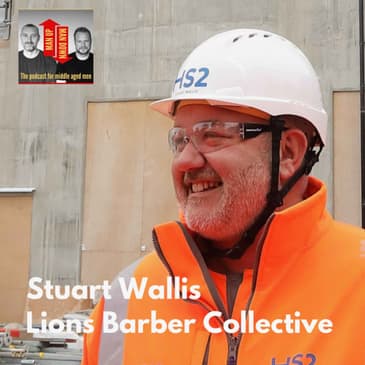
In this episode of "Man Up/Man Down," hosts David and Volker interview Stuart Wallis, an associate director at Mace, a global construction and consultancy company. Stuart shares his involvement with the Lions Barber Collective (LBC), a charity aiming to reduce male suicide rates, particularly in the construction industry, where the suicide rate is alarmingly high.
Stuart discusses the creation of safe spaces through LBC's pop-up barbershops on construction sites, offering workers not only haircuts but also an opportunity for open conversations about mental health. The initiative aligns with Mace's commitment to employee well-being, emphasising mental health alongside physical safety. Stuart recounts personal motivations stemming from his wife's illness and the impact of COVID-19 on his family, highlighting the importance of workplace support.
The discussion also touches on the challenges within the construction industry, including job instability, isolation, and the traditional macho culture that often discourages open dialogue about mental health. The LBC's approach, through Barber Talk Light training, empowers barbers to engage in mental health conversations, providing a unique avenue for support that complements traditional mental health resources.
Stuart's enthusiasm for the LBC's mission is palpable, as he shares stories of the positive impact on workers' morale and mental well-being. He encourages other organisations to embrace similar initiatives, stressing the broader applicability beyond the construction industry.
The episode concludes with a call to action for more awareness and support for mental health in the workplace, emphasising the LBC's role in fostering a culture of openness and care within traditionally stoic industries.
You can find out more about the LBC here: https://www.thelionsbarbercollective.com/
Hosted on Acast. See acast.com/privacy for more information.
[00:00:00] Welcome to the Man Up Man Down podcast presented by Volker Ballueder and David Pawsey.
[00:00:12] We discuss the pressures and challenges faced by men approaching middle age that we're often
[00:00:16] too embarrassed to speak about with our friends.
[00:00:20] You can find us online at www.manupdown.com.
[00:00:26] Enjoy the show and don't forget to subscribe and leave us a review.
[00:00:35] So welcome to another episode of Man Up Man Down.
[00:00:38] Today we welcome Stuart Wallace.
[00:00:41] So Stuart is an Associate Director of Maze, a global construction and consultancy company,
[00:00:46] shaping the future of the world we live and work in.
[00:00:49] Since 2022, Stuart has been the construction patron for the Lions Barber Collective,
[00:00:55] providing support to the LBC when working with companies across the construction sector
[00:00:59] to provide safe spaces via Lions pop-up barbershops.
[00:01:04] We go into all that in detail, so I'm kind of just reading it out.
[00:01:07] So the figures for men's suicide and construction are horrifying, with two men a working day
[00:01:13] dying from suicide in the construction sector alone.
[00:01:16] And Stuart is striving with the LBC to push these figures down.
[00:01:21] So there's a lot in there and there were four lines I read out.
[00:01:25] Stuart, first of all, welcome to the podcast.
[00:01:27] Thank you very much.
[00:01:29] Thanks for having me on the show.
[00:01:31] So when we're talking LBC, we're obviously talking about the Lions Barber Collective.
[00:01:35] So not that anyone thinks we are now on the radio, we're only doing podcasts, right?
[00:01:41] So I had to bring that up.
[00:01:42] No, absolutely.
[00:01:44] We are not part of the global media empire.
[00:01:49] Not yet, right?
[00:01:50] Neither are we.
[00:01:51] We're still waiting for Global to call us and go like, why don't you do the
[00:01:56] show for Global?
[00:01:57] Anyway, let's talk about you.
[00:02:00] Let's talk about MACE and let's talk about the great work you do with LBC, the Lions
[00:02:04] Barber Collective.
[00:02:05] Yeah, so MACE are a global construction and consultancy company.
[00:02:11] We work around the globe on projects such as the Shard.
[00:02:16] We built hotels in the Middle East, worked across Europe, currently working on projects
[00:02:22] such as HS2.
[00:02:23] HS2, doing a lot of work with there.
[00:02:26] Heathrow Airport, we've been there for over 30 years as part of the major construction
[00:02:32] work that is ongoing for such a vast project.
[00:02:38] The real vision and mission of MACE, we say we redefine the boundaries of ambition
[00:02:46] That can mean to you whatever you want it to mean.
[00:02:50] In the field of employee relations, which is my industrial relations, my specialism,
[00:02:57] it's about looking after the people that we work with every day.
[00:03:00] So all elements of health, safety and wellbeing.
[00:03:05] One thing that has become a particular passion of mine is talking about mental health and
[00:03:12] seeing that people have the opportunity to talk.
[00:03:15] So we make a big part of our inductions when people come to our project, regardless
[00:03:20] of what role they're going to play to deliver in our projects.
[00:03:25] We're here as colleagues, we want to go home safe and well every day, at least
[00:03:30] as well physically and mentally as when you arrive on the project.
[00:03:35] So always think about how I want to be treated at work, the facilities that I've
[00:03:39] got at work.
[00:03:41] And I've found work a great solace with some things happening in your private life,
[00:03:47] such as my wife has not been well the last couple of years.
[00:03:53] I'm sure she wouldn't mind me talking about that.
[00:03:56] She got diagnosed with breast cancer a couple of years ago.
[00:03:59] Sorry to hear that.
[00:04:01] The ability for me to talk to my colleagues at work and whether it was someone who
[00:04:09] worked directly for MACE or subcontractors on the project of all kinds and types, they
[00:04:16] be able to sit and have a coffee with someone and say, I'm having a tough day today.
[00:04:20] I had to tell my kids about the mum and support them and just having people listen
[00:04:25] was great.
[00:04:26] And I think for the macho industry that construction used to have and still to
[00:04:33] lesser extent has is not as prominent.
[00:04:38] You know, people will talk, people open up more and that's I think a success in
[00:04:42] itself that you can go onto a site and people will talk about feelings, stress
[00:04:47] and psychological issues that they may have and want to help each other.
[00:04:55] And it's something I've wanted to do.
[00:04:57] And I saw a pop-up barbershop on LinkedIn on another MACE site, a smaller MACE
[00:05:04] project.
[00:05:05] I thought, you know what?
[00:05:06] I need that on our project.
[00:05:08] I want to do this for our workforce.
[00:05:11] And that's where it was born from when I got in touch with Tom Chapman,
[00:05:15] who's the chairman of the Lives barbers and set up a meeting and it went
[00:05:20] from there really.
[00:05:21] So it's been an interesting, absolute joyful journey.
[00:05:26] You've got to take some joy out of providing these opportunities for our
[00:05:32] colleagues at work.
[00:05:34] And that's been it.
[00:05:35] And they've become friends for life as well, you know, and we talk to
[00:05:40] each other about our own trials and tribulations each day, but also what
[00:05:46] we can do to make the industry and the world a better place.
[00:05:49] You know, their core function is about preventing male suicide.
[00:05:55] That is their mission.
[00:05:58] Doesn't mean they won't do hair for and talk to anyone.
[00:06:02] They absolutely will.
[00:06:03] You know, male, female, people of all backgrounds.
[00:06:07] You know, they have specialists in technical specialists that can do
[00:06:12] Afro, for example.
[00:06:14] So it's really good.
[00:06:15] Really great.
[00:06:17] I love it.
[00:06:17] Second passion for me.
[00:06:20] So what are the Lion Barbers Collective exactly?
[00:06:24] So they just provide, as if they don't provide haircuts, right?
[00:06:29] Do they?
[00:06:30] No, they do actually.
[00:06:31] So if you go back to Tong, he experienced a close friend of his
[00:06:38] died from suicide in mid-20s, mid-teens, 20-teens.
[00:06:45] And he went to a funeral and he turned around and thought, wow,
[00:06:48] there's a lot of people here affected by this issue.
[00:06:51] I want to do something.
[00:06:52] I want to make a difference.
[00:06:54] So he started off with a lion's book for haircuts.
[00:06:58] You know, you go to barbers or hairdressers and you might see a
[00:07:01] book of potential haircuts long before you just Googled nice haircuts.
[00:07:07] And he was going to sell the book.
[00:07:09] And the reason the lions is he had barbers from England, Wales,
[00:07:13] Scotland and Ireland.
[00:07:15] And so a bit like Lion's Rugby is the Lion's Barber Collective.
[00:07:19] And any money raised, he was going to give to a charity such as
[00:07:22] Samaritans or a suicide prevention or help charity.
[00:07:28] And then he thought, actually we can do more for this.
[00:07:30] I want to do more.
[00:07:32] You know, he's a hairdresser's barber working in a shop.
[00:07:35] People tell me about their issues when they're sitting in the chair.
[00:07:39] I'd like to learn to do more.
[00:07:41] So he put himself through a mental health first aid course.
[00:07:44] Quickly realized it's difficult for a barber or hairdresser who's
[00:07:48] self-employed to do three or four days in a training session.
[00:07:52] Where you got the cost of the training, lost earnings.
[00:07:55] So he developed something called Barber Talk Lite, which trains barbers
[00:08:01] or hairdressers or beauticians in having those conversations with
[00:08:05] people sat in their chair and did a lot of research.
[00:08:09] I recommend on a movie length documentary about the 1.7 million
[00:08:17] pound haircut because they believe that all the evidence shows each
[00:08:22] suicide costs the economy 1.7 million, which always feels difficult
[00:08:30] talking about money associated with it.
[00:08:32] But a fact is the economy loses that sort of cost.
[00:08:37] So in the documentary you see him meet Dr.
[00:08:41] Akin who does that research, but also talks about people
[00:08:45] opening up with physical contact.
[00:08:48] And it's difficult on a construction site to have physical contact
[00:08:53] without getting in trouble, right?
[00:08:55] Unless you come up with something like having a haircut.
[00:09:00] So they provide pop-up barbershops on sites with trained
[00:09:05] professional barbers who are volunteers.
[00:09:08] They give up a day of their time.
[00:09:10] I think a few times a year they come along and provide half an hour
[00:09:15] slots for people to come along, book in or walk up, have a haircut
[00:09:21] and have a conversation.
[00:09:23] And I was skeptical at first about whether it would work because
[00:09:27] I thought a meter or so between each chair will people open up?
[00:09:32] Will they have a conversation?
[00:09:34] Wow.
[00:09:35] What on the day we did it, I think 55 haircuts done by five
[00:09:41] barbers on a project.
[00:09:44] People was coming in going, I'm not sure I can do this or I haven't
[00:09:49] had my hair cut for ages because I work six days a week.
[00:09:52] And when I get home, I got to clean my clothes, got to see my wife
[00:09:56] and family, then a barber's not open on a Sunday.
[00:09:59] So this is amazing Stu.
[00:10:01] And they would sit down and then come out of it.
[00:10:03] And you could see people lifted like this.
[00:10:09] It's like a world had been lifted off their shoulders from having
[00:10:11] a short conversation and a haircut, a good haircut as well.
[00:10:14] By the way, they are all excellent.
[00:10:17] And people coming over and giving me a hug.
[00:10:20] Right.
[00:10:20] And said, thank you so much for doing this.
[00:10:22] This is amazing.
[00:10:24] And the lift in morale on the project at Houston, this was
[00:10:30] HS2 Houston, was just, you could feel it.
[00:10:35] You know, when people ask you, why'd you do this?
[00:10:38] Why, what are we going to get out?
[00:10:40] Right.
[00:10:41] Was it a fair question?
[00:10:43] Cause we, you, you're spending quite a bit of cash as the donation to the charity.
[00:10:49] What, what is it we get out when you're there, you can feel it.
[00:10:54] Right.
[00:10:55] And I'm quite emotional.
[00:10:57] I had to go and have a little one, wander around after about three hours of
[00:11:02] seeing people going in and out, people talking to me and saying, you know,
[00:11:05] you know, this has made a massive positive impact on my week.
[00:11:09] I know the conversations remain confidential and, you know, we don't
[00:11:13] know who says what or who's got an issue in the subjects can range from
[00:11:18] people who generally just want a haircut.
[00:11:20] So they might sit down and talk about Jürgen Klopp leaving Liverpool at
[00:11:24] the end of the season or, you know, and if they're a Liverpool
[00:11:27] fan that might stress them out through to, you know, weird one person
[00:11:34] didn't want to have a haircut and kept coming in to tell us he
[00:11:36] didn't want to have a haircut.
[00:11:38] He only goes to a hairdresser's, you know, and he's, you know, bar
[00:11:41] bizarre, don't look after my luscious hair.
[00:11:44] And then at the end of the fifth time he came in, Tom said, listen,
[00:11:49] you can have a haircut if you want.
[00:11:50] You just sit down and have a head massage if you want.
[00:11:53] I ain't gone.
[00:11:54] He meant health issues.
[00:11:56] Finally sat down in the chair and he told us about his first marriage
[00:12:00] failing and then not being a very good dad because he worked away a lot
[00:12:03] and that stressed him out.
[00:12:05] And he's got remarried and more kids were taking his career
[00:12:11] incredibly seriously now.
[00:12:12] And he wanted to be a better person and a, a better employee,
[00:12:17] but a husband, better father, not enough to kill a world of
[00:12:21] better people.
[00:12:22] You know, and it was just great to see this tough, funny, you
[00:12:27] know, geezer that was coming in actually come out at the end
[00:12:31] saying thanks to you.
[00:12:32] That was brilliant.
[00:12:34] So we've done it a few times.
[00:12:35] I've spoken to other companies.
[00:12:37] So when the barbers go to talk to other construction companies, they'll
[00:12:40] ask me to come along as a reference if you like, or as a cheerleader
[00:12:46] as to why it's worthwhile.
[00:12:48] And that's been a great success.
[00:12:51] I'm incredibly proud of what they do and to be part of it.
[00:12:55] I mean that is, you know, that well there's got, there's quite
[00:12:59] a few sort of incredible things you've said there.
[00:13:01] I mean, I did actually had a look at the website and saw Tom's Ted
[00:13:05] talk that he did.
[00:13:07] And I mean, bearing in mind, I mean, this, this might sound like
[00:13:12] a very strange comment, but you know, we talk about suicide and the
[00:13:18] male rate of suicide on this podcast a lot and in some ways,
[00:13:23] you know, it could become, you can become almost desensitized to it.
[00:13:28] And watching like Tom's Tedx talk, I mean, it was, it was a good sort
[00:13:34] of example of public speaking because he, you know, sort of made a few
[00:13:37] jokes at the start and got the audience on side, but you know,
[00:13:41] sort of by the end of it, everyone was definitely silent.
[00:13:45] And, you know, as I say, I'm sort of, I've watched a lot of Ted
[00:13:48] talks, you know, particularly around male mental health and, and
[00:13:53] yeah, I was just sort of sitting here thinking, wow, you know, that,
[00:13:56] that was sort of, well, a powerful talk and a powerful mission.
[00:14:01] So yeah, I just, just wanted to say that, that, you know, that,
[00:14:04] that I was quite blown away by that.
[00:14:06] Um,
[00:14:06] It's incredible.
[00:14:08] That stuff.
[00:14:09] Yeah.
[00:14:10] I mean, so I guess one of my sort of questions is, you know,
[00:14:14] why do you think construction?
[00:14:16] Because I think, you know, we might've mentioned it, but it,
[00:14:20] it's an, isn't it, is it the got the industry that has the
[00:14:24] highest suicide rate or is it?
[00:14:26] I believe is, yeah.
[00:14:28] I think there's some industries would say it was such as emergency
[00:14:32] services, fire, fire fighters, several high rate as well.
[00:14:36] Well, it is very high, you know, in, you know, the rate of
[00:14:41] may male to female suicide is three to one naturally in
[00:14:46] construction, that goes three times more, you know, it's nine to one.
[00:14:50] And just shocking.
[00:14:53] Right.
[00:14:54] And it's six.
[00:14:55] So just for it in context, in construction, in the sixties,
[00:15:02] hundreds, five, six, 700 people a year were killed at work through incidents.
[00:15:09] Though the health and safety of worker came in 1974 and since then
[00:15:15] a steady decline in deaths at work.
[00:15:18] One is too many, right?
[00:15:20] But we're down to about 30, 30 to 35 a year from six, 700.
[00:15:26] And the effort's gone in massively.
[00:15:27] And now we're looking at physical health as well.
[00:15:30] Things like asbestosis or dust, dust mitigation by a different
[00:15:35] concrete and all that stuff.
[00:15:37] And brilliant.
[00:15:40] It's only now we're looking at suicide, mental health issues.
[00:15:46] And which is all fantastic stuff that we need to do.
[00:15:52] And I talk about mental health for a status at work and about having
[00:15:56] a conversation as a line manager.
[00:15:59] And what I find or found across the sector, across all sectors, in
[00:16:05] fact, is we say, here's an app.
[00:16:09] Here's a phone line.
[00:16:10] You know, here's a resource for you to go to, which I'm not belittling
[00:16:16] any of that, but I want to make it even easier for people to make that
[00:16:23] connection with someone in front of them.
[00:16:27] And sitting in front of a barber, you've never met before in your
[00:16:31] life, but they're great, aren't they?
[00:16:32] Right.
[00:16:32] You know, the whole going into a barber's summit for the weekend.
[00:16:37] So, you know, conversation.
[00:16:40] Well, it is full-month counsellor here.
[00:16:43] Hello, it's Volker here.
[00:16:45] I hope you enjoy this episode.
[00:16:48] You might not realise that I have been coaching for almost a decade
[00:16:52] through both third parties and private clients.
[00:16:55] During that time, I've worked with brands such as General Electric,
[00:16:59] Imperial Brands, DHL and Pepsi.
[00:17:03] However, this year I'm putting a big emphasis on growing my
[00:17:06] private coaching practice, improving lives of middle-aged men
[00:17:10] in leadership positions.
[00:17:12] So if you hit mid-life transition point and you might be a bit stuck
[00:17:16] or looking to improve your work-life balance, your career or productivity,
[00:17:21] you want to build a new habit, or you just want to become a
[00:17:24] better version of yourself, please hit me up.
[00:17:28] You can reach me on volker.natos.
[00:17:31] That's volker at obnat.us or LinkedIn, whatever is easiest.
[00:17:39] Thanks.
[00:17:40] And now back to the episode.
[00:17:44] Well, I think also though, you know, it is sort of for some men,
[00:17:47] it probably is the only hour or half an hour that they get
[00:17:52] that is purely just about them.
[00:17:54] Yeah.
[00:17:55] And I think just to go back to your question about why construction
[00:18:00] has this high rate of suicide, there is no single cause, I don't believe.
[00:18:10] But there are many.
[00:18:11] So it could be sort of that peripatetic nature of the work where you
[00:18:16] work, move from place to place to place.
[00:18:18] Might be working from home, loneliness, stress.
[00:18:24] It can be quite a casual industry.
[00:18:25] By that I mean, you've got a month, two months, three months,
[00:18:29] a week on a project and then you move onto the next one.
[00:18:33] You've got to try and find the next job.
[00:18:35] There might be a shortage of work.
[00:18:38] It could be being away from your family, your issues at home, money
[00:18:44] worries, it could be people at work that cause you an issue.
[00:18:47] You know, it is still a tough industry.
[00:18:49] You're working outside because you haven't built what you're building yet.
[00:18:53] Yeah.
[00:18:53] I was on a job on Wednesday, you know, climbing 15 stories.
[00:18:59] There are 15 sets of stairs up to the top floor to see the
[00:19:03] workforce on the top and it's windy and it's cold.
[00:19:07] And you do all you can to make the facilities great, the canteen great,
[00:19:11] put toilets or wherever people can get it.
[00:19:14] But still it's hard work and all these things play into affecting
[00:19:21] your mind and your mental health.
[00:19:25] So I would also make that better.
[00:19:26] And we strive to do that, right?
[00:19:28] Because I'm a decent person.
[00:19:30] I'm everyone who works for Mace, want people to be well.
[00:19:33] So we try our best, but you can't, you can't counter every issue that people have.
[00:19:40] And we talked, you know, we put on financial wellbeing sessions for
[00:19:45] people to come to, to our projects.
[00:19:48] Not everyone will come along.
[00:19:49] No one has got financial issues will come along.
[00:19:52] You have labor from other countries that come and work in the UK.
[00:19:57] Still, despite Brexit, you know, we have a, we won't go into whether
[00:20:03] that's good or bad.
[00:20:04] Yeah, let's not start politics now.
[00:20:08] No, it was a German in the room.
[00:20:11] But it has undoubtedly made it harder for people to come and work in the UK.
[00:20:16] So there's that stress and people being away from their families and
[00:20:19] their home for months, right?
[00:20:22] And then go back for a short period and then come back and earn some money.
[00:20:26] It's hard.
[00:20:28] So it's a tough game to be in.
[00:20:31] Not games, not the right word, but it's a tough industry to be in.
[00:20:34] And we recognize that and we've got to do something to help people.
[00:20:39] You can't, you can't fix everyone's problem.
[00:20:42] I was talking to one of the barbers at the Lions Awards,
[00:20:47] Lions Barbers Awards last year.
[00:20:50] And she was absolutely distraught that someone she knew had died from suicide.
[00:20:57] And I said, Oh, it's awful for you.
[00:21:01] But do you know how many you've saved?
[00:21:03] Right.
[00:21:04] Each one you've saved.
[00:21:05] You can't save them all was the point.
[00:21:08] But what you have done is amazing.
[00:21:12] You've made people say it feel listened to for a short period of time.
[00:21:18] So, and I think that is great what they're doing.
[00:21:22] So by doing the pop-ups on site is good for us and good for the
[00:21:25] mental health of our workforce and the charitable donation that is made by
[00:21:30] the contractors, obviously there's costs associated with it, but anything
[00:21:34] that is there, there's not profit made.
[00:21:37] It goes into training more hairdressers, more barbers, more beauticians.
[00:21:41] So that I would love to see this become part of the curriculum for when
[00:21:46] people are training and being an apprentice as a hairdresser or barber.
[00:21:51] So that people that are in their shops know how to look out.
[00:21:53] For the signs.
[00:21:55] And that's incredible, right?
[00:21:57] I'm in my brother's barber.
[00:21:58] So I have a dual loyalty to this and I can see the difference he makes
[00:22:05] to his customers and obviously construction is my passion of 20 odd years
[00:22:11] working in the sector.
[00:22:12] So if I can tie those two things together, great.
[00:22:16] And Tom and my good mate now, Dan is my barber.
[00:22:25] I know there's not much to cope on that because he used foils on my hair.
[00:22:30] You know, they're great people.
[00:22:32] My son loves going to see Dan.
[00:22:34] You know, he's 12 coming up 13, good footballer.
[00:22:39] Covid didn't do his mental health any good.
[00:22:41] You know, he really struggled with it.
[00:22:44] So when he goes to see Dan, they do have a mental health conversation.
[00:22:49] You know, Frankie will talk about football, but Dan will make sure
[00:22:52] he asks how he is and just knowing that person who's looking after your kids.
[00:22:58] And that doesn't change, right?
[00:23:00] I'm 46.
[00:23:01] My dad asks me how I am and he wants to make sure people
[00:23:03] know I'm looked after and it's the same.
[00:23:07] You're like, he knows what he's doing there.
[00:23:09] He's talking to someone.
[00:23:11] It's incredible what they're doing.
[00:23:13] Have you sort of noticed that from, you know, kind of creating an environment
[00:23:20] where so they're going to the barbers and they're talking, has that meant
[00:23:25] that like when they go back to work, have you noticed if, you know,
[00:23:30] workers are sort of, you know, I'm not saying that they're, you know,
[00:23:34] suddenly kind of like, you know, oh, no, let me make you a cup of tea.
[00:23:40] But yeah, you know, I just wondered whether, you know, have you noticed
[00:23:45] that there's sort of a bit more openness on site or, you know,
[00:23:49] or in offices, et cetera?
[00:23:51] Yeah.
[00:23:52] It is.
[00:23:53] No, they didn't make me a cup of tea for sure.
[00:23:57] In the immediate aftermath of someone coming out of the chair,
[00:24:02] like it was just, it just sounds really weird, but the smile on their
[00:24:08] face was like, you just don't see that at work when they're going out
[00:24:13] in this cold outside and they're going to go back and operate a massive
[00:24:17] piece of machinery, a crane or something, right?
[00:24:19] Or one of them's a crane driver.
[00:24:21] And yeah, that was incredible.
[00:24:24] And that feeling and hearing people talking around the site going,
[00:24:29] you haven't the barbers back.
[00:24:31] That was great that day.
[00:24:32] And other projects over the road, right?
[00:24:35] A rival project to us.
[00:24:37] And hearing their workforce go, come pass, they're doing free
[00:24:42] aircoats on that job.
[00:24:43] Because that's what you always said, right?
[00:24:45] Was free aircoats today.
[00:24:47] Because you'd be coming and say, come and have a mental health conversation.
[00:24:50] People go, I don't really want people to know I'm struggling.
[00:24:54] Come and have a free aircoat.
[00:24:56] And then you get in the chair and the barber says, listen, this is
[00:24:58] what we do, this is why we do it.
[00:25:01] What are you having?
[00:25:02] And now what are you?
[00:25:04] And then they'll ask again.
[00:25:05] Yeah.
[00:25:07] And if I say most, most people, I mean, you just mentioned your, your
[00:25:10] lack of hair, but, um, you know, looking at David, you know, I've
[00:25:13] seemed to be the only one that regularly needs to go to a barber,
[00:25:16] but it does come to here, but it's just so great.
[00:25:19] You can't, and when you got the bit of overhead lighting,
[00:25:23] it looks worse than it is as well.
[00:25:26] I have a beard trim.
[00:25:27] That takes longer.
[00:25:28] Yeah.
[00:25:28] To be honest, I, I need to get that regularly as well, but I think,
[00:25:32] you know, we all need to go to the barbers at some point or another.
[00:25:35] Right?
[00:25:35] So I think it's, it's such a no brainer.
[00:25:38] And what I'm, you know, what, what you said as well, right?
[00:25:41] We said, there's a construction industry.
[00:25:44] Traditionally, you know, it's, it's a tough man's work, right?
[00:25:48] You know, there's a tough lads out there.
[00:25:50] Um, they don't cry, right?
[00:25:52] They don't talk about their feelings, you know, not know whatever
[00:25:55] went on a construction site and go like, Oh, you know, I don't want
[00:25:58] to be here because you, you, you man up and just get on with your job.
[00:26:03] So I think it's, it's, it's a brilliant way of how to best face it.
[00:26:07] If I say almost like getting people to talk without, you know, because if
[00:26:12] you put up a side as you say, right?
[00:26:14] Oh yeah.
[00:26:14] Men mental health counseling, free therapy, you know, um, construction
[00:26:18] site over here, people got like, Oh, we don't need that.
[00:26:21] Right.
[00:26:21] We, we, we as a tough guys.
[00:26:24] So I think it's, it's, it's genius.
[00:26:26] It really is.
[00:26:27] I think they, um, talk it to the barbers after and, and, you know, we had
[00:26:33] obligatory photo shoot with the site behind it.
[00:26:35] And, um, I went around and spoke to all of them and said, that was amazing.
[00:26:41] Do you understand the impact you have on all these people's lives
[00:26:45] that you've seen today?
[00:26:46] I'm in a waiting list of 30 by the way, but I couldn't make
[00:26:49] them work for any longer barbers.
[00:26:51] So they need to go home.
[00:26:53] Uh, but yeah, you're right.
[00:26:55] It is a brilliant idea.
[00:26:57] And, you know, I'm not a salesman.
[00:27:01] I hate sales and especially when someone's selling to me, but on this
[00:27:05] subject, on the different calls I've been with, you know, uh, peer companies.
[00:27:11] I can sit there and talk and they go like, well, I will sign that off
[00:27:15] because it is amazing what they do.
[00:27:18] And I think it complements what we do really well as a business because
[00:27:24] you know, there's a real basic needs of going to work, make sure you're paid.
[00:27:32] It's a nice clean environment to work in, which is hard on the construction
[00:27:36] side, but we work really hard, you know, decent welfare, so food, drink,
[00:27:41] that sort of stuff, we try and do that and train our people to spot
[00:27:44] signs if someone's not right.
[00:27:46] And we say that to every single person that's on there.
[00:27:49] So our supervisors, our managers, but it's still making it accessible.
[00:27:59] We're not having to make that call, right?
[00:28:02] We are, I mean, I'm bad enough with phoning the GP when I've got a sore
[00:28:05] knee trying to make the call.
[00:28:08] Said it's a bit out of my day.
[00:28:10] I've got other things to do.
[00:28:12] You know, I'm being silly.
[00:28:13] It's just a sore knee.
[00:28:15] If I was struggling mentally to tell someone, I'll take you to ending this.
[00:28:22] Wow.
[00:28:23] That's a hell of a call to make, right?
[00:28:26] But I'll be in a barbers chair and it flows out then.
[00:28:30] Great.
[00:28:32] I mean, I think you've hit the nail on the head in several ways there.
[00:28:36] And it is such a kind of common thread that we get in the number of
[00:28:43] people we've had on here.
[00:28:44] It's like, well, we realize that you get men in a room and say, right, chat.
[00:28:49] They don't.
[00:28:49] But if you give them something, yeah, if you create the right
[00:28:54] environment, it then comes naturally.
[00:28:57] And you know, and sort of, you know, obviously made a joke about hair.
[00:29:01] And I've just all-
[00:29:03] Just because I can.
[00:29:05] Well, I mean, I've recently just gone to going for the number one,
[00:29:11] just shaving it all off, you know, and it's like, oh, well I'm saving myself money.
[00:29:16] And I did actually sort of think, well, actually, you know, I am missing out on
[00:29:21] that sort of little window.
[00:29:23] And yeah, and you know, I've, I sometimes my beard gets a lot of
[00:29:27] bushy and I think, you know, I was thinking, well, maybe I'll just book
[00:29:30] myself in and say, well, I want number one all over on top, but, you
[00:29:34] know, have a shave and a beard trim because, you know, it's like, well,
[00:29:38] actually it is, you know, an experience.
[00:29:42] And, you know, I do have forums where I can talk, so I guess it's not
[00:29:47] necessarily about that for me, but it's that realization, well,
[00:29:51] actually that might be the only time that, you know, as I say,
[00:29:56] someone, a guy gets to talk, you know, it is perhaps the only time
[00:30:00] he's been asked that month, what have you been up to?
[00:30:04] Man Up Man Down is sponsored by Well Doing.
[00:30:07] As someone who has seen a counselor for a number of years, I think
[00:30:09] their approach is great.
[00:30:11] They want you to find the mental health professional who is right
[00:30:13] for you.
[00:30:14] You can filter your search to highlight therapists with expertise
[00:30:17] where you need it, or you can pay to use their personalized matching
[00:30:20] service.
[00:30:22] The people who run Well Doing are experts in mental wellbeing and
[00:30:25] they also have loads of posts and interviews to keep your mental
[00:30:28] health in good shape.
[00:30:29] Take a look at welldoing.org.
[00:30:32] You know what, for me going to the barbers, because I work from home
[00:30:36] 99% of my time, right?
[00:30:38] I mean, I see the family regularly, you know, if I say I don't have
[00:30:41] many friends, you know, I have friends and I see them regularly,
[00:30:44] but sometimes they don't get out at all all day, right?
[00:30:47] So if I go to the barbers, you know, once of a sudden I have
[00:30:50] to go to town.
[00:30:51] I have a reason to go to town, right?
[00:30:52] I don't do school runs anymore.
[00:30:54] Right.
[00:30:55] So once of a sudden I'm in town, I meet people, I talk to my
[00:30:58] barber, he has the latest gossip, what's happening and has
[00:31:00] this right, which is great, right?
[00:31:02] He knows about the new construction of, you know, hopefully a
[00:31:06] restaurant and flats and, you know, instead of the tire center
[00:31:09] we had for years and all these little nuggets, right?
[00:31:12] You get, and actually I had to rebook because I'm travelling in
[00:31:15] two weeks time.
[00:31:15] I had to rebook my barber's appointment.
[00:31:18] And by the way, COVID, now we're talking about barbers here,
[00:31:20] but COVID revolutionized barber, I say barber appointments for me,
[00:31:24] right?
[00:31:25] Don't have to sit there anymore for hours.
[00:31:28] How do you politely say no to someone else, right?
[00:31:31] When you want to see someone, someone different and it's just,
[00:31:36] yeah, you just get out to your point, David, right?
[00:31:38] It's great.
[00:31:39] It's great.
[00:31:39] And, you know, as the money you spend, you easily get back in
[00:31:43] terms of, you know, absolutely.
[00:31:45] Yeah.
[00:31:45] Oh, I mean that, that's the other bit that sort of, you know,
[00:31:49] again, you're not the first guest that's come on here, talked
[00:31:52] about mental, an aspect of mental health and then said,
[00:31:56] Oh, and this, you know, when you put a figure on it and then
[00:31:59] suddenly is almost like when it's like, Oh, Oh, it's costing
[00:32:03] us how much?
[00:32:04] Right.
[00:32:04] We'd better do something about that.
[00:32:06] Yeah.
[00:32:07] You know, when it's like, well, it's a, well, yeah, there
[00:32:11] is a lot more to a person than a monetary value, but you
[00:32:15] know, the sad thing is that is how you get the board or the
[00:32:19] shareholders attention, you know,
[00:32:21] Obviously you're not saying that about Mace at all.
[00:32:24] No.
[00:32:25] I see.
[00:32:26] I wouldn't listen.
[00:32:27] You've got to justify it's a private company, right?
[00:32:30] And you've got to be able to afford it.
[00:32:32] And the project that I did it on is a public funding
[00:32:36] company.
[00:32:36] So we're paying taxpayers money out, right?
[00:32:39] So you've got to make sure it's good value.
[00:32:41] So there's nothing wrong in saying, is this the right
[00:32:45] thing to do?
[00:32:46] And then you say, well, of course the economy 1.7
[00:32:50] million for every suicide.
[00:32:52] So yeah, it's worth it.
[00:32:54] But if we save a life and it's crass, maybe if you just
[00:32:59] crass, but I don't, I don't care.
[00:33:01] I want someone to live.
[00:33:03] And if there's a cost benefit to that even better,
[00:33:07] but you should, you should challenge it.
[00:33:09] You should challenge what you're doing.
[00:33:11] Is it the right thing?
[00:33:12] Don't make a box ticking.
[00:33:13] We don't want to tick boxes here.
[00:33:15] We want to make a difference.
[00:33:17] And what we've done on the project is we've done
[00:33:22] on the projects with the barbers that day and the
[00:33:26] ongoing conversations of what are you bringing them
[00:33:29] back?
[00:33:30] Are they here again tomorrow?
[00:33:31] I'm like, no, no, I'll do it every day.
[00:33:33] Right.
[00:33:33] This is only a cost more than the station to
[00:33:36] build, but, but it is incredible.
[00:33:41] What you can, we do all the things right.
[00:33:43] So I mentioned the inductions before and you
[00:33:46] try and get people to talk and you get that.
[00:33:49] This is the first impression.
[00:33:50] Someone comes onto your project and you are the
[00:33:52] face on the face of Houston.
[00:33:55] All right.
[00:33:55] That's probably not a good thing, but you get to
[00:33:58] a bit about you do.
[00:34:00] I've put mental health before physical health.
[00:34:04] So we're the first aid boxes and hospitals and
[00:34:07] all that sort of stuff.
[00:34:08] Right.
[00:34:08] Mental health comes up first.
[00:34:09] You say, do you think we have a problem with
[00:34:11] our industry with mental health?
[00:34:13] Most people say yes.
[00:34:14] Right.
[00:34:15] Let's put it in the room and say yes, we do.
[00:34:16] And then you hit them with the stats.
[00:34:20] Two men per day.
[00:34:22] That's 600 a year.
[00:34:23] Right.
[00:34:23] We've got 400 on our project.
[00:34:25] That's more than we're on.
[00:34:26] That's more people than we have on this job.
[00:34:29] Um, so we show a video, which is really powerful
[00:34:32] video called over the edge and it was shot on
[00:34:35] a bam, not all site.
[00:34:36] And it's really good because they can relate
[00:34:38] to it.
[00:34:39] They can see the people, they can see
[00:34:40] themselves in this video.
[00:34:42] Then you try and bring it to life yourself
[00:34:43] with the real life stuff.
[00:34:44] So I talk about the issues are about dealing
[00:34:46] with Jackie being poorly.
[00:34:49] I say, look, I didn't come here and talk to
[00:34:52] you guys openly about this, which I would
[00:34:55] never have done five years ago.
[00:34:57] Well, I wouldn't have stood in front of
[00:34:58] a room.
[00:34:59] 40 people have never met before.
[00:35:01] Like literally they turned up that day
[00:35:03] and say, listen, we need to talk about
[00:35:05] this because I struggled with hours going
[00:35:08] to tell my children and dealing with that.
[00:35:10] And my son was fine.
[00:35:12] Actually he understood it because I told him
[00:35:14] she was going to be all right.
[00:35:15] Daughter not absolutely.
[00:35:18] That was hardest conversation, but telling
[00:35:21] people in front of you and then they
[00:35:23] start opening up and go, well, this
[00:35:24] happened to me.
[00:35:26] This happened to me.
[00:35:27] Or if I don't tell a story about
[00:35:29] Jackie, I talk about COVID and say,
[00:35:31] you know, my son was all of a sudden
[00:35:33] locked down because he couldn't see
[00:35:37] his friends at school.
[00:35:39] Didn't have to do online learning,
[00:35:41] which he hated and hates a strong word,
[00:35:44] but he hated it.
[00:35:45] And he quickly realized if dad was
[00:35:47] incapacitated, he wouldn't have to do
[00:35:50] his schoolwork because dad wasn't able
[00:35:53] to do it.
[00:35:53] I was furloughed at the time.
[00:35:55] And so I was the teacher, I was
[00:35:58] dad, I was teacher, I was football
[00:35:59] coach and disciplinary and all that
[00:36:01] stuff.
[00:36:03] So he would try ways of like, if
[00:36:05] I would go for a shower, I'd lock
[00:36:08] me in the bathroom.
[00:36:10] So no, he didn't have to do it.
[00:36:12] But it really messed with his head.
[00:36:16] This kid went from this lively,
[00:36:18] outspoken, beautiful boy to real,
[00:36:24] you're angry all the time and you
[00:36:26] have to deal with that.
[00:36:28] I mean, eventually I spoke to
[00:36:29] the schoolers like, you've got
[00:36:30] emergency workers in, journalists.
[00:36:34] You got their kids in because
[00:36:35] they're journalists and they're
[00:36:36] emergency worker.
[00:36:37] I thought that would be an
[00:36:38] ambulance driver.
[00:36:39] I've got this kid who's trying
[00:36:40] to hurt me, you know, and he
[00:36:43] doesn't want to, but it's about
[00:36:44] getting out of this.
[00:36:46] So we need to deal with his
[00:36:47] mental health.
[00:36:48] They took him back to school.
[00:36:49] Things that have in that
[00:36:50] conversation at work, it helps
[00:36:53] me.
[00:36:54] I'm in a good place where I
[00:36:56] have a great job for a great
[00:36:58] company, a good home life for
[00:37:00] an family.
[00:37:01] And I count my blessings every
[00:37:02] day and want people that I
[00:37:06] work with to feel like at
[00:37:07] least they're listened to and
[00:37:09] respected at work and they can
[00:37:10] come to me if they want.
[00:37:12] And I always say to them, if
[00:37:13] you've got a problem at work
[00:37:16] or you just need someone to
[00:37:17] talk to, find me.
[00:37:19] Just ask anyone that gives
[00:37:20] him a number.
[00:37:22] Every time I see him, that's
[00:37:24] what we should be doing more
[00:37:26] of that.
[00:37:27] You sort of mentioned about
[00:37:29] well how long you've been,
[00:37:30] you know, as an organisation
[00:37:32] at Heathrow and you know, and
[00:37:35] I'm sort of thinking there's
[00:37:36] obviously with these product
[00:37:38] projects, there's such a kind of
[00:37:40] long term aspect to them.
[00:37:44] And I'm thinking there's, you
[00:37:45] know, almost like a very long
[00:37:47] term, well not very long term,
[00:37:48] but a longer term sort of
[00:37:50] aspect to this and there's an
[00:37:53] element of sort of paying it
[00:37:54] forward.
[00:37:56] And you know, I'm sort of
[00:37:57] thinking, well how many of
[00:37:59] these guys that worked on
[00:38:01] building sites?
[00:38:03] And so again, it's almost
[00:38:05] like is this the first time
[00:38:07] that they're being exposed to
[00:38:09] this sort of environment, you
[00:38:12] know, open environment and
[00:38:13] talking about your feelings.
[00:38:15] Yes.
[00:38:16] And then actually they're
[00:38:17] going home and speaking to
[00:38:19] their children about it where
[00:38:21] you know, their father or
[00:38:22] parents didn't.
[00:38:24] Oh yeah.
[00:38:25] Possibly.
[00:38:26] I think it is a case, I
[00:38:28] would say over the last five,
[00:38:30] ten years, let's say five,
[00:38:32] ten years, people are paying
[00:38:33] more attention to mental
[00:38:35] health and it gets better
[00:38:37] and then I have no criticism,
[00:38:39] any initiative in
[00:38:41] construction, in dealing with
[00:38:43] mental health.
[00:38:44] I think it's all good.
[00:38:45] The more we do the better.
[00:38:47] But yes, I think there are
[00:38:49] the conversations where
[00:38:51] people will go home now and
[00:38:52] say, shall we did this
[00:38:53] amazing thing?
[00:38:55] Absolutely amazing thing at
[00:38:57] work today.
[00:38:58] And we talked about our
[00:38:59] feelings or I just talked to
[00:39:03] a colleague about what's going
[00:39:05] on.
[00:39:06] So yeah, it is tremendous.
[00:39:08] And I think the other great
[00:39:10] thing that's happening in
[00:39:11] construction is people are
[00:39:12] realizing it's not 1980s,
[00:39:15] 1970s and building and we're
[00:39:17] making these amazing projects.
[00:39:19] More people are seeing
[00:39:20] construction as a career.
[00:39:24] So we've got to deal with
[00:39:25] these issues because if we're
[00:39:27] going to make it an
[00:39:28] attractive, well-paid,
[00:39:31] enjoyable thing to do, we've
[00:39:33] got to look out for each
[00:39:34] other, haven't we?
[00:39:35] I mean, my kids love
[00:39:37] construction now.
[00:39:38] I don't know whether they're
[00:39:38] going to go into it, but
[00:39:40] everywhere we go, they go,
[00:39:41] dad, that's a Mace project.
[00:39:43] Dad, did Mace build this
[00:39:45] terminal?
[00:39:46] Yeah.
[00:39:46] And then we went to New
[00:39:47] York and they're like,
[00:39:48] dad, there's Tiffany's.
[00:39:49] Mace did that.
[00:39:50] You're like, yeah, man,
[00:39:51] this is brilliant.
[00:39:53] Dad just doesn't work with
[00:39:54] people with shovels.
[00:39:55] You know, it's an amazing
[00:39:57] industry.
[00:39:58] And I think the more we
[00:40:00] can do to secure each
[00:40:01] other and things like
[00:40:03] Alliance who I love, you
[00:40:04] know, I have a pin badge
[00:40:06] in whatever suit I'm
[00:40:07] wearing.
[00:40:08] I said a pin badge off and
[00:40:09] I put the lion back on
[00:40:10] and it goes everywhere
[00:40:11] with me.
[00:40:11] It's good conversation
[00:40:13] starter.
[00:40:13] Like are you a Millwall
[00:40:14] fan?
[00:40:15] No, this is the Lions
[00:40:16] World Collective.
[00:40:16] You can't quite miss it.
[00:40:18] So yeah, it is brilliant.
[00:40:20] Fantastic.
[00:40:22] This is such an
[00:40:23] important topic, right?
[00:40:24] Because it's, I mean, we
[00:40:26] talk a lot of us
[00:40:26] construction industry, but
[00:40:28] it can be any industry,
[00:40:29] right?
[00:40:29] Yeah.
[00:40:30] And then there's so much
[00:40:32] more we need to do, which
[00:40:33] is why we do the podcast,
[00:40:35] right?
[00:40:35] I mean, don't want to blow
[00:40:36] my own trumpet here,
[00:40:37] but it's like that's,
[00:40:40] you know, just, just,
[00:40:41] just to talk more about
[00:40:42] it and creating more
[00:40:43] awareness.
[00:40:44] You're right.
[00:40:45] I mean, so I'm
[00:40:46] construction biased,
[00:40:48] but the Lions are not,
[00:40:49] right?
[00:40:49] They've worked with major
[00:40:52] household names, shall
[00:40:54] we say.
[00:40:55] Yeah.
[00:40:56] And I think they are
[00:40:59] doing incredible things.
[00:41:00] You know, the, the whole
[00:41:02] British GT thing came about
[00:41:04] from a well-known
[00:41:06] marketing and advertising
[00:41:08] company.
[00:41:09] And they are, they
[00:41:10] organized the sponsorship
[00:41:11] and they organized it.
[00:41:12] The press that goes with it.
[00:41:14] And I think whatever
[00:41:16] sector you put this in,
[00:41:18] it works.
[00:41:19] It just works.
[00:41:22] And I think, you know,
[00:41:24] I'm never going to stop
[00:41:25] blowing the trumpet for,
[00:41:26] for Tom and, and the
[00:41:28] charity and my man,
[00:41:30] Dan, who always says,
[00:41:31] don't mention me,
[00:41:32] but he is incredible.
[00:41:34] Right.
[00:41:34] He's the lead barber.
[00:41:36] He's super and Cara and
[00:41:38] all the people that
[00:41:39] work from there.
[00:41:39] Amazing.
[00:41:40] Can't say enough good
[00:41:41] stuff about it.
[00:41:43] Yeah, it does.
[00:41:44] It does sound like an
[00:41:46] amazing initiative.
[00:41:47] So if there are other
[00:41:49] organizations out there
[00:41:51] that want to get the
[00:41:52] Lions in, how do they
[00:41:53] go about that?
[00:41:55] Look at what first on
[00:41:56] their website, Lions
[00:41:57] barber collective,
[00:41:58] search on Google.
[00:41:59] It comes up right.
[00:42:00] Nice and easy.
[00:42:01] All the search engines
[00:42:02] are available.
[00:42:03] I suppose it's insane.
[00:42:04] I look me up on LinkedIn
[00:42:07] Stuart Wallace,
[00:42:08] Tom Chapman's on there
[00:42:09] as well.
[00:42:11] Reach out.
[00:42:11] You know, we will talk
[00:42:14] and help and we want
[00:42:17] to see this go further.
[00:42:19] They're on Instagram
[00:42:20] as well.
[00:42:21] You can see their
[00:42:22] latest pop-ups on there.
[00:42:23] And we'll look out for
[00:42:24] on the British GT
[00:42:27] as it comes in there.
[00:42:27] A GT4 car next year.
[00:42:29] You'll see the car Tom
[00:42:31] and Ian Goff are the two
[00:42:33] drivers.
[00:42:34] It's like a pro am so
[00:42:35] yeah, raising awareness.
[00:42:38] Getting it out there.
[00:42:40] Awesome.
[00:42:41] But yeah, I mean sort
[00:42:43] of going back to what
[00:42:44] Volker just said.
[00:42:45] That was something that
[00:42:46] did occur to me when
[00:42:47] I watched Tom's video
[00:42:49] or his Ted talk on
[00:42:51] the Lions collective website.
[00:42:53] And you know, he's like
[00:42:54] I walked in 2015
[00:42:56] and I'm like, God,
[00:42:58] you know, we're almost
[00:42:59] a decade on and
[00:43:01] you know, it's like
[00:43:03] obviously so much work
[00:43:05] has been done.
[00:43:06] But yeah, it's still
[00:43:09] a lot more needs to be done
[00:43:11] because, you know,
[00:43:12] yeah, if not our friends
[00:43:14] and our friends are friends
[00:43:16] that are dying because
[00:43:18] they don't have someone
[00:43:19] to talk to.
[00:43:20] So and I think
[00:43:22] sorry, I'm going on
[00:43:23] a bit of a ramble now,
[00:43:24] but I mean, another
[00:43:25] another point you made is,
[00:43:28] you know, a common thing
[00:43:29] with if you sort of
[00:43:30] discuss mental health issues,
[00:43:33] a lot of people are,
[00:43:35] well, you know,
[00:43:36] let me know if you want to talk.
[00:43:38] And the thing is,
[00:43:39] it's like when you're going
[00:43:40] through a bad mental
[00:43:42] health episode,
[00:43:43] a lot of that narrative
[00:43:44] is I'm useless
[00:43:46] and I'm a burden.
[00:43:47] And then the last thing
[00:43:49] you want to do is
[00:43:50] vote someone out and go,
[00:43:51] I'm feeling like
[00:43:52] I'm going to kill myself
[00:43:54] and, you know,
[00:43:55] and it is just like,
[00:43:56] oh shit, what do I do?
[00:43:57] You know, 100%.
[00:43:59] I think it is,
[00:43:59] you know, just trying to get people
[00:44:01] in an environment where
[00:44:03] they then can talk
[00:44:04] if they need to
[00:44:05] or just making, you know,
[00:44:07] it just a lot more natural
[00:44:09] to say, lads,
[00:44:12] I'm struggling.
[00:44:13] It is so important
[00:44:15] and I meet people
[00:44:16] getting more and more open
[00:44:17] to having a good conversation
[00:44:20] and saying,
[00:44:22] I need help
[00:44:23] or I'll just add
[00:44:24] a rubbish day.
[00:44:27] Someone listen,
[00:44:28] because it's not always
[00:44:29] your partner you live with, right?
[00:44:30] You might have both had a bad day
[00:44:32] and that is a recipe.
[00:44:33] It doesn't always work, does it?
[00:44:35] Right.
[00:44:36] You've had a bad day
[00:44:37] and someone comes there and go,
[00:44:38] well, I've had a more bad day
[00:44:39] than you have.
[00:44:40] All right.
[00:44:41] Yeah.
[00:44:42] You know,
[00:44:43] and you can't always go to the pub
[00:44:44] and see your pals
[00:44:45] because that's
[00:44:46] that's just not good.
[00:44:47] That's just going to exacerbate it.
[00:44:49] But I mean, someone like
[00:44:51] I will text Dan or Tom
[00:44:53] and say, how you doing, bro?
[00:44:56] Yeah.
[00:44:56] Send the love.
[00:44:57] And, you know,
[00:44:59] we might talk about wrestling.
[00:45:00] Tom is massively into wrestling.
[00:45:01] I have to tell you
[00:45:02] one funny story right
[00:45:03] before we finish.
[00:45:04] So I met up with Tom
[00:45:06] when he first started.
[00:45:07] And obviously,
[00:45:08] when he worked for Mace,
[00:45:09] obviously apart from me today,
[00:45:10] I'm in a jumper,
[00:45:11] but it is blue suits
[00:45:13] and, you know, look in the biz.
[00:45:15] And so I took him in,
[00:45:17] met Tom and he turned up
[00:45:19] and I mean,
[00:45:20] he looks stunning.
[00:45:21] Like he could be Aquaman.
[00:45:22] This guy.
[00:45:24] Tattoos, long flowing hair,
[00:45:27] vest, shorts.
[00:45:28] So I took him
[00:45:29] he's probably googling him now.
[00:45:32] I took him into the office
[00:45:34] and walked right past all the desks
[00:45:37] and all the suits.
[00:45:38] They're like,
[00:45:39] who is Steve Roy in today?
[00:45:41] You know,
[00:45:43] this is my guy.
[00:45:44] This is where you're going to pay
[00:45:45] for to come and help us.
[00:45:47] And he just,
[00:45:48] you know, he's a conversation star.
[00:45:50] He's just brilliant.
[00:45:52] You know,
[00:45:54] much love for Tom.
[00:45:54] I think he's an incredible guy.
[00:45:57] Well, perhaps we might try
[00:45:59] and get him on at some point.
[00:46:01] Not saying that you're not
[00:46:02] good enough for a stupid.
[00:46:04] No, and listen,
[00:46:05] I have very much the sideshow
[00:46:07] he is.
[00:46:08] I mean, he's conscious of
[00:46:10] this is about the Lions,
[00:46:11] why it's not the Tom Chapman show.
[00:46:13] But, you know,
[00:46:14] you've got to pay him credit
[00:46:15] for it, for what he started
[00:46:16] and what he's created.
[00:46:17] And this is why I do it.
[00:46:19] You know, I volunteer
[00:46:20] to support them and long may it continue.
[00:46:24] More power to their elbow.
[00:46:26] So I Googled him.
[00:46:27] You're right.
[00:46:28] He looks there.
[00:46:29] How tall is he?
[00:46:30] He looks quite tall as well.
[00:46:31] I reckon he's got,
[00:46:32] he's over six foot six,
[00:46:33] two, six feet, somewhere like that.
[00:46:35] Yeah, so it's not as tall as you, Valka.
[00:46:37] I don't think he's tall there.
[00:46:40] But it looks like he's a,
[00:46:41] he's a bit broader built than me.
[00:46:44] He's in the gym every morning.
[00:46:46] Massive.
[00:46:46] I think his actual dream, right?
[00:46:48] Genuinely, to be an American wrestler.
[00:46:52] I think he could be one
[00:46:52] of the sisters to the picture.
[00:46:54] I mean, I'm in the gym every morning,
[00:46:55] but look at me.
[00:46:58] Hey, Frankie calls him Roman Reigns.
[00:47:02] Right.
[00:47:02] Well, on that note,
[00:47:04] it's probably time to wrap up.
[00:47:07] So yeah, sorry for objectifying you, Tom.
[00:47:09] If you're listening.
[00:47:12] But yeah, anyway, go and check out Tom
[00:47:14] and the wonderful work
[00:47:15] that he does for Reigns while the collective.
[00:47:18] Thanks very much, Stuart.
[00:47:19] Take care.
[00:47:20] Thank you guys.
[00:47:20] See you soon.
[00:47:21] Yes.
[00:47:25] Thanks for listening to this week's episode.
[00:47:28] Feel free to reach out to Volker or David
[00:47:30] via our website,
[00:47:31] www.manupdown.com
[00:47:34] or podcast at manupdown.com
[00:47:36] with any feedback
[00:47:37] or to let us know what topics
[00:47:38] you'd like us to cover in the future.
[00:47:40] Hear you again soon.