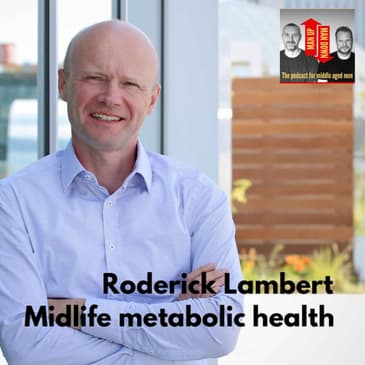
In this episode of "Man Up Man Down," hosts David and Volker welcome Roderick Lambert, who specialises in helping midlifers lose weight and regain metabolic health. Roderick shares his personal journey of struggling with obesity for 15 years until a doctor's warning prompted him to delve into nutrition and fitness, leading him to not only lose over 20 kilograms in six months but maintain it.
Roderick explains that obesity and related health issues stem from cellular and sub-cellular dysfunction, particularly within the mitochondria. He emphasises the importance of looking beyond just food and exercise, suggesting that light, water, and magnetism also play crucial roles in metabolic health.
The conversation covers the historical shifts in human lifestyle, particularly the move towards an industrialised society, which has led to increased indoor living, convenience food consumption, and a departure from our evolutionary dietary patterns. Roderick argues that these changes have disrupted our natural circadian rhythms and mitochondrial function, contributing to the rise in obesity and metabolic diseases.
He advocates for a diet high in animal protein for its bioavailability and satiety effects, and discusses the benefits of time-restricted eating and fasting. Roderick stresses that proper timing and quality of food, exposure to natural light, and managing artificial light exposure are key to resetting our body's internal clock and improving metabolic health.
The discussion also touches on the benefits of low-intensity steady-state exercise over high-intensity workouts for fat loss, and the importance of aligning eating patterns with natural circadian rhythms for optimal health.
Listeners are encouraged to explore Roderick's program and resources for more detailed guidance on achieving metabolic health and weight loss.
You can find out more about his programmes here:
Linkedin: http://www.linkedin.com/in/rodericklambert
Instagram tag: #midlifemetabolichealth
Facebook: Roderick Lambert
Hosted on Acast. See acast.com/privacy for more information.
[00:00:00] Welcome to the Man Up Man Down podcast presented by Volker Ballueder and David Pawsey. We discuss
[00:00:13] the pressures and challenges faced by men approaching middle age that we're often too
[00:00:17] embarrassed to speak about with our friends. You can find us online at www.manupdown.com.
[00:00:25] Enjoy the show and don't forget to subscribe and leave us a review.
[00:00:35] So welcome to another episode of Man Up Man Down. On today's episode we welcome Roderick Lambert
[00:00:40] who helps busy midlifers lose weight forever and regain their metabolic health. It's a program
[00:00:47] for if you are 40 to 60 old and you might find that you're struggling with overweight or
[00:00:52] obesity or your doctor has started to warn you about cholesterol, blood pressure, diabetes
[00:00:59] or insulin resistance. The joist of getting older, hey? Roderick struggled with obesity for
[00:01:05] 15 years himself until his doctor told him that he could have a heart attack within the
[00:01:10] next five years. After getting the usual advice of eat a little bit less, move more
[00:01:16] and get a less stressful job, he decided to deep dive into nutrition and fitness.
[00:01:22] Roderick, before I tell the whole story how you got to it because we had a pre-talk as well.
[00:01:26] I signed up to your newsletter and I was just saying I'm really excited about the stuff you
[00:01:30] shared this week on social. First of all, welcome to the podcast and we look really forward to
[00:01:36] understanding and hearing how you lost 20 kilos in six months and kept it off. I think that's
[00:01:41] a big bit and B, I'm curious how I can shed nine centimeters below my waist as well.
[00:01:48] Well, I'm not saying anything.
[00:01:51] Thank you, Falka. Thank you, David. Great to be here and great to be talking exclusively almost
[00:01:56] to the people I work with. That demographic that is exactly right up my street and where
[00:02:03] I am myself today. So yeah, how did I get here? Born in Britain, educated in Britain,
[00:02:10] left school, went to university, free life, started the usual kind of path that took me into
[00:02:18] corporate HR for a big international banking group. And as many of us experience, you leave
[00:02:25] school and you go to university, start that free life when you're responsible for yourself.
[00:02:30] You enjoy life and whether it be going to the pub late night curries or whatever,
[00:02:36] are we gaming till late at night? That wasn't quite our thing so much in those days.
[00:02:41] You join a company, you start your career, office life, then you meet your partner
[00:02:48] or partners depending on how many you get through before you find the right one.
[00:02:53] Then you might invest in your first property, you might have children and you find
[00:03:00] yourself in your 30s already piling on the weight, which is simply an external sign of
[00:03:07] things that have been going on for a while. And you reach your 40s, 45, 50 and you get your
[00:03:14] first diagnosis as the doctor's ticking off your cholesterol. Then there's your blood pressure,
[00:03:21] then it's things like uric acid and all these things. You start getting the pills
[00:03:25] and unfortunately once you start getting that first one, it's a slippery road from that point
[00:03:30] on. And the only advice they'll give you about your lifestyle is simply eat less, move more
[00:03:34] and get a less stressful job. The good news is while all these symptoms are simply the
[00:03:41] incarnations of what's going on inside you at a cellular level and a subcellular level,
[00:03:48] you can actually do something about it and reverse all these conditions and actually
[00:03:53] regain energy, lose weight within two months. You've been doing it for two decades,
[00:03:59] it's not going to take two months but within six to 24 months you can really get yourself
[00:04:07] back up to speed and looking and feeling really great. What happened to me simply was
[00:04:13] that I'd been through the typical yo-yo dieting, trying this thing, trying that thing,
[00:04:18] trying to take up jogging. At one point I was even quite successful at it in my late 30s but
[00:04:24] then got a new job, next big promotion and all that ended and I just rebounded to I think my
[00:04:32] maximum was about 95 kilograms for my 179 centimeters and I had a huge belly.
[00:04:40] I had two kind of realizations a while back. I implemented them five years ago. One was
[00:04:46] that I didn't want to work in corporate anymore or for a company. Creating shareholder value
[00:04:53] wasn't something that fulfilled me anymore and the second thing was that I had to do something
[00:04:58] different about my health because everything I read in the papers, the newspapers, the magazines
[00:05:03] online in those days, I got information from the doctors was that was simply eat less move more.
[00:05:11] So I quit my job and trained as a coach and I also having a couple of years earlier discovered
[00:05:20] low carb, decided to implement what I'd learned and studied and done my own research on as well.
[00:05:27] And yeah and within six months I dropped a little over 20 kilograms to my current weight.
[00:05:34] Since then I've continued studying, researching, working out actually how it is the body works and
[00:05:41] what impacts the body, why it starts malfunctioning and you put on weight and things go wrong
[00:05:48] and applying them to myself and the last three and a half years to my clients who are
[00:05:54] particularly men in that midlife bracket who are in the same spot as I was. And that's where
[00:06:02] I'm today. Brilliant. I mean 20 kilos, so first of all thank you for that, I mean 20 kilos in
[00:06:08] six months that's a lot. I mean I managed 10 kilos in about yeah six months and I thought
[00:06:17] I was doing well. Well you were pushing the needle back so you were doing well.
[00:06:23] What happened though afterwards? It lasted for probably about a year, year and a half and
[00:06:30] it slowly came back and to be honest and you know maybe that's a longer fall of a question for me
[00:06:37] to share my experience. Obviously the listeners can't necessarily see us but so I'm quite tall
[00:06:44] so I can hide a belly, not like David. So David is really short and you know he
[00:06:49] can't hide anything anyway. He can talk for himself and it's Fet Friday football or whatever
[00:06:55] it is. Anyway so as I'm quite tall so I can hide it. So I can go up to about 100, 105 maybe 110
[00:07:04] kilos without people noticing but then when I dropped down, so that's a few years ago now,
[00:07:09] and when I dropped down to about 90-92 kilos people almost go like oh you're looking ill
[00:07:14] right because you start shedding weight and you know your cheeks kind of drop in and
[00:07:19] you get really slim. What I find, I can keep it around 95 to 100 easily so if I go a little
[00:07:28] bit over you know I just reduce a little bit of food I eat and you know but to really push
[00:07:33] it down to 90 or maybe even below 90s because it's not impossible because I can staff myself.
[00:07:39] So I'm very disciplined person, I staff myself but then you go back into the routine right so
[00:07:46] the kebab on a Friday night, you know a couple of beers more. I like my red wine you know and
[00:07:51] we all know red wine you know it doesn't have any calories whatsoever, no sugar whatsoever right
[00:07:56] so it's a health drink isn't it? It's grapes. It's good for your heart right? As the doctor
[00:08:01] says right look after your heart. I mean how do you keep it up without really restricting
[00:08:05] yourself? I mean do I have to live you know I deliberately say that like a monk right
[00:08:10] some bread some water and although monks used to drink lots of ale right so.
[00:08:15] They did and they are the mead and all that stuff. A monk typically in you know when you look
[00:08:20] at the character of a monk is a retund bald guy so probably not your best
[00:08:28] example for health advice but well how would you keep it up? Well you feed your, well
[00:08:34] first thing I'd like to say is it's not just about food and movement that's two parts of
[00:08:38] the equation but what food and movement do is they are impacting your cells at a sub cellular
[00:08:46] level and very specifically in your mitochondria which are these little organelles. You've got
[00:08:52] hundreds even thousands of them each single cell of your body except for red blood cells
[00:08:57] and they are responsible for signaling your environment and for energy metabolism and for
[00:09:03] antioxidant production and all sorts of stuff. So basically this focus on just calories and movement
[00:09:11] and food and biochemistry is misguided because when you go to look at and this is your question
[00:09:18] about the electrons perhaps it's about the easy passage of ample electrons in your mitochondria
[00:09:26] that creates something called ATP at the end of it and that's what your cell uses for energy.
[00:09:32] When it's not getting enough ATP because there's not enough electrons coming through
[00:09:36] or the little tiny nanomotors that are in this mitochondrion get clogged up then your
[00:09:43] cell starts to die and there's a backup of substrate energy or food if you like
[00:09:50] in your system that has to be stored somewhere stored as fat. So if you're getting bigger
[00:09:56] it's a sign that your mitochondria are starting to fail. If you're starting to get blind blood
[00:10:02] pressure if you're starting to have you know the early signs of heart disease,
[00:10:06] insulin resistance or leading to diabetes, prediabetes even your mood and is impaired then
[00:10:16] this is all a sign that at the level of your cells your mitochondria are starting to fail.
[00:10:22] Now that was a bit too much but the currency of energy that we should be talking about but we don't
[00:10:28] is electrons and when you see it through that frame you realize that you get electrons from
[00:10:33] the things you eat, you stimulate and revive your mitochondria through exercise but there
[00:10:39] is a whole series of other things where you can either get electrons or improve the function
[00:10:45] of your mitochondria or rather prevent the damage of mitochondria. In three words light,
[00:10:53] water and magnetism. So you don't have to starve yourself I do fast but I do it for let's say
[00:10:59] therapeutic reasons for the things that happen after about 24-36 hour fast about that's about
[00:11:06] cleaning up the side product byproducts of metabolism and about creating new cells in
[00:11:15] your body but that's I do that's a sort of a not very regular cadence. I don't go around
[00:11:21] hungry because when you actually know what food does to your body then actually you eat
[00:11:28] so that you don't get hungry and you're satiated for longer. I eat once to twice a day
[00:11:35] and it's perfectly ample. I don't get hungry. I mean my biggest feat so far in terms of let's
[00:11:41] say challenging myself was last summer I did a 48 hour fast and I went marching in the hills
[00:11:48] each day 30 kilometers without a single calorie in that 48 hour period and it was
[00:11:56] pretty much apart from the certain hangers behind my knee ligament
[00:12:03] soreness I could have carried on fasting for longer. So the problem with the life we live in
[00:12:12] we've evolved for about what 500,000 years 50,000 yeah when did we tell the sapiens come
[00:12:20] along about 70,000 years but of course we've been evolving for at least 64 million years when
[00:12:27] we stopped being furry animals furry underground mammals. We've evolved in an environment that is
[00:12:35] completely different to the one that we find ourselves now in the 21st century
[00:12:39] and in particular the last 150 years has completely changed the environment and the
[00:12:44] way that we live our lives. So we spend time indoors, we don't move, we look for convenience
[00:12:52] and comfort food. We're eating all the wrong food all the recommendations are completely back
[00:12:58] to front. We don't expose ourselves to cold and winter. I'm talking to us northern Europeans
[00:13:04] who are adapted for cold and winter. We don't get out in the sun or if when we do we put
[00:13:09] on cream and hats and sunglasses preventing the actual light from getting into our eyes onto our
[00:13:17] skin which our mitochondria absolutely need. So when you realize all this and you start taking
[00:13:23] action then in fact maintaining weight putting on weight is a sign of things going wrong when
[00:13:29] things are going right you don't put on weight so that's how I keep it going.
[00:13:32] So how do you lose weight? That's the other question then right because if you say
[00:13:37] you know when things go wrong you put on weight does that mean when things go right you still need
[00:13:43] a calorie deficit or how do you ensure you can lose weight? I mean I suppose you lose weight
[00:13:48] if you go out hiking and don't eat for 48 hours right?
[00:13:55] Yes you do and then for sure you know with one client he did 2 48 hour fast in November
[00:14:00] and he dropped you know he's towards the end of his journey but he's already lost
[00:14:05] by now he's lost about 29 kilograms but in November he was he was frightened of
[00:14:10] patoing which happens and that's by the way what happens often when you just do eat less
[00:14:16] move more is that it works for a bit and then you kind of get stuck because you're not
[00:14:21] actually treating the root cause which is the function of your mitochondria.
[00:14:27] So how do you lose weight? You focus on the composition of food so you're eating stuff that
[00:14:33] actually enables your body to gives your body the nutrients micronutrients that it needs
[00:14:40] and start working again you look at the but also it means you can eat less because
[00:14:44] you're satiated for more you look at the timing of food so you know in what sort of
[00:14:50] period of time are you consuming calories and how much of the time are you not consuming
[00:14:56] calories? If you think about our evolutionary pattern it would have been feasting and
[00:15:01] fasting and so we would have there be successful hunting the mammoth we would
[00:15:05] have had food for you know a number of days and then we might have gone a long time without
[00:15:11] nourishment. Hello it's Volker here I hope you enjoy this episode. You might not realize that
[00:15:18] I have been coaching for almost a decade through both third parties and private clients.
[00:15:24] During that time I've worked with brands such as General Electric, Imperial Brands, DHL and
[00:15:30] Pepsi. However this year I'm putting a big emphasis on growing my private coaching practice
[00:15:37] improving lives of middle-aged men in leadership positions. So if you hit midlife transition point
[00:15:43] and you might be a bit stuck or looking to improve your work-life balance, your career
[00:15:48] or productivity you want to build a new habit where you just want to become a better version
[00:15:54] of yourself please hit me up. You can reach me on volker.natus that's volker at obnat.us
[00:16:04] or linkedin whatever is easiest. Thanks and now back to the episode.
[00:16:12] We now eat 24 7 of course. Yeah snacking. I'm sorry David I know you want to say something but
[00:16:19] for me a big problem is snacking in between meals and I'm not snacking because I'm hungry.
[00:16:25] I was snacking because I fancy something salty, something sweet you know I just fancy something
[00:16:30] different and then of course you know I mean once you open the mini eggs out again right
[00:16:37] in time for you. These two already bloody hell. You know we'll back up mini eggs right.
[00:16:43] I'll just take one. If you could have got to eat the back we'd be rooting up to.
[00:16:49] Well that's what we're encouraging you know why I've won and the Pringles are so good you
[00:16:53] can't put them down or whatever the slogan is. Yeah well you know you can look at look at
[00:16:59] the I'm going to give you you know a key key tip that I always start all my clients on.
[00:17:06] Eat much more animal protein than you do currently. It's very I don't I'm
[00:17:12] obviously without looking at what you're doing currently it's difficult to say but
[00:17:17] very likely you're under eating animal protein. First of all there's a number of reasons why
[00:17:22] animal protein is really important. First of all it's highly bioavailable. It's and we
[00:17:29] digest a very high absorptibility by the body. Secondly protein is the building block of pretty
[00:17:36] much everything that happens in the body. Thirdly there's a thing called the the protein
[00:17:41] leverage hypothesis. It's a hypothesis that demonstrating now in more and more research that
[00:17:48] we crave food until we've had enough protein. Once we've had enough protein our craving our
[00:17:55] brain doesn't get the signal to go and eat. Yeah so that those are that's probably the sort
[00:17:59] of the key kind of reasons why. And you need to get rid of something called leptin resistance.
[00:18:03] Leptin resistance is to do with a hormone that's generated by basically it's a hormone
[00:18:08] that tells your brain how much energy you've got on board. But when you've got too much fat then
[00:18:12] you've got too much leptin and your receptors get resistant to the signal so that when we're
[00:18:20] asleep and our brain does it's got a daily accountancy it doesn't realize that it's got
[00:18:25] plenty of energy on board and so the next day we're still hungry. But if you want to
[00:18:30] miraculously get rid of this emotional eating then go and have your first meal of the day
[00:18:39] make sure it's like mainly protein, a lot of it and eat that first the first thing on your plate.
[00:18:47] Okay so kebab for breakfast with all the bread of course. Kebab for breakfast yeah why not you
[00:18:53] know. Kebabs are quite a handy thing when you're in town because whenever you go
[00:18:58] somewhere it's just rubbish on sale everywhere. So sometimes a kebab is handy because it is
[00:19:05] meat and with a bit of salad on the side. The only thing is what is the origin of that meat
[00:19:10] and what's the quality? That's the only problem right. I always think it's chicken cheese with
[00:19:16] salad with lots of pita bread is actually quite healthy right but yeah you just don't know
[00:19:20] whether. I don't know healthy but it's the best of a bad choice. Yeah sorry David you
[00:19:26] want to get a word in as well sorry. That's all right I've got lots of questions so I'll try and
[00:19:32] not jump around too much. I mean what you said about you know kind of our well how things have
[00:19:39] changed in society over the last 150 years but you know we're almost wired the same way that
[00:19:46] we've been for millennia. I wasn't even thinking about like today's podcast but this
[00:19:52] week I sort of had a lot a couple of random thoughts. One was you know when did we start
[00:19:59] eating three meals a day? You know and when did that become the standard? And also you know
[00:20:06] what are there many cultural differences in terms of you know I mean like because in
[00:20:11] western society which you know is a bit of a generalisation but it's you know either
[00:20:18] cereal for breakfast or you know eggs and bacon and then you've got lunch and then you've got
[00:20:24] dinner and it is well you eat because it's time to eat as opposed to what you've described as
[00:20:31] because your body needs it. Yeah do you sort of well are there many cultural differences
[00:20:37] and you know is there any kind of logic to the reason for us to eating three meals a day?
[00:20:45] There totally is absolutely. I wouldn't call it necessarily western style,
[00:20:49] I call it industrialised society because the same thing happens wherever the societies become.
[00:20:56] Take on this our industrialised society pattern the same things happen. You look at the massive
[00:21:02] epidemic increase in diabetes in China or India. They've gone from rural to highly industrialised
[00:21:09] to today technological societies and the whole population is suffering as a result.
[00:21:17] You can trace it back to about you know 10,000 years ago roughly when there was the
[00:21:21] so-called agricultural revolution when we learnt how to breed animals and
[00:21:29] grow crops and we could settle down more. We didn't have to be so mobile,
[00:21:32] we had a more stable food supply. So that's the first kind of milestone. Then you can look
[00:21:38] fast forward to the industrial revolution where people moved from the countryside where
[00:21:44] you know you're outdoors most of the time, you were getting up with the
[00:21:48] sunrise, you were physically active, you were eating you know lots of animal products and
[00:21:53] whatever grew in your backyard and you maybe ate only twice a day to the cities where
[00:21:58] you know the factories needed labourers and the labourers had to work you know in shifts
[00:22:04] and you need to feed those labourers. So what do you do? You produce bread
[00:22:10] and you know based on grains which are fairly easy to grow and quite easy to process and
[00:22:16] produce a large amount of calories but not nutrients to keep your workforce not healthy
[00:22:23] but to keep them going. Productive. Yeah productive and then 140, 50 years ago
[00:22:30] electrification happened so we ended up you know with houses full of AC currents. 50 years ago
[00:22:37] you know we discovered things like fluorescent lighting, 20 years ago LEDs came in then all
[00:22:42] these digital devices so we're filling our air with non-native electromagnetic frequency.
[00:22:48] We're living indoors 95% of the time not out in the daylight. We're because of artificial
[00:22:55] light we're able to stay awake for longer and be productive so I think it's all about the
[00:23:01] trend of productivity is what makes us ill. Unfortunately also decreases our productivity
[00:23:09] because we spend more days, worse mood, less energy, more health issues so it's kind of
[00:23:17] ironic. The other question I had was sort of just around fasting. I mean you sort of
[00:23:23] mentioned there that so you personally haven't gone longer than 48 hours.
[00:23:29] No I plan this year is my next challenge is to go on five days for instance.
[00:23:34] Right I don't know if you've seen the there was a TV series on National Geographic
[00:23:40] it's one of the Hemsworth brothers I think it was Chris Hemsworth the guy the guy that
[00:23:45] plays Thor basically he kind of put himself through all these sort of
[00:23:52] I don't want to say physical challenges but it was always all about increasing
[00:23:56] you know his longevity. One of the episodes was dedicated to fasting and I can't remember
[00:24:02] I think he went four or five days but I mean is there sort of a an optimum amount of time
[00:24:12] and sort of what are the risks and you know what are the benefits
[00:24:18] sort of not by an hour hour by hour basis but you know what is the benefit of a 24 hour fast
[00:24:26] versus a 48 hour fast. There's a kind of small fast really I mean in the end I mean once
[00:24:32] generally you've talked about the second thing I had to go with the clients is the
[00:24:36] timing of food so we eat for too many hours of the day we also eat out of sync with the circadian
[00:24:43] daily circadian rhythm of ourselves. The second thing we do is we shorten the window in which
[00:24:50] you consume calories yeah you might have heard of intermittent fasting or time restricted eating
[00:24:56] the point about that is that as soon as you put any food into your mouth doesn't matter
[00:24:59] it's a snack or a big meal you ramp up certain processes in your body that are demanding plus
[00:25:06] the actual digestion metabolism of food creates a whole bunch of side products by products that
[00:25:13] that need to be dealt with so if you're continually eating you never have that rest
[00:25:18] and digest time. You're always in this active mode of metabolizing food so when you reduce
[00:25:25] that to well let's say maximum 12 hours ideally let's say 10 apparently the sweet spot is about
[00:25:32] eight hours then you're giving your body 16 hours to deal with all that. Then when you go
[00:25:40] to like longer fast side 24 or longer when you extend it then things start to happen.
[00:25:46] I'll go through in a second what but one thing to your listeners I'd point out is
[00:25:51] that if you're on a high carbohydrate standard western kind of pattern diet then your ability to
[00:26:00] access your own body fat as a source of fuel is going to be let's say rusty. Before you start
[00:26:08] fasting you need to you need to reactivate your ability to switch between glucose metabolism
[00:26:14] and fat metabolism. I mean there's a reason we have glucose and free fatty acids in our
[00:26:19] blood. There's a reason we store fat it's for energy in lean times and we are physiologically
[00:26:25] in fact babies are born burning fat in fact they're in ketosis for up to like eight
[00:26:29] years of their life that's why babies are fat when they're born because their stomachs are
[00:26:34] too small to consume enough foods yeah so they use the body fat for everything from of
[00:26:41] course energy supply but also you know heat production etc they don't have a thermodynamic
[00:26:45] system that we have as adults they create brown fat from their white fat to to create heat so
[00:26:53] it's absolutely normal to burn fat it should be I call it the diesel I call it our standard
[00:26:59] long distance fuel your glucose essentially is for your fight or flight running away from the
[00:27:05] big animal that's going to kill me that's when you need your glucose but we have plenty of
[00:27:09] glucose in us for that stored in our liver stored in our muscles. Unfortunately we've
[00:27:13] turned into these kind of combustion engines that just run on high octane glucose and that
[00:27:22] causes a lot of problems so when you extend but once you get to the point where you can you know
[00:27:28] that 16 eights or whatever the the time restricted fasting pattern that you you start doing
[00:27:35] once you get used to that then you can start you know extending that gradually to let's say
[00:27:40] 24 hours to 36 hours 48 hours and what happens is that after a period of time without eating
[00:27:47] your body switches into different modes so the first thing that happens is something called
[00:27:51] autophagy which is literally from the greek eat yourself it happens actually should happen
[00:27:57] if you're metabolically healthy every night for a few hours you burn fat for fuel
[00:28:02] and sorry autophagy is eating yourself it's burning up or eating up
[00:28:07] and then you start disposing of all the exhaust and litter that your body has created during the
[00:28:13] day because day and awake and sleep are two different very two very different modes
[00:28:19] and sleep is there for a reason very different to the reasons we we are awake and lots of
[00:28:24] different things happen during the day and then other different things happen during the night
[00:28:28] to clear up that mess you don't want the mess around because that's when you start getting
[00:28:34] inflammation and you know cell reproduction gets out of control turns into cancer etc
[00:28:41] so you need to clean up the mess and autophagy is something that should happen every night but
[00:28:46] for a lot of people work because they're not sleeping enough or they're simply
[00:28:49] not incident sensitive and unable to to burn fat so that's just one thing that happens then
[00:28:57] a bit later on down the line you get things like apoptosis which is the programmed cell
[00:29:03] death our cells are you know cells are being replenished on a daily basis depending on what
[00:29:08] type of cell it is it may not be daily maybe monthly might be weekly whatever
[00:29:13] the periods are different so but if they but if they don't get the signal to say bye bye
[00:29:20] come and clear me out i'm dead then they stay there they linger and that creates inflammation
[00:29:26] and all these cancers and that sort of stuff so apoptosis again is something that should be
[00:29:30] normal but because of the way we lead our lives doesn't happen as thoroughly as it should
[00:29:35] so if you put in a 24 36 40 hour fast depending on your health status that when you do all this
[00:29:42] you will set off this process of cleaning out all the kind of defunct or dying cells
[00:29:48] and replacing them with new ones as soon as like 36 hours roughly you start getting new
[00:29:54] stem cells produce stem cells are you know the ones that haven't yet been programmed to do a
[00:29:59] function they're produced and then your body says okay you're going to be a liver cell you're
[00:30:04] going to be a heart cell you're going to be a hair cell or whatever and you get new cells
[00:30:09] so in fact it's like regenerating you're actually becoming younger if you can do that
[00:30:14] so uh that's that's a number of things the benefits of of uh doing longer fast sorry i'm
[00:30:20] just going to ask one more question then i'll let volker get back in and you go
[00:30:25] that's so much to learn you sort of mentioned well you know sort of the phrase how we live
[00:30:30] our lives is impacting you know the body's ability to carry out the process you've just
[00:30:35] described is that the things that we eat or is that the times that we eat i mean i
[00:30:43] i'm a terrible sort of snacker in the evening so i will eat often an hour before i go to bed
[00:30:51] whereas like today you know and i'd say this is relatively typical i haven't eaten yet um you
[00:30:56] know my first food would be well you know around one o'clock i mean like in in relation
[00:31:04] you're asleep and when you fast or well yeah is that the impact or would it be
[00:31:12] what i've eaten before i've gone to bed
[00:31:17] all those things plus the light you shine in yourself during the day the light you have on
[00:31:23] at home the devices we're talking on the temperature that we have pretty much temperate
[00:31:30] all year round etc so it's all these things so to go to directly to your point though um yeah
[00:31:36] it's what you're eating it's when you're eating if you eat the right stuff then you
[00:31:41] won't feel the need to snack certainly you want to be eating uh much earlier than than one
[00:31:47] hour before you go to bed for the simple reason that as i said it takes like four to
[00:31:52] eight hours for your body to deal with what you've put into so if you're going to bed
[00:31:57] with that those processes going on which is an active process let's call it or a
[00:32:03] waking process then you're not going to sleep well and it's going to impact all the things
[00:32:10] that are supposed to happen while you're asleep you said you know you it's one o'clock or
[00:32:16] in the uk almost um so you know that that's my kind of was my regular model not eat till
[00:32:23] roughly lunchtime in the winter that i discovered it's actually more beneficial
[00:32:28] and probably overall it's better beneficial to have your first meal in the morning
[00:32:32] once the sun's come up and then have a second meal at some point later in the day when you're
[00:32:37] hungry you talked about earlier now it's breakfast morning we have breakfast it's lunchtime we
[00:32:41] have lunches dinner time we eat by the clock but actually one of the i've got these 14 rules
[00:32:47] of golden rules of fat loss a folk i think you're getting so one of those golden rules is only eat
[00:32:55] when hungry which of course is difficult to fit in because you're at the office today david so
[00:33:01] you know everybody gets up at i know 12 o'clock goes off to have some some lunch so you go
[00:33:05] with them so so you have to find a way how to combine that with what a wife said man up
[00:33:11] man down is sponsored by well doing there's someone who has seen a counselor for a
[00:33:15] number of years i think their approach is great they want you to find the mental health professional
[00:33:20] who is right for you you can filter your search to highlight therapists with expertise where you
[00:33:24] need it or you can pay to use their personalized matching service the people who run well doing are
[00:33:30] experts in mental well-being and they also have loads of posts and interviews to keep your
[00:33:34] mental health in good shape take a look at welldoing.org one thing i wanted to say because
[00:33:41] i missed this opportunity earlier you know like like a fat monk i have bad habits
[00:33:48] all right anyway back to you volker you look like a fat monk or did i miss
[00:33:53] yeah well i do look like a fat monk it's a dad joke volker it's a dad joke
[00:33:59] so so many questions you say right i'm yeah i'm getting your newsletter and stuff as well but
[00:34:04] so the whole fasting thing is i'm trying to get my head around now what i need to do
[00:34:08] because i i stop eating at nine o'clock at night i don't eat until usually one ish
[00:34:15] the next day i take my supplements in the morning but you know i always skip breakfast
[00:34:19] because it's easy to skip then i have a huge breakfast right i mean breakfast lunch right
[00:34:26] so but i'm not losing any weight right so i know friends of mine they go like oh yeah
[00:34:29] do this intermittent fasting thing you know 16 eight and they just drop two or three kilos
[00:34:34] four kilos six kilos you know and i'm like i don't should i stop should i go back to my
[00:34:40] breakfast and my fry ups and without knowing more it'd be quite difficult to say exactly
[00:34:46] i'll spend the year it depends on what you're reacting as well and uh as i've said you know
[00:34:51] one thing one thing in winter you might like to try is going back to your especially
[00:34:56] if you know you don't have an office clock to to live by then is have a substantial breakfast
[00:35:04] don't know what time the sun comes up in the uk right now as far as about 10 o'clock
[00:35:11] no i didn't say when you can see the sun otherwise you know you'll never eat them but
[00:35:15] um but but when the light you know light comes and the sun is out there's about 7 30
[00:35:19] in this part of the world anyway yeah this time of year then have a substantial breakfast
[00:35:24] of protein and fat go out and see get yourself into the daylight first thing
[00:35:30] absolutely important it resets uh your your body's master clock and therefore all the clocks
[00:35:35] in your in your in yourselves then uh do you have your day if you can get out as well go
[00:35:42] for a 20-minute walk or something um at this time of year there's very weak or even no uv
[00:35:48] light so it's not that important but uh in the summer it's really important to get out also
[00:35:53] for that uv light and then in the evening at sunset at 3 34 o'clock what a time is ideally
[00:35:59] you would also get out so you can get that signal that the day is coming to a close
[00:36:04] and have your second meal ideally you know around four or five p.m and then after sunset
[00:36:12] either switch off your lights totally impractical light up your house with candles
[00:36:16] and lanterns a bit dangerous perhaps um or get yourself uh these bulbs that actually uh
[00:36:24] have no blue in them no blue and green or all glasses a bit like these these yellow ones are
[00:36:29] 70 p.m blocking for during the day when i'm looking at screens or under artificial uh modern
[00:36:35] lighting but after about 7 p.m not quite after sunset a bit later but after about 7 p.m i put
[00:36:42] on these red ones that are um 100 blocking blue and green because light is a signal i
[00:36:49] mean light isn't just a signal it's as much more than that but uh light is a signal um and
[00:36:54] depending on the spectrum of the lights which means the visible and non-visible which you get
[00:37:01] from the sun to the stuff you get indoors which is mainly peaked at blue and blue
[00:37:07] blue light blue light is strongest at midday in the evening you're telling your brain that
[00:37:11] it's midday um so not surprising that hormonal cascade that goes around on a 24 hour
[00:37:19] 25 hour cycle is completely out of sync and that's one of the all these things i mentioned will
[00:37:25] help you actually get that clock ticking properly and then your cells will start
[00:37:30] working properly and then you'll start to uh perhaps you know lose weight interesting so i
[00:37:36] need to read that because what i find difficult from what you just said is
[00:37:39] so if i didn't mishear you you skip literally lunch and you don't eat until four o'clock in
[00:37:45] the afternoon then you don't have a dinner until or you don't have dinner right so you you
[00:37:50] you eat early in the morning and then you eat that's kind of an optimal i'm talking about
[00:37:54] an optimal yeah it's like at about 7 38 o'clock have a substantial breakfast and then
[00:38:00] a second meal later on uh in the day at some point but of course we have families
[00:38:07] we have jobs yeah and so you have to find a way that's going to work but you definitely
[00:38:12] don't want to be eating later or later than three hours before you go to bed yeah and uh
[00:38:18] you definitely want to be ideally eliminating amounts of blue rich light uh hitting your
[00:38:24] skin and going to your eyes after sunset so yeah we we interviewed a sleep expert
[00:38:30] and and it's just something that i'd learned about before but how well i guess you know
[00:38:36] i sort of thought right i need to make sure that i can get as much sunlight as i can
[00:38:41] during the day and then i'll sleep better at night um i mean i didn't actually realize
[00:38:46] that you know there's a digestive or you know like a metabolic sort of aspect to that
[00:38:52] as well i mean again this is i thought that i had when i went out well as you say because
[00:38:58] this time of year you know there isn't as much sun and you know i find that it affects
[00:39:03] my mood i try and get out for a walk every day and i went out went out the other day
[00:39:10] and i sort of had my coat on i had a hat on and i was like actually how much sun am i
[00:39:16] actually daylight am i actually getting you know i'm like well if it was summer i'll be out
[00:39:20] of my shorts and my t-shirt whereas you know i'm like how much benefit am i getting
[00:39:26] so can you sort of just talk about that whether you know is it literally the amount of skin i've
[00:39:33] got on show is you know is is is that how much sun i attract so do you know
[00:39:39] totally yes so the the less skin you have i'm sure david the better it is i can tell you
[00:39:44] that already well perhaps for your environment but uh for you the more you've got out the
[00:39:52] better for sure but nevertheless in winter it's a bit different to the summer but in winter
[00:39:59] cold is a much more strong is a much stronger circadian input but nevertheless it's not just
[00:40:05] your skin it's your eyes the light that comes into your eyes you have visible light receptors
[00:40:10] we have also non-visible light receptors we need one the ones you have for vision
[00:40:15] and then you have these non-ganglion receptors that pick up light but you're
[00:40:20] not seeing an image in your brain they react to the type of light you're getting and they
[00:40:25] they monitor the changing uh spectrum strength wavelength of light and of course as uv comes
[00:40:34] and goes during the day they monitor what's going on so is your skin and uh your the
[00:40:39] ones in your eyes are directly connected to what's called the scn the supracasomatic nucleus
[00:40:46] that's in your hypothalamus and that's your master clock so basically they're sending
[00:40:49] signals directly to your master about what time of day it is what season it is and based on that
[00:40:54] sending signals to your pituitary gland they're they're sending you know internally signals to
[00:41:01] to all your cells which have their own clocks and they're setting them so if the best thing
[00:41:07] you can do in terms of getting out even in winter is get out in the morning in that early
[00:41:12] morning sun because that's going to reset your clock every day and the more consistently
[00:41:18] you can do that the better the effect will be so yes ideally you'd be going out there in your
[00:41:23] shorts shirtless on that freezing field wherever it might be but let's face it well actually if
[00:41:31] you did that would be great because it's also you're getting some of that cold effect
[00:41:34] as well but as i messaged volker the other day when i went out for a walk well because
[00:41:40] we've had a lot of snow oh i actually got my phone out to write a message to volker and
[00:41:45] immediately slipped over and got covered in mud but anyway that's a completely irrelevant anecdote
[00:41:51] um i mean you sort of talked about fasting and hiking i mean sort of i said to someone over
[00:41:58] christmas i'm like oh my new year is going to involve a lot of fasted like cycling i mean
[00:42:05] obviously you've said it's not necessarily about calories in and calories expended but
[00:42:12] i mean what is sort of a you know exercising low a low aerobic long exercise in a fasted state
[00:42:24] is that i say better but i is that more likely to generate weight loss than high intensity
[00:42:31] stuff or is it you got to mix it up let's let's put aside the the the fastest day first of
[00:42:37] okay that's separate um yeah one thing that a lot of people do is they get on that treadmill and
[00:42:42] they pound away for half an hour at a higher heart rate if your goal is losing fat then
[00:42:50] that's going to be detrimental low uh low intensity steady state is the way to go
[00:42:57] and that means that you're keeping your heart rate below a certain level
[00:43:00] uh called the lactate threshold so it's when your body is able to deal with the lactate
[00:43:06] being produced and it's not overcome by lactate and you don't start going into
[00:43:10] the the anaerobic process of glucose burning or even fat when you stop burning fat you start
[00:43:18] burning more glucose we're burning both fuels at the same time just in different proportions
[00:43:23] depending on how fast our cells need to do for the respiration during exercise so
[00:43:29] there's a guy called philip maffatoni oh he's looking him up he's great um he's he's big
[00:43:34] on this he's an ex-ceo he's still a trainer a sport an athlete trainer of athletes sportsmen women
[00:43:41] and you will notice that even elite sportsmen do a lot of low intensity steady state exercise
[00:43:49] off season because it actually in the end it helps build up their VOT their their lactate
[00:43:54] thresholds actually pushes it higher and the higher you can push your lactate threshold
[00:43:58] the more endurance you're going to have when you when you actually go into your race for us
[00:44:02] that's irrelevant what you need to know is that if you stick below a certain level
[00:44:08] of heart rate then you won't be getting beyond that lactate threshold and in fact
[00:44:13] i tried it first time i came across this i did an experiment i just went jogging
[00:44:17] monitoring my heart rate below for me it was about 127 beats per minute and the experiment
[00:44:23] was just to see how far i could how long i could go and after about two hours and 15
[00:44:28] minutes i i stopped because i was bored mindlessly bored going around the in the part of the
[00:44:34] circuit and my phone battery was running out so i'd run out of music so um you know but i
[00:44:39] didn't feel tired at all i felt i could have carried on forever knowing and what's you and
[00:44:45] you know and know that when you do that you're actually with taking out your bloodstream fatty
[00:44:50] acids and of course you're using glucose and both of those things require body to replenish
[00:44:55] the levels and where is it going to take it it's going to take it from your fat stores
[00:44:59] to the fasting point i don't know exactly um i don't think this antiviral has has identified
[00:45:07] whether or not it's more beneficial in a faster state or in a fed state so you know i
[00:45:12] do i find i do exercise with more pleasure and that's really important um when i'm
[00:45:22] in the fastest state but that's my personal experience but the key thing is
[00:45:28] if fat burn is your goal keep below your lactate threshold all right we could we could carry on
[00:45:37] and on i have so many more questions well i take three months with my clients getting
[00:45:42] through all this so you know it's yeah so i think what i suggest to all the listeners first
[00:45:47] of all is to to say to add to my questions i still have right and to maybe collect a few
[00:45:54] questions and get you get you back for round two there's this there's so much to find out
[00:45:59] because it's not as easy as you know i thought not as easy as calories in calories out right
[00:46:05] exactly so you know there's i mean i you know i don't eat i go to the gym in the
[00:46:10] morning and everything else right but i think it's it's a cheese and a wine that's that's
[00:46:15] one of this really but a highly fascinating topic as well and i think so relevant right i mean if
[00:46:21] we look at obesity rates and you know see not only in this country in the uk you know if i
[00:46:26] always say you know i lived in scotland for a while i think the child obesity rate in Scotland
[00:46:30] is higher now than the child obesity rate in the states so if that's the case or not um
[00:46:36] fact check it somewhere else but you're gonna get sued by Scotland for making such outrageous
[00:46:42] accusations it's a fright miles pass right although they're high in fetch right and we
[00:46:48] think we need to have a high fetch low-calc diet but anyway i love that country by the way
[00:46:53] that's a disclaimer but no we we see so many people unfortunately that are overweight and
[00:46:58] can't keep it off and that's to say i can hide it you know i don't have to join the
[00:47:02] fetch football club which we haven't talked about in this episode at all and well yeah
[00:47:07] just to explain to Roderick i play football on a Friday but it's man versus fat football so you
[00:47:15] have to be a certain level of you have to have a certain BMI to be able to play but um yeah
[00:47:22] it's my first one of the year tonight so i'll be getting on the scales and seeing all the
[00:47:27] damage from Christmas so uh but i'll certainly be putting all uh well and actually i've got
[00:47:32] myself booked in for a health check next Wednesday so i'll be getting all my
[00:47:38] cholesterol and everything uh so maybe uh with all that data we can come back to
[00:47:45] and see how long i've got to live very i think you know answer any specific questions
[00:47:52] we can have a look at your data uh this is something i do with clients is you know
[00:47:57] look at that and uh and yeah absolutely yeah on the notes of clients um you know shameless
[00:48:04] fuck obviously for you as well but you know where you know if someone wants to join your
[00:48:09] fortune program where can they find out more i mean i get the newsletter and uh
[00:48:13] you know i'm always that close to signing up but i'm like you know we talk about that
[00:48:18] offline uh but what's the best way to get in touch roderick yep absolutely so my my my
[00:48:24] links page is called midlifemetabolichealth.com it's all one word midlifemetabolichealth.com
[00:48:31] there's a whole bunch of like free stuff there and and and client testimonies and that sort
[00:48:35] of thing so so go and have a look there uh and i'm most active on linkedin where i post
[00:48:40] almost daily uh stuff around all this is i see it's kind of a way of getting out the message
[00:48:47] getting tips as well of course it's also the business drumming up business but um
[00:48:52] so so those two places uh and if you want to email me directly it's very simple it's roderick
[00:48:58] at midlifemetabolichealth.com really and we put all that in the show notes as well
[00:49:04] and uh yeah thank you so much for your time that was so insightful to say we
[00:49:08] you know we always often see that we need to get someone back for for round two but i think
[00:49:12] yeah there's lots more questions we need to ask you thank you so much
[00:49:16] i'll be happy to ask and thank you for the invitation
[00:49:22] thanks for listening to this week's episode feel free to reach out to folker or david
[00:49:27] via our website www.manupdown.com or podcast at manupdown.com with any feedback
[00:49:34] or to let us know what topics you'd like us to cover in the future hear you again soon